The old contract name now points to off-chain services
Gild Contract's former GitHub address redirects to Nuvex services. The name change matters because the current project does not deploy programs. It supplies an account indexer, an HTTP read API, and price-provider adapters around a separate protocol. The README at our measured commit describes the same boundary. Someone looking for smart contracts could install this successfully and still be working in the wrong repository.
Our checkout was 0.2 MB, with 104 files and roughly 2,886 source lines. That small codebase makes the boundary inspectable: the API reads a store, the indexer decodes known account layouts, and the data package aggregates external observations. The AI directory contains no model. These pieces can support a Nuvex dashboard or integration, but they do not constitute a complete execution platform simply because the folder structure names those broader functions.
What happened when we ran it
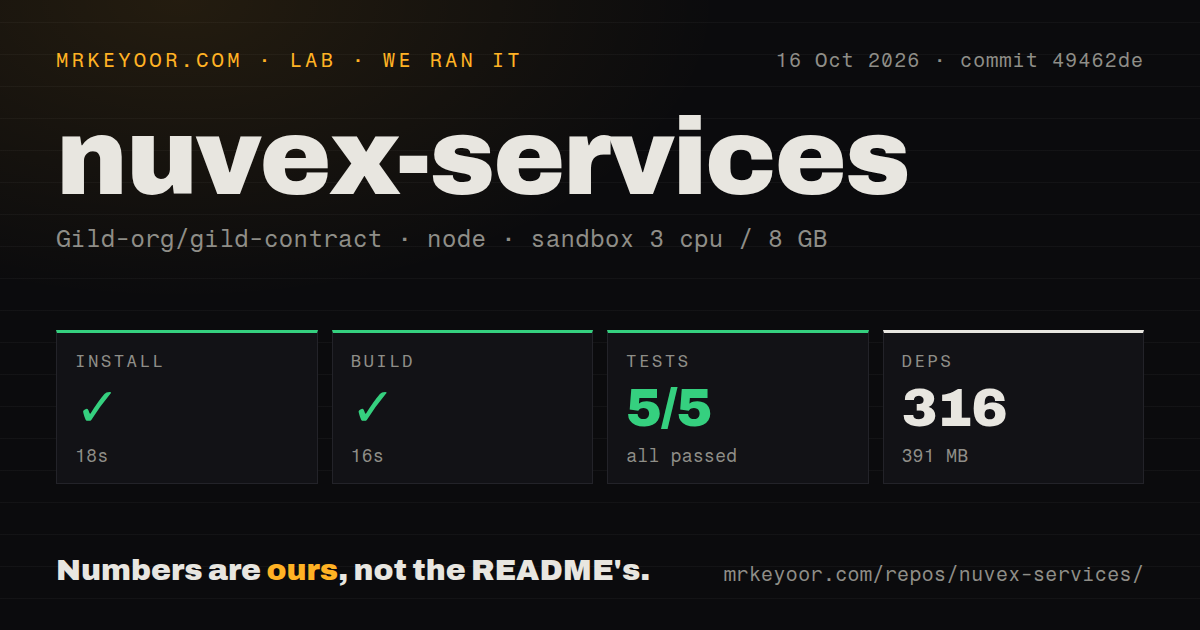
Our run installed 316 pnpm packages in 18 seconds and used 391 MB on disk. The build passed in 16 seconds, followed by a successful 7-second test step with 5 passed and 0 failed out of 5 reported Vitest tests. We measured commit 49462de on October 16, 2026, using lab-node:22 in an unprivileged container with 3 CPUs, 8 GB of RAM, and no secrets.
The lab identified 1 CI workflow and monorepo workspaces, with no tests directory or Dockerfile detected. Source inspection shows tests beside implementation files and Dockerfiles inside component directories. The scan therefore does not describe the entire packaging layout. The passing command is useful evidence about this checkout, but our measurements do not establish live RPC behavior, a continuously updated database, or the correctness of deployed protocol programs. No dependency-audit result was supplied for this run.
Indexing needs real program IDs and a store
The indexer expects an RPC endpoint, configured Nuvex program IDs, and either a PostgreSQL connection or a JSON-snapshot path. Its configuration reader checks those inputs before returning a usable configuration. That makes missing setup explicit instead of letting the service manufacture activity. For PostgreSQL, the README also requires applying the SQL migrations before pointing the API at the database.
The 18-second install does not include those services. The documented developer check does not start a database, and the local compose file separates API and indexer profiles. Its optional node profile expects an image built in the protocol repository. Decide whether you want a snapshot for inspection or a maintained database for an application, then provision that path deliberately. Merely copying the environment example leaves program IDs blank and cannot produce meaningful indexed records.
A healthy process does not prove fresh indexed data
The API's application wiring exposes health, liveness, and readiness responses. Readiness labels its scope as the process and reports whether the read model is configured. That is a useful distinction for an operator: a web server can answer while its data is unavailable or behind the chain. An application depending on current activity needs a freshness policy outside the fact that the process is reachable.
Our 5 passing tests do not replace that operational check. The source lets the API use a supplied read model, which helps separate response handling from a running database. Requests, nodes, and network counts come from stored records. The README expressly says the indexer does not invent rows. For an integration, verify where a displayed record came from and when it was updated before treating an empty or old view as a statement about the network.
Provider medians carry no protocol authority
The price aggregator collects provider observations, rejects unusable or stale entries, and only returns a median when enough fresh observations remain. Its output marks the source as providers and the authority as none. The HTTP price route returns an error status when the source set is insufficient. That explicit absence is preferable to substituting an invented number, and clients need to handle it as a normal possible response.
The 391 MB installed environment gives you this off-chain machinery, not a finalized oracle decision. The README says jobs and models return HTTP 501, and its AI folder has no model implementation. If your application needs executable jobs, model inference, or protocol-authoritative values, those are missing requirements rather than configuration details. Do not design a consumer that silently treats a provider median as interchangeable with a chain result.
A small active repository needs a narrow adoption case
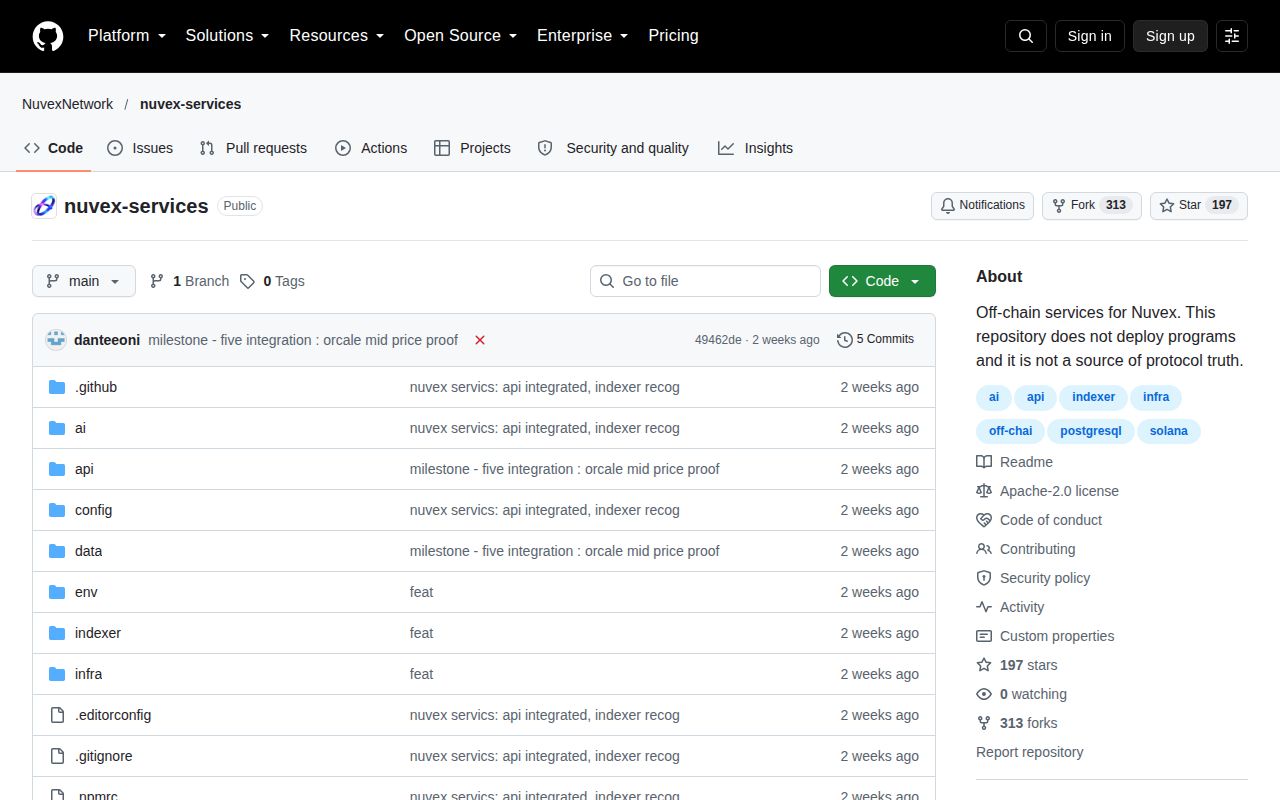
GitHub showed 197 stars, an October 3, 2026 push, and no open issues or PRs. The issues endpoint returned no discussion, and the latest-release endpoint returned no release. Those facts provide little public feedback about real deployments, though the recent push argues against calling the repository abandoned. Apache-2.0 licensing is declared. The stronger adoption evidence is still the explicit code and its modest, clearly bounded behavior.
Use this repository when you are integrating Nuvex's read side and can own the RPC, migrations, and data-freshness checks. Squid SDK is a broader starting point for a custom blockchain indexer, while Anchor addresses the separate task of writing Solana programs. The 16-second build makes source exploration approachable. Before depending on the service, follow a known account from RPC to storage to HTTP and confirm that the result carries the authority your application actually requires.