The classifier barely beats always guessing higher quality
Wine-quality-svc-tuning is most useful when you resist its headline accuracy. The author's README reports roughly 96% accuracy for a support vector classifier, then shows that predicting higher quality for every wine achieves almost the same result. The default classifier misses every lower-quality wine in the reported evaluation. That makes this small notebook a useful lesson in choosing an evaluation target before celebrating a tuned model.
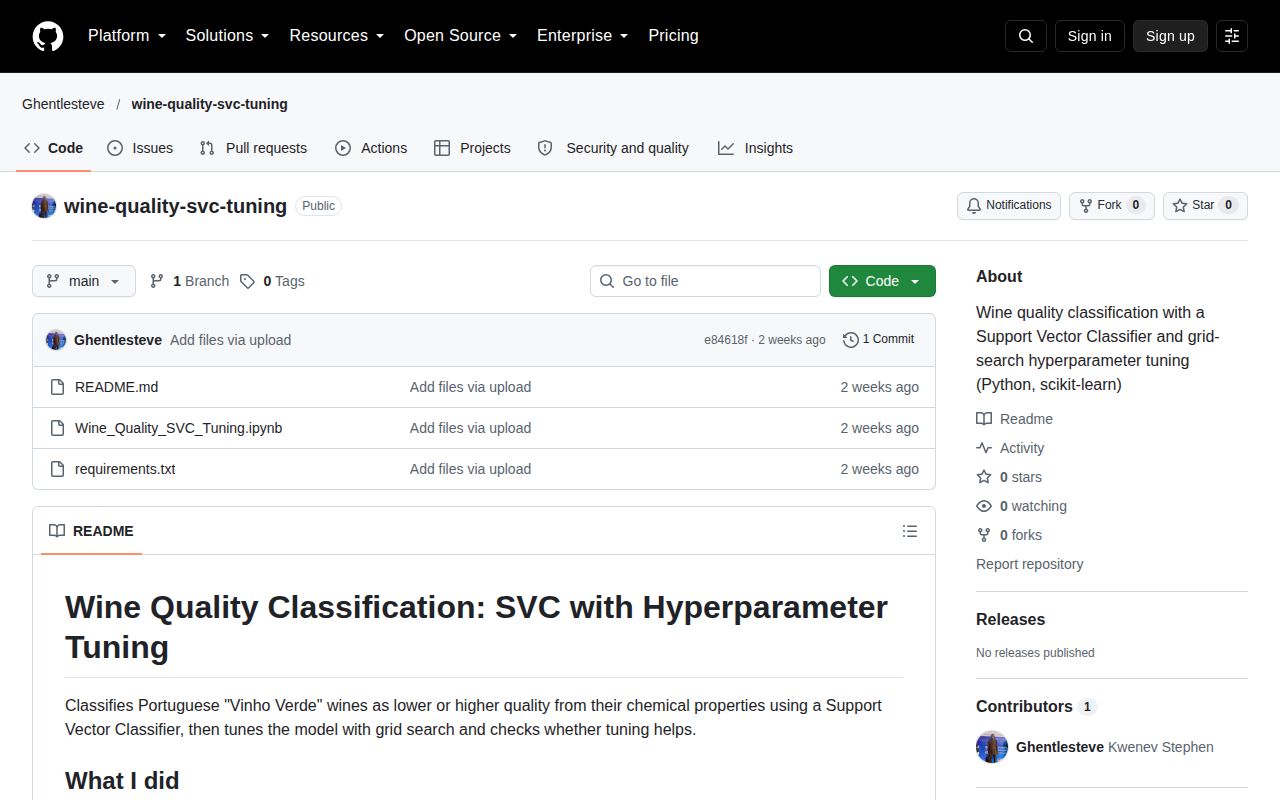
The project works with chemical measurements of Portuguese Vinho Verde wines and turns their quality scores into lower and higher categories. It then compares a default classifier with a grid search over its settings. Our checkout contained just 3 files and occupied 0.1 MB, so the analysis is easy to inspect as a whole. The appropriate reader is someone learning to question a classification result, rather than someone shopping for a deployable wine-rating service.
What happened when we ran it
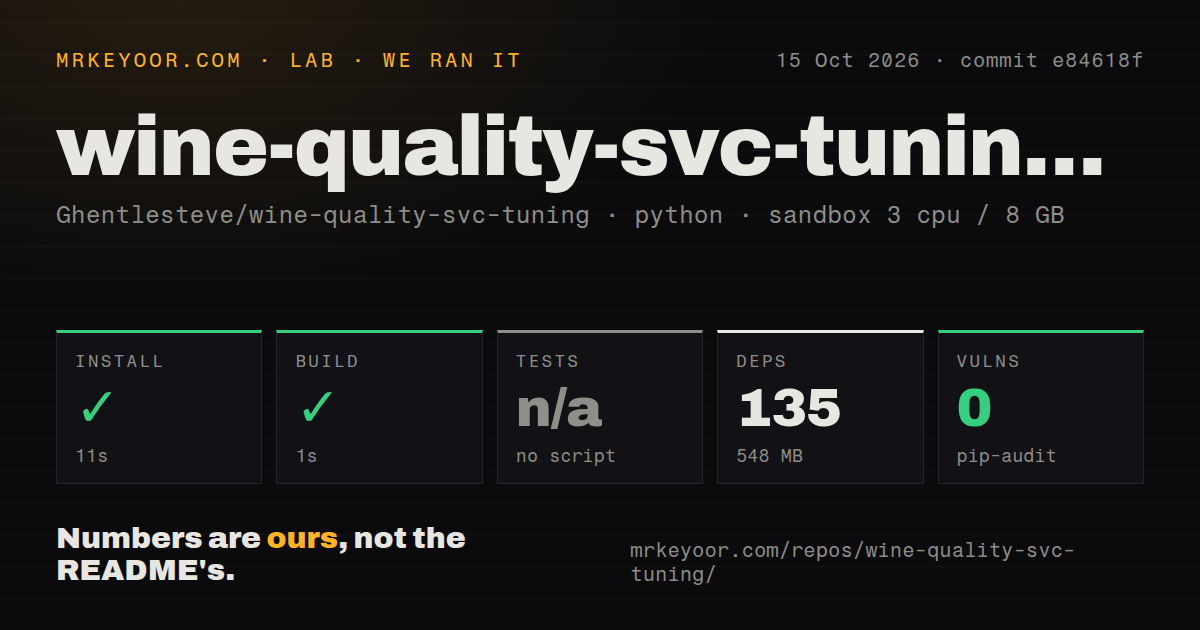
Our sandbox installed 135 packages in 11 seconds and occupied 548 MB, then completed the build step in 1 second. We ran commit e84618f on October 15, 2026, using Python 3.12 in an unprivileged Debian container with 3 CPUs, 8 GB of RAM, and no secrets. Installation succeeded. The package footprint is substantial beside the tiny checkout, though it is manageable for a local notebook environment.
The lab found no test script or target, so tests were skipped. Pip-audit reported 0 known vulnerabilities, and the scan found no CI workflows, Dockerfile, or tests directory. Those results describe environment setup and the checks available to our harness. They don't show that the notebook executed from top to bottom, reproduced the author's accuracy table, or retrieved its remote dataset successfully. A passed build step shouldn't be stretched into that claim.
The notebook makes its preprocessing mistake visible
The analysis notebook fits StandardScaler before calling train_test_split. That allows the scaler to use information from the full dataset, including the held-out portion. For a learning exercise, the mistake is useful because you can point directly to the ordering of those calls. For a trustworthy model comparison, move preprocessing into a pipeline fitted only within the appropriate training partitions.
The README itself lists that change as future work. It also suggests balancing classes and using minority-class precision, recall, or F1. Those suggestions are not implemented guarantees. With no automated test target in our run, there's also no supplied regression check proving that a preprocessing rewrite preserves the intended labels or evaluation split. If you fork the notebook, treat the existing output as something to investigate rather than a reference result your changes must imitate.
Its log-loss scorer receives class labels
The custom scoring function clips predictions away from zero and one before computing log loss. However, the notebook calls it with predict output and creates a scorer without requesting probabilities. That evaluates hard class decisions as if they were probabilities. A reader studying probability calibration or selecting a classifier by log loss should correct that path before borrowing it. The code is short enough that the mismatch isn't hidden behind a framework.
The 548 MB environment doesn't buy you a complete experiment-management system. What it buys here is familiar Python tooling around a compact example: pandas, NumPy, scikit-learn, plotting, and Jupyter appear in the requirements file. The requirements don't pin package versions. Our successful installation establishes that the measured snapshot resolved in the lab, while a later installation may select different versions. Keep an environment lock if you want classmates or colleagues to compare the same execution conditions.
Dataset access depends on a remote CSV
The notebook reads its CSV from an Explore-AI GitHub URL. The README's run instructions say an internet connection is required, and no account credentials are described. That's convenient for an introductory session. For a repeatable exercise, save a documented copy of the input and record where it came from. Otherwise, a changed or unavailable remote file can alter what the notebook receives without any code change.
The supplied run installed 135 packages, but it didn't validate the dataset or the model's decisions. That boundary matters if you're tempted to reuse the classifier outside the exercise. The binary threshold groups most wines into the higher-quality class, which explains why a constant prediction is competitive. Before changing model settings, decide what a missed lower-quality wine costs and whether this labeling scheme matches the question you actually need answered.
No issue history supports a claim of established maintenance
GitHub recorded the last push on September 28, 2026, with 0 stars and 0 open issues and PRs. The latest-release endpoint returned no release, and the API reported no license. The recent push establishes recent code activity, while the empty discussion history gives us little evidence about support. Anyone copying the notebook into a commercial deliverable should resolve reuse permission instead of assuming that a public repository grants an open-source license.
Scikit-learn's examples are a better starting point for learning supported estimator and pipeline patterns. Imbalanced-learn is worth studying when resampling is part of the experiment. This repository earns its place as a small, inspectable demonstration of why tuning can leave the important errors untouched. Start by fixing the scaler placement and scorer input, then compare minority-class behavior against the constant baseline before you spend more time on a wider parameter grid.