One binary fronts more than 20 model providers
AIChat gives a terminal user one command for hosted APIs, cloud model services, local engines, and OpenAI-compatible endpoints. The README names more than 20 providers, including OpenAI, Claude, Gemini, Ollama, Groq, Bedrock, Vertex AI, Mistral, and OpenRouter. That breadth is its clearest advantage. Scripts can keep one invocation style while the selected client and model live in configuration.
Input handling fits normal shell work. A prompt can receive stdin, local files, directories, remote URLs, or the output of an external command. Interactive use adds multiline input, history search, configurable keys, themes, roles, and saved sessions. Those pieces make AIChat more capable than a thin curl wrapper, yet the basic path stays simple: install a binary, configure one model, and run aichat with a prompt.
Roles, RAG, and MCP turn the CLI into an agent host
A role combines a prompt with model settings. Sessions preserve conversation context, macros group REPL commands, and RAG collections add local documents to a conversation. Function calling can connect a model to external code, while MCP support brings in tools published by compatible servers. An agent combines instructions, functions, and documents in one definition. This is enough to build a personal research or operations assistant without maintaining a separate web application.
Every added capability also adds trust decisions. A model that reads command output or whole directories may receive secrets that were never meant for a provider. A function or MCP tool can take actions beyond text generation. The shell assistant produces commands for the current operating system and shell, but model output still needs review. Open issue 1489 reports that the execute flag returned explanatory prose instead of one executable command with a Claude model.
What happened when we ran it
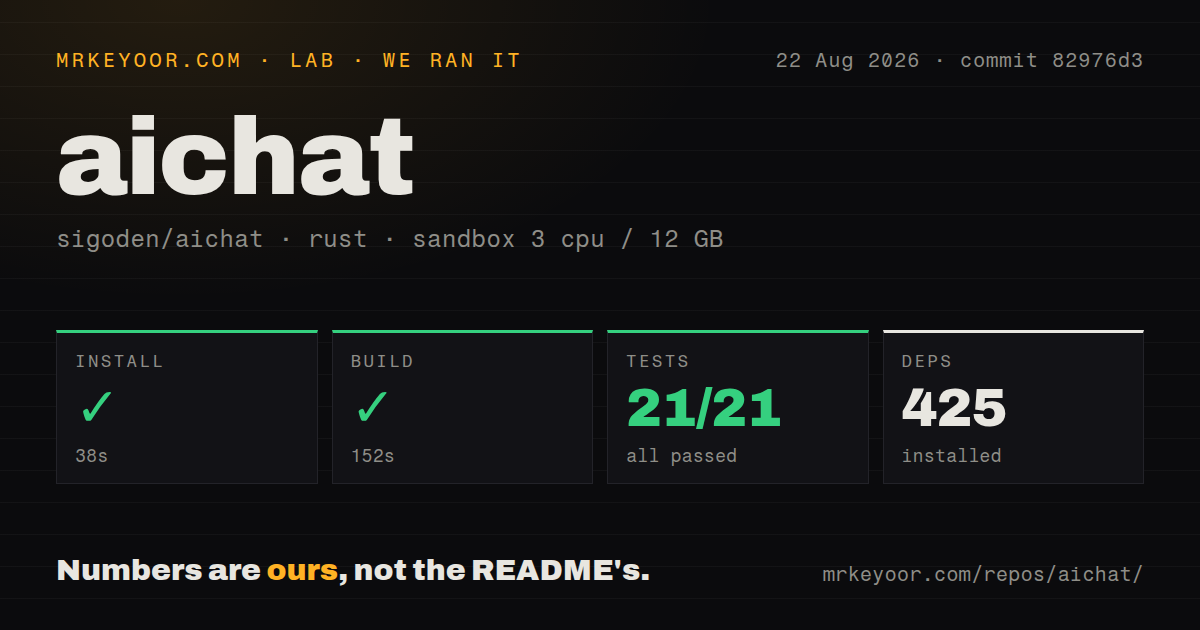
Our sandbox installed 425 Rust packages in 38 seconds. Building commit 82976d3 took 152 seconds, then cargo test completed in 63 seconds with 21 passed and 0 failed. The repository itself was compact at 83 files, about 17,287 lines of source, and 1.8 MB checked out. These results came from an unprivileged Debian container with 3 CPUs, 12 GB of RAM, and no secrets.
The scan found 2 CI workflow files, no Dockerfile, and no tests directory. A missing tests directory is unsurprising for Rust because unit tests can live beside the code, and the 21 passing tests confirm that a test target exists. We did not call a model provider, build a RAG collection, or execute an MCP tool. The lab result covers installation, compilation, and the repository's test command, not answer quality or provider compatibility.
For end users, release binaries for macOS, Linux, and Windows remove the 152-second compilation step. Package-manager paths also cover Homebrew, Pacman, Scoop, and Termux. cargo install aichat remains useful for Rust users who want to build locally. The operational setup begins after installation, when API keys, local endpoints, model names, session storage, and function permissions have to be chosen.
The local server is a personal proxy, not a finished gateway
Running aichat --serve starts chat-completions, embeddings, and rerank endpoints on 127.0.0.1:8000. It also exposes a browser playground and an arena for side-by-side model comparisons. This can give local applications one API while AIChat handles provider differences. Binding to localhost keeps the README example narrow and sensible for one machine.
The documentation does not present that server as a multi-user gateway with accounts, rate limits, tenant isolation, or central audit records. If another host needs access, put authentication and transport controls in front of it and decide which provider keys the process may use. Teams that mainly need a production model proxy should compare a dedicated gateway. AIChat's server is most convincing as an extension of the local CLI.
Bedrock tool results expose the cost of provider breadth
Open issue 1542 reports a concrete adapter mismatch in version 0.30.0 built from commit 82976d34. A Bedrock tool call succeeds, but the follow-up fails when the tool returns a top-level array, string, number, or null. Bedrock requires an object in that JSON field, while the reported code forwards any JSON value. The same tool reportedly works through the Anthropic-native client.
This is the maintenance tax of a client spanning more than 20 providers. A common interface cannot erase different message schemas, tool-result rules, authentication methods, or model quirks. Before adopting AIChat around a provider, test streaming, tool calls, errors, files, and session behavior on the exact service. The 21 local tests are clean, but they cannot cover every remote contract.
Current issue traffic continues after the release cadence slowed
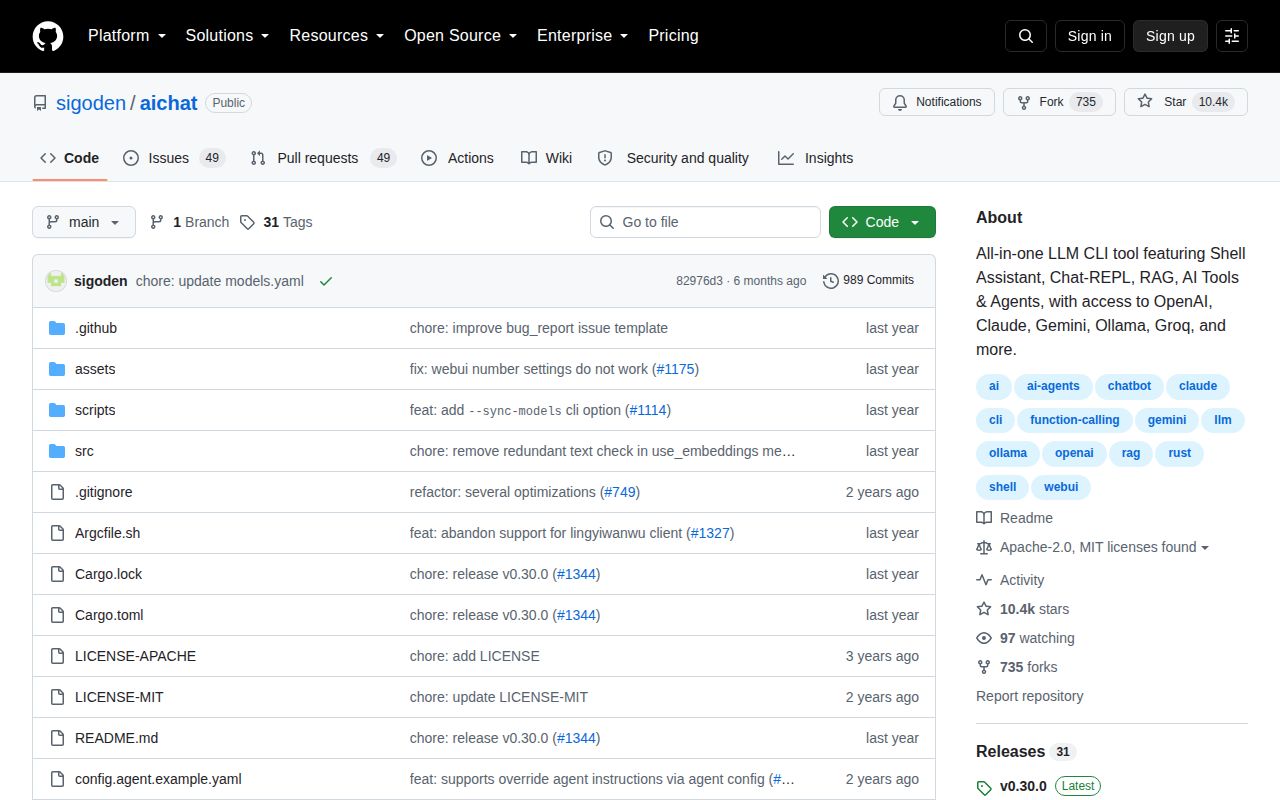
GitHub recorded 10,393 stars and 98 combined issues and pull requests when fetched. The last repository push was February 23, 2026. The latest tagged release, v0.30.0, arrived July 6, 2025, with clipboard, theme, REPL, tool-use, and error-handling changes. Issue activity continued through August 2026, including the Bedrock report, while issue 1517 openly asks about the project's state after the long release gap.
That record does not prove abandonment. It does mean a buyer should separate popularity from current adapter maintenance. AIChat remains a strong personal terminal client because the binary is small, the interface is broad, and our full local test command passed. For a shared internal dependency, pin the version, test the chosen providers, and keep an exit path to direct SDKs or another CLI if a remote API changes before the next release.