Nine workshops turn agent concepts into exercises
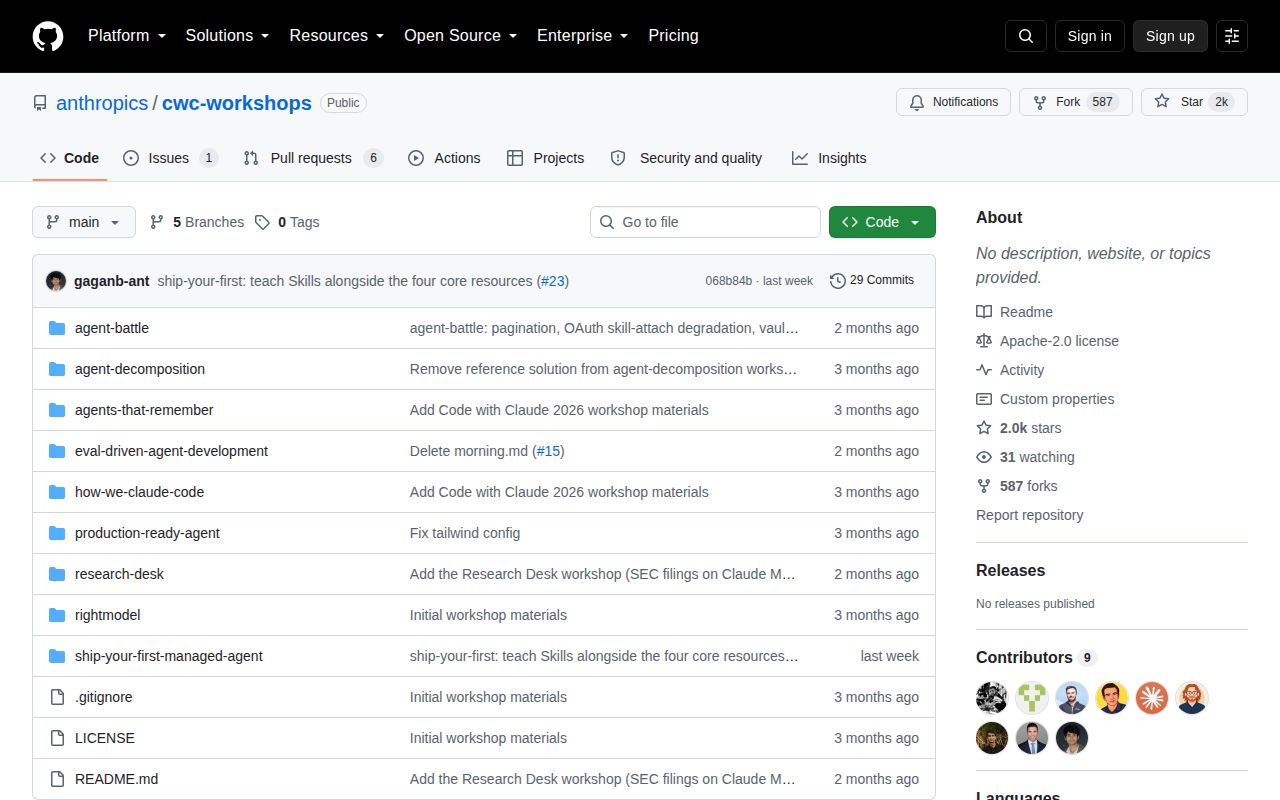
Anthropic's repository contains 9 conference exercises rather than one application. The subjects include model selection, prompt decomposition, product design with Claude Code, a first managed agent, a game competition, cross-session memory, evaluation-driven development, a deal desk, and an SEC research desk. Each folder is its own project with separate prerequisites. The root README gives the most important maintenance fact in one line: these materials are not maintained and contributions are not accepted.
The format works because participants change working systems instead of reading a slide deck. agent-decomposition starts with an inventory agent whose instructions have grown into a roughly 400-line prompt, then moves durable guidance into skills, code execution, and callable agents. eval-driven-agent-development compares 6 presentation-agent variants against a 10-task suite. Those examples make design choices visible, though their results belong to a workshop and do not prove production reliability.
Seven API functions expose the agent boundary
ship-your-first-managed-agent asks participants to implement 7 API functions in a Streamlit incident dashboard. The remote agent searches a 70,000-line log in its sandbox, while custom tools retrieve application data. Readers can see what belongs in the environment, session, event stream, and local application instead of letting one model call own the whole system.
The Claude Code workshop applies the same discipline to interfaces. Its React example gives components fixtures, invariants, and a machine-readable DOM contract, then checks those properties through a verification matrix. The lesson travels beyond Anthropic's tooling because generated UI becomes observable by an agent or CI job. agent-decomposition makes a related point: deterministic calculations, durable instructions, and delegated judgment need different homes.
What happened when we ran it
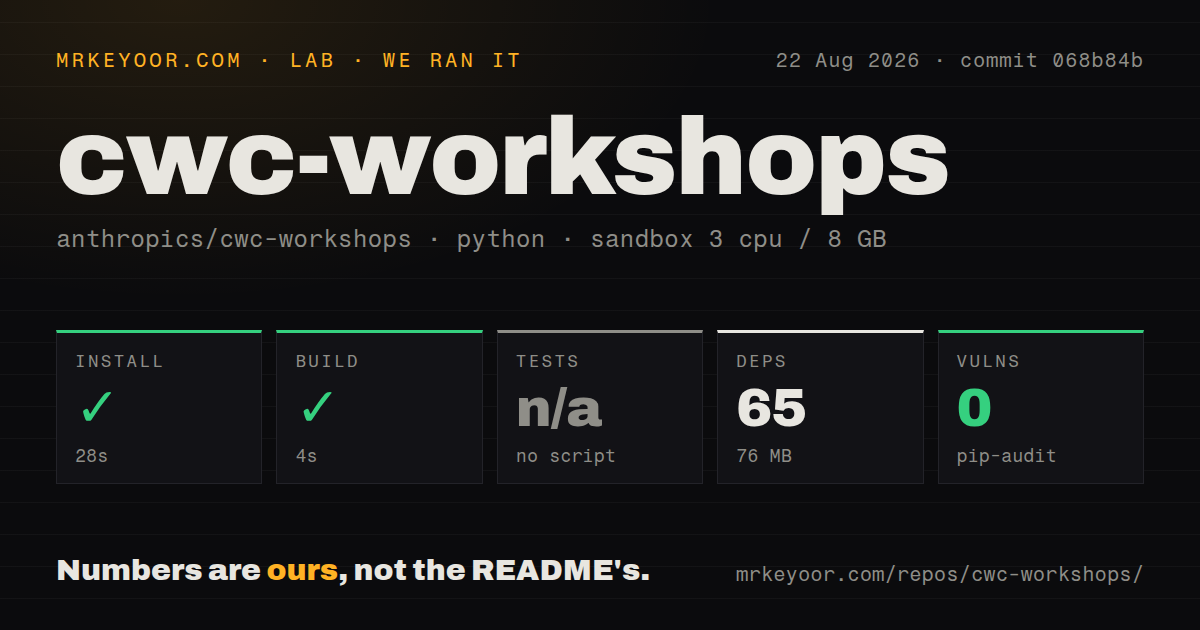
Our sandbox run used commit 068b84b and the Python project in agent-battle/. Installation succeeded in 28 seconds, pulled 65 packages, and occupied 76 MB. The build completed in another 4 seconds. Pip-audit reported 0 known vulnerabilities in that environment. The unprivileged Debian container had 3 CPUs, 8 GB of RAM, no secrets, and the Python 3.12 uv image.
There was no test script or target, so we skipped tests. The 1.9 MB checkout contained 382 files and about 25,578 lines of source. Our scan found 0 CI workflow files, no Dockerfile, and no tests directory. A passing build shows that this subproject assembled on our box; without a supplied test target, it does not establish whether the game integration or agent behavior works.
Claude access is harder than the 28-second install
There is no root command that prepares all 9 workshops. The tested battle project uses Python and uv, while the smallest Vite example uses bun. The first managed-agent lab needs Python 3.10 and an Anthropic API key. The presentation evaluator calls for Node.js 22, Docker, a locally built rendering image, LibreOffice inside that image, and the ant command-line tool. The game lab adds a Minecraft server, Java, npm, ports, and local processes.
Most deeper exercises require Claude Managed Agents access. The deal desk calls for an API key with the beta enabled, and the memory workshop says the organization must join a research preview before its bootstrap script can create resources. Repeated model sweeps and evaluations also consume paid inference. Setup scripts may create agents, environments, sessions, memory stores, or deployments, so users should record what they provision and clean it up afterward.
Four research agents still make a teaching system
The Deal Desk looks close to a product: it has a Next.js interface, streaming events, confirmations for tool calls, a coordinator, 4 research agents, memory, outcomes, and optional Linear access through MCP. Its companies and financials are fictitious. The Research Desk adds SEC filing analysis, bounded fan-out, scorecards, and a long-running server orchestrator, while leaving numbered participant tasks in the main branch.
Neither example supplies the controls a production buyer should assume. Authorization, tenancy, retry rules, observability, retention, spend limits, and recovery depend on the application that adopts the pattern. Agent Battle was designed for a 45-minute competition, with a roughly 30-second decision probe and 5-minute run described by the README. Those are teaching constraints, not service-level claims.
The repository says support is unavailable
GitHub showed 2,026 stars, 7 combined issues and pull requests, and a last push on August 20, 2026 when we fetched the metadata. The project has declared that contributions are not accepted, so the open count should not be read as an active support queue. There is no tagged GitHub release, and beta interfaces can move faster than copied workshop code.
Issue 18 remains open and reports that a workshop video instructs users to install from a requirements.txt file that was not present at the expected location. That mismatch is the practical risk of event material: videos, folder layouts, beta APIs, and account access can drift independently. The 28-second install makes agent-battle/ cheap to inspect, and the other folders contain concrete agent patterns. Use the repository to learn or borrow a pattern you can verify, then rebuild it in a maintained application.