Open tool_use/customer_service_agent.ipynb when you need to understand how a Claude response becomes a tool call. Anthropic's Claude Cookbooks gives that question a concrete starting point, alongside calculator and SQL examples. It's useful when you're building an integration and want to see the conversation shape before designing your own application. Our run also found a reason to inspect what you copy: installation succeeded, while the repository's checks returned failures.
The recipes help you choose an API pattern
The README's recipe index separates classification, retrieval augmented generation, and summarization from tool use and vision. That organization makes it possible to start with a job, such as extracting information from a form, rather than reading every notebook. Examples are primarily Python, though Anthropic says the concepts can be adapted to other languages that can call Claude's API.
The distinction matters if you're choosing between learning material and an application dependency. A customer-service notebook can explain a tool interaction without supplying your service's permissions or recovery policy. I'd use the collection to settle a specific design question, then move the relevant code into a small application I can review. Copying the whole notebook into a backend leaves you responsible for separating the demonstration from the behavior your users need.
What happened when we ran it
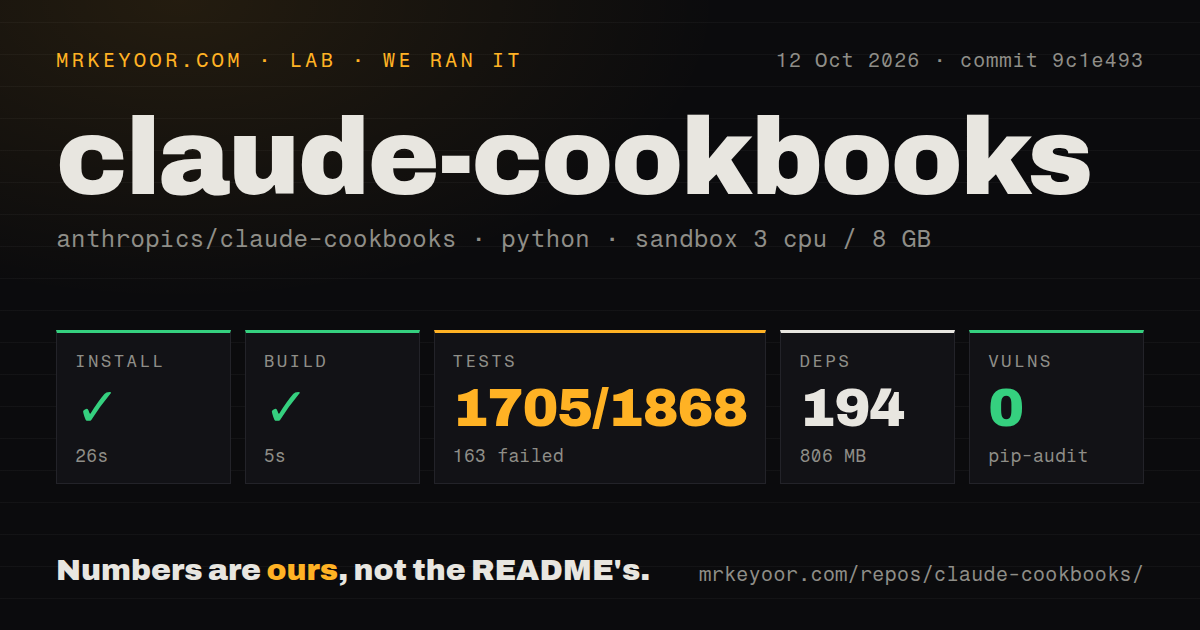
Our sandbox installed Claude Cookbooks commit 9c1e493 in 26 seconds, recording 194 dependencies and 806 MB on disk, and the build succeeded in 5 seconds. The run took place on October 12, 2026 with 3 CPUs and 8 GB RAM. Its recorded image was ghcr.io/astral-sh/uv:python3.12-bookworm. That label identifies the configured image, while the actual interpreter and operating-system versions require raw toolchain logs.
The test step failed with exit 1 after 16 seconds. Pytest reported 1,705 passed, 163 failed, and 152 skipped, alongside a stated total of 1,868. Those counts don't reconcile if skipped cases are included in that total, so we aren't presenting a pass percentage. The log's own final summary reports 4.94 seconds for pytest, which is distinct from the recorded duration of the enclosing test step. Neither number measures Claude response speed.
The visible tail includes execution-count assertions for calculator, customer-service, and other tool-use notebooks. Their counters didn't satisfy the check that execution counts start at one. It also names observability/usage_cost_api.ipynb under a hardcoded-API-key detector and finetuning/finetuning_on_bedrock.ipynb under a deprecated-model check. The tail doesn't establish whether any detected key was live, whether a model endpoint rejected a request, or how all the other failures arose.
Pip-audit reported 0 known vulnerabilities. That result concerns the dependency audit, while the notebook key-pattern flag is a separate finding. Neither establishes application security. The checkout contained 570 files, roughly 26,191 source lines, and occupied 217.9 MB. Our scan found 9 CI workflow files and a tests directory, with no Dockerfile. These observations describe the snapshot we measured, without certifying every recipe or an authenticated production workload.
A Claude API key is only the first prerequisite
Anthropic explicitly requires a Claude API key for making the most of the examples. The index also points to Pinecone retrieval and Voyage AI embeddings, so the selected recipe determines which additional service configuration you need to investigate. Reading a calculator example and adopting a retrieval example are different commitments. Check the imports, credentials, and external calls in the actual notebook before putting customer data through it.
The 806 MB installed footprint is worth budgeting when you want only one example. Our measurements cover the repository setup, without attributing that footprint to any particular package. For a trial, pick the notebook closest to your intended request and identify its prerequisites first. If the Bedrock finetuning recipe interests you, the deprecated-model flag makes checking its model references a necessary next step before spending time on that path.
October activity doesn't resolve the measured failures
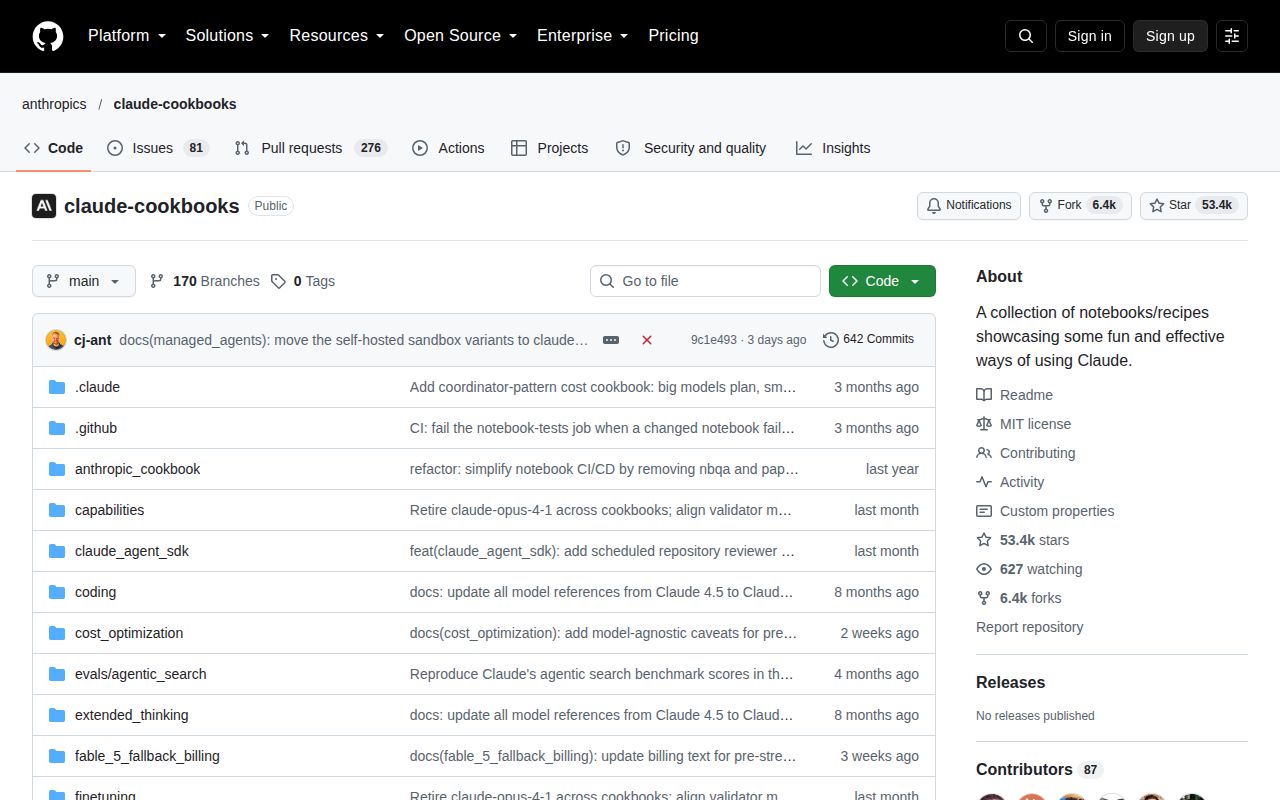
The repository API records a last push of October 17, 2026 and 362 open issues and PRs when checked on October 19. The recent contribution list includes an open proposal to fix default notebook discovery in the validator, pull request 927. That is evidence of current work on the checking machinery. An open proposal doesn't establish that our earlier failures have been fixed.
For documentation, my 4/5 judgment uses a simple scale: 1 means a reader cannot locate a usable starting point, 3 means task examples exist, and 5 adds clear prerequisites and troubleshooting for the chosen path. The recipe index and API-key guidance earn credit, while the README alone doesn't resolve the notebook-check findings. Support responsiveness and behavior across authenticated recipes remain unassessed, so those cards carry no numerical rating.
Choose the SDK when you already know the request
The Claude SDK for Python provides API access from Python applications. Choose it directly when you already understand the Messages request you need and want to write your own script. The cookbook earns its place when the unresolved question is how to structure a tool interaction or retrieval flow. Both can help the same application at different stages.
The OpenAI Cookbook supplies examples for the OpenAI API and requires its own account and API key. Pick that collection when OpenAI is the provider you've chosen. For a Claude integration, start with one Anthropic recipe, check its model identifier and credential handling, then write an application check around the behavior you intend to ship. The failing repository baseline makes that last step particularly worthwhile.