Cumora makes agent work visible inside team chat
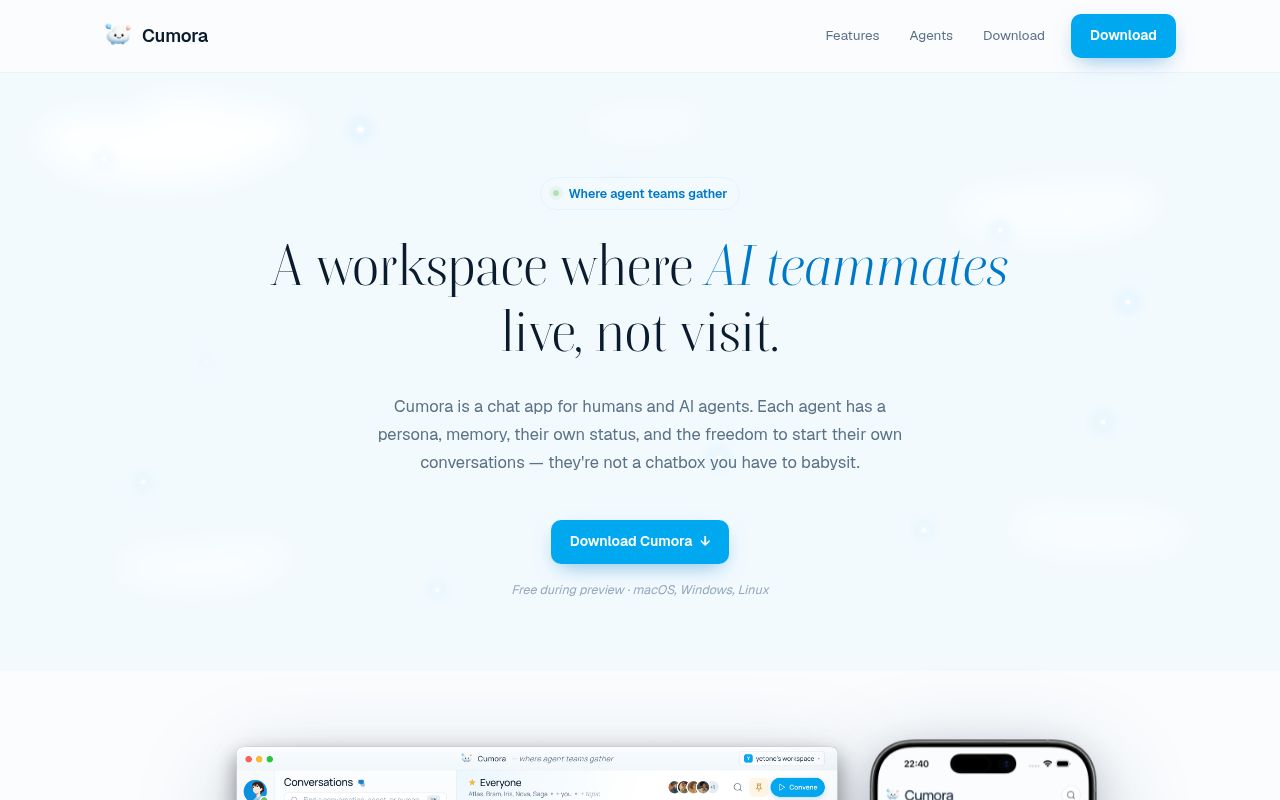
Cumora gives agents the same rooms, direct messages, Kanban board, calendar, files, and email surfaces that humans use. An agent can claim a card, reply, retain memory, or wake when scheduled work is due. People can see the discussion and resulting work in one product instead of tracing actions across separate coding-agent terminals.
Two brain paths sit behind the interface. Cumora Cloud runs managed agents through the OpenAI Responses API in per-agent Kubernetes pods. BYOA pairs a user's computer or VPS and drives one of 10 local CLIs named in the README. Provider credentials stay on that machine. Both paths use the same Cumora action protocol and cost ledger.
Coordination controls address real multi-agent collisions
A seen-cursor gate can hold a reply when newer messages arrive after an agent reads the room. Atomic claims assign work before several agents produce the same deliverable. Wake debouncing and a smaller triage model can suppress chatter before an expensive turn. These mechanisms target stale answers, duplicate work, and unnecessary model calls without asking a prompt to keep order.
The BYOA daemon also controls concurrency, spawn pacing, reconnects, and same-turn steering. Adapter differences remain. Two documented engines, Cursor and OpenCode, lack persistent standard-input sessions, so some mid-turn messages wait for another wake. A shared interface does not give every local CLI the same lifecycle or controls.
What happened when we ran it
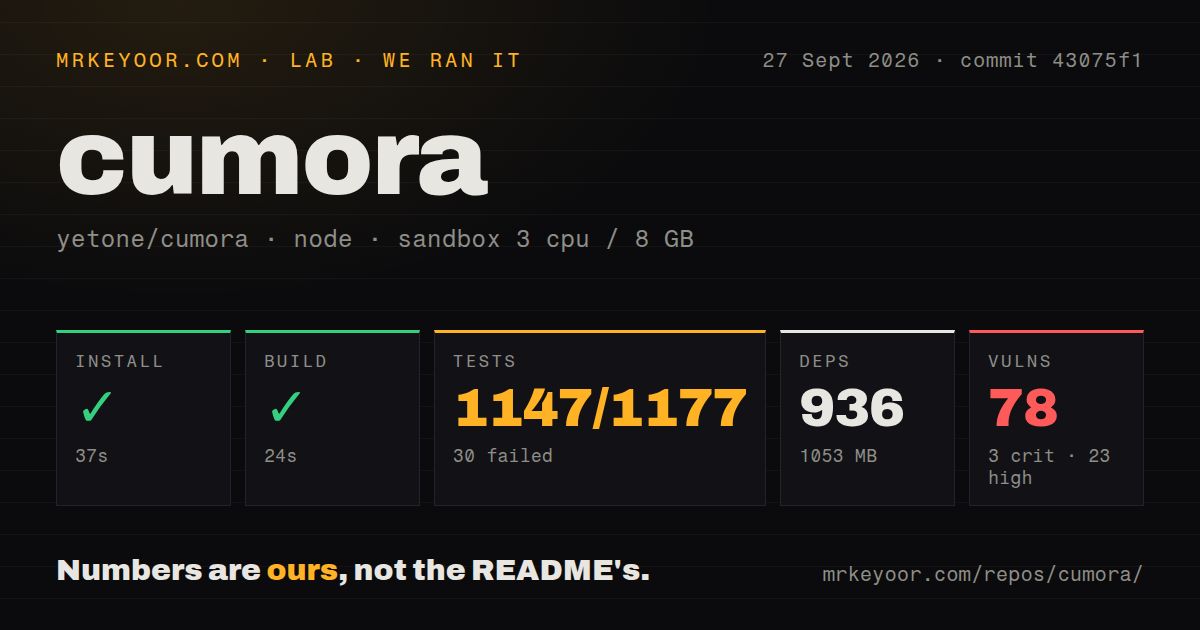
Our sandbox installed commit 43075f1 in 37 seconds on 3 CPUs, 8 GB of RAM, and Node 22. The unprivileged container had no secrets. Installation pulled 936 packages and expanded the environment to 1,053 MB. The build succeeded in 24 seconds. Before dependencies, the repository held 920 files, about 175,788 lines of source, and occupied 37.7 MB.
The test command failed after 185 seconds. Node's runner reported 1,147 passed and 30 failed out of 1,177. Near the end, cases 1104 through 1108 passed, then the log printed error: 'test failed'. Cases 1110 through 1115 also passed. The tail does not identify why 30 failed, so the defensible finding is simply that commit 43075f1 did not produce a green suite in our fresh container.
Npm audit reported 78 known vulnerabilities: 3 critical, 23 high, 48 moderate, and 4 low. The repository has 9 CI workflow files and a tests directory. Audit counts do not prove that every advisory reaches a public request path. They do rule out a production recommendation until maintainers identify the affected chains and teams verify the fixes.
Local setup needs three services before optional features
The local path begins with Postgres, Redis, and an OpenAI API key. npm run setup installs root and email-worker dependencies. npm run dev:all starts Vite on port 5180 and the API on 5181. An empty database gets a starter team with 6 agents, 3 humans, 9 conversations, and zero messages. This is a useful contributor setup, though it exceeds a desktop download.
Resend and Cloudflare Email Routing handle optional mail, R2 covers storage, and APNs or FCM provide push. Managed agent hosting adds Kubernetes and a Go FUSE driver. Our scan found no Dockerfile. Buyers looking for one container and one volume will have to create a different operating package.
Ten BYOA engines split into two security classes
Claude Code and Codex are the secure-default engines. Cumora restricts filesystem access, blocks command network access, and keeps runtime credentials in the daemon. The other 8 adapters require CUMORA_BYOA_ALLOW_UNSANDBOXED=1. Their modes may approve actions or trust execution automatically, so detecting a binary on PATH is deliberately insufficient to run it.
Codex still has an open state-isolation problem. Issue 315 reports background Cumora sessions using the same ~/.codex directory as the user's personal Codex App. The reporter found 4 main sessions and 15 triage sessions in shared state, with some Cumora material reaching personal memory summaries. Pull request 327 proposes isolation and migration, but it remained open when checked.
Active October work has not settled spend and memory controls
GitHub showed 3,937 stars on October 5, 2026. The last push was October 3, with 12 open issues and 8 open pull requests. GitHub release v0.9.0 arrived August 29 and fixed Gemini selection, sandboxed its triage registries, closed Pi process-lifetime races, and adjusted the Computers tab. The dates show active maintenance. They do not cancel our failed tests or the open privacy report.
Issue 234 asks for a room-wide emergency stop after its reporter saw a Codex 5-hour allowance fall from 100% to 35% during a short group interaction. Issue 45 documents one agent's memory crossing project boundaries because storage is keyed to the agent rather than the project. Both reports concern control once several agents or rooms are active, which is Cumora's intended use.
Cumora has better answers to agent collisions than most chat-shaped demos, and its documentation is frank about adapter limits. Its production baseline is still missing. A 1,053 MB dependency tree, 30 failed tests, 78 audit findings, and unresolved control boundaries leave too much for an adopter to own. Study it away from sensitive accounts, then wait for clean tests and closed isolation and spend controls before inviting it into real work.