Eleven tools move bulk output into local subprocesses
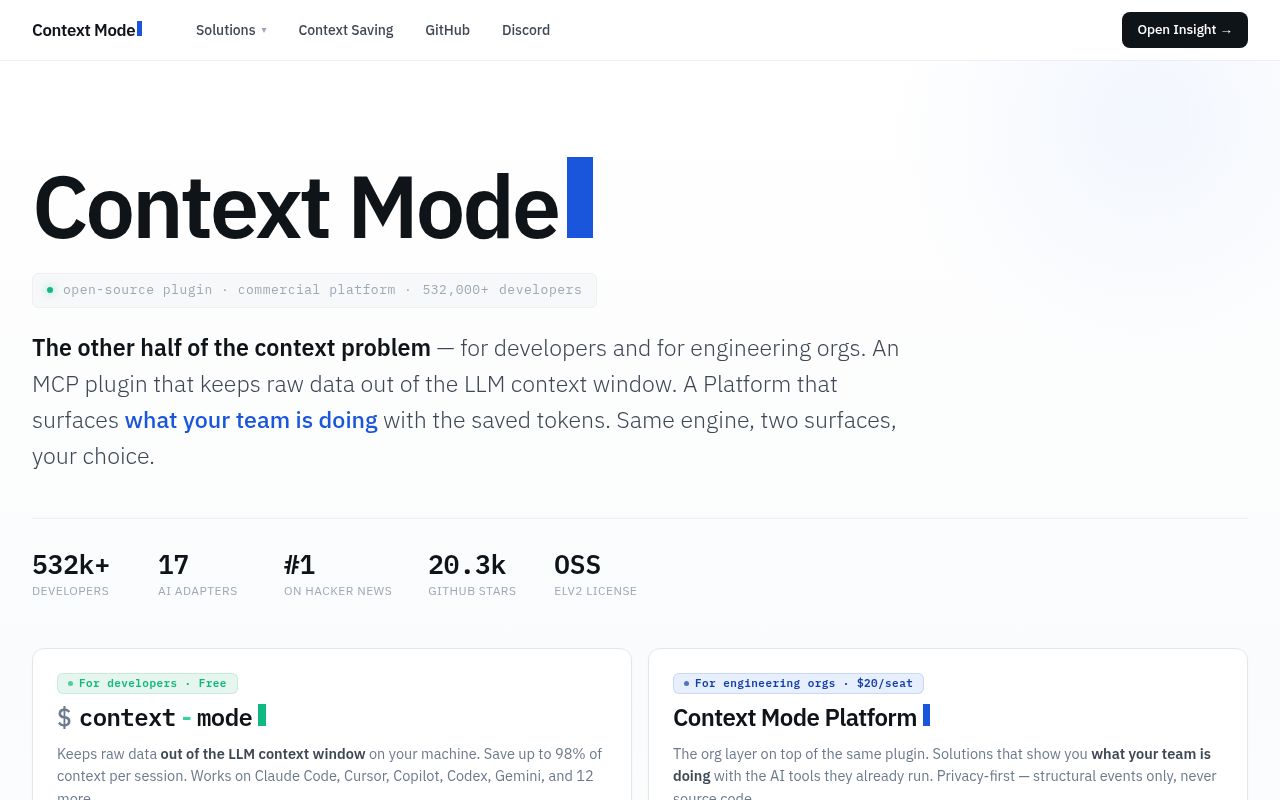
Context Mode v1.0.169 exposes 11 MCP tools in its Claude Code plugin: six execute, fetch, index, or search data, while five diagnose, report, upgrade, purge, or open its Insight view. The useful idea is that raw logs and responses stay in a child process. Only chosen stdout or retrieved snippets enter the model's conversation. Large output with an intent can be indexed first and searched locally instead of pasted into the prompt.
Our commit b433086 checkout contained 599 files and about 145,227 lines of source, so this is a sizable adapter and storage project rather than a thin command wrapper. It combines subprocess execution, SQLite FTS5 search, hook-based routing, and session-event capture. Developers who mostly lose context to one giant test log or a long GitHub response have a concrete reason to try it. A chat that is already concise will gain less.
Claude Code gets the shortest setup; hookless clients need manual routing
Claude Code v1.0.33 or newer gets the cleanest route: add the marketplace, install the plugin, restart, and run the supplied doctor command. That path registers the MCP server, lifecycle hooks, utility commands, and routing instructions. Gemini CLI, Copilot clients, Codex, Cursor, OpenCode, KiloCode, Kiro, Pi, OMP, and others each have separate instructions. The README is unusually explicit about which hook fires on which client.
The 90-second install in our Debian sandbox confirms that the dependency step can complete without secrets, but it does not make every client a two-command job. Most non-Claude paths require editing JSON or TOML, installing a plugin, or copying a routing file. Zed and Antigravity IDE lack hooks, so their instruction files can guide the model without intercepting a bad tool call. Codex and Cursor have their own partial-support caveats.
What happened when we ran it
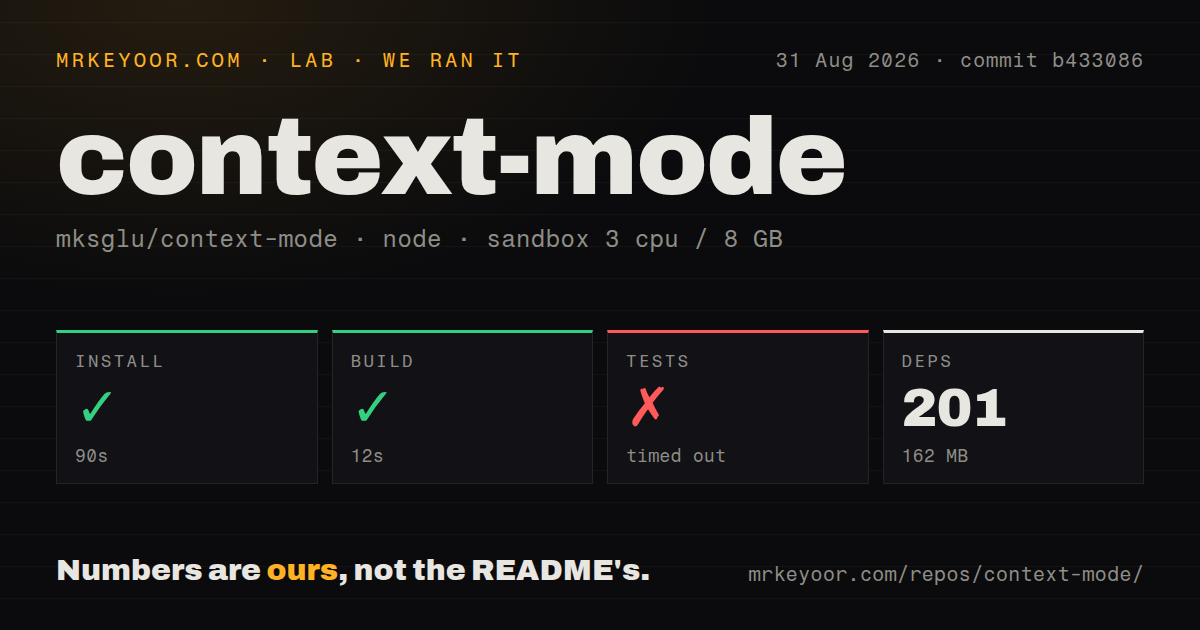
Our sandbox installed 201 packages in 90 seconds and used 162 MB on disk. The build then completed in 12 seconds. Our measurement setup used commit b433086, 3 CPUs, 8 GB of RAM, and an unprivileged Node 22 container. The repository itself was 12.4 MB before dependencies. Those results make the basic checkout and compile path credible, with a moderate local footprint for a tool that bundles many client adapters.
The test command timed out at 900 seconds, so Context Mode did not produce a complete suite result on our box. The final log lines showed successful hook, session, adapter, policy, and core test files; one executor case was marked skipped. No assertion failure or timeout cause appeared in that tail. The checkout included a tests directory and 5 CI workflow files, while our scan found no Dockerfile. We cannot call the suite passing or assign a cause.
Local SQLite protects privacy; arbitrary execution still inherits host access
Context Mode keeps indexed content and session records in local SQLite databases, with a 24-hour default fetch cache and startup cleanup for content older than 14 days. The README says the core path has no account, cloud sync, or usage telemetry. Fresh sessions delete previous session data unless the user resumes, while indexed material can persist for search. Teams should still decide what local retention is acceptable before hooks record prompts and tool events.
The 12.4 MB checkout becomes 162 MB after our install, and the more important expansion is authority rather than disk. The README says authenticated command-line tools pass environment variables and config paths into execution subprocesses. It also warns that execute and batch-execute approve arbitrary code and retain the process's filesystem access. Project-boundary checks protect the file-processing tool, but they are not an operating-system sandbox. Keep the host agent's permissions and containment enabled.
Continuity works fully on some clients and not at all on two
Context Mode v1.0.169 documents full session continuity for Claude Code, Gemini CLI, VS Code Copilot, JetBrains Copilot, OpenCode, and KiloCode. Cursor and Codex have partial paths, while Zed and Antigravity IDE have no session hooks. The gap affects the main promise: without capture, compaction snapshots, and restore hooks, local search may still work while the agent cannot reconstruct its previous task state automatically.
Current issue reports add client-specific risk that our 900-second test run did not resolve. Issue 985 describes shared-project SQLite contention during concurrent Windows sessions, including CPU spin and hangs. Issue 1101 reports a Pi MCP process surviving session shutdown and growing its database. Issue 1085 traces HTTP 500 failures with a strict local Qwen template to extra system messages injected by the OpenCode adapter. These are scoped reports, not proof that every client fails.
The 200-item open queue and ELv2 narrow the buyers
GitHub listed 20,289 stars, 108 open issues, and 92 open pull requests when fetched on September 1, 2026. The repository's pushed date was also September 1, but the newest commits were automated install-stat updates. The latest release and most recent non-bot source change we found were v1.0.169 on June 29. Issue activity continued through September 1, so the project has current attention alongside a large review queue.
The 12.4 MB source tree uses Elastic License 2.0, which allows use, modification, and distribution but bars a hosted or managed service that exposes a substantial set of its features. That restriction rules out some vendors before technical testing. For permitted local use, Context Mode is most persuasive when an agent repeatedly swallows large tool output and the chosen client has full hooks. Choose claude-mem for memory first, Context7 for current docs, or Mem0 for application-level memory.