Consolidation puts more of the library under one application's control
Arrmada built in 1 second in our sandbox, but its failed suite is the reason I would start with a separate trial library. The project brings movie and television management together with books, audiobooks, and household requests. It connects that workflow to Plex or Jellyfin and includes qBittorrent in its usual deployment. Fewer applications can mean less configuration to keep aligned. They also mean more library behavior depends on the same young project.
The README explicitly calls Arrmada early software and asks users to keep backups. That warning fits the scope: it can import and rename media, upgrade releases, and convert video. These are consequential operations on files you may care about keeping. I would adopt it to reduce an existing maintenance burden only after checking the exact import and recovery behavior against media that can be replaced.
What happened when we ran it
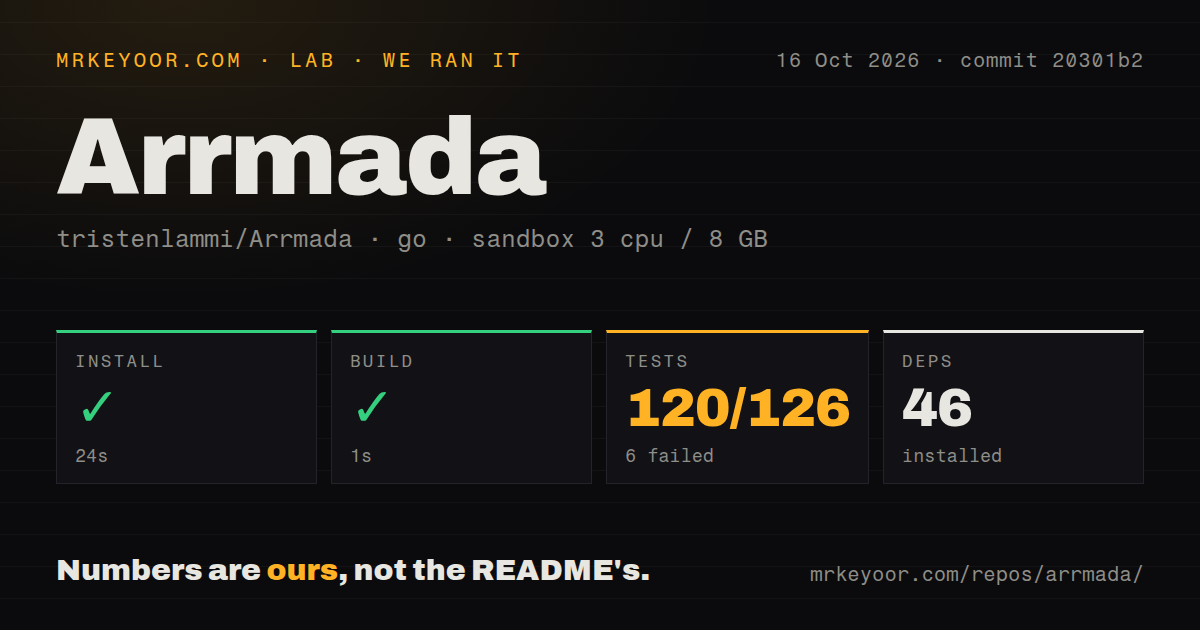
Our run installed commit 20301b2 in 24 seconds, adding 46 packages, and built successfully in 1 second. The Go test command failed with exit code 1 after 457 seconds: 120 passed and 6 failed out of 126. We ran it on October 16, 2026, in an unprivileged Debian container using golang:1.24-bookworm, with 3 CPUs, 8 GB of RAM, and no secrets. A successful build and a failed suite are separate findings.
The supplied log tail contains successful package results, including internal/store, internal/series, and templates, followed by FAIL. It does not identify the failing cases or include their exception messages. Calling the 6 failures missing system packages, unavailable services, or application defects would invent an explanation. The result establishes that this fresh-container run did not finish green. It gives us no basis to blame a particular feature such as imports or scheduling.
The checkout occupied 21.6 MB across 2,553 files and roughly 410,942 source lines. The scan found 3 CI workflow files, a Dockerfile, and a Compose file, with no tests directory detected. That last label does not contradict the Go test results, since directory names cannot establish whether tests exist. The supplied measurements contain no vulnerability-audit result, so there is no clean-audit finding to attach to the successful build.
Docker simplifies delivery while storage paths still decide imports
The installation guide calls for a Linux server with Docker and Compose. Setup needs a TMDB API key, library locations, and indexers, plus the credentials for whichever media-server integrations you use. Optional Usenet support adds SABnzbd and your provider. Arrmada combines management screens, but those external services and access details still belong to the operator. Our container had none of those secrets and did not validate a connected household deployment.
The 24-second measured install says nothing about the cost of an incorrect storage layout. The configuration guide requires downloads and the library under a shared mount for hardlinks. On Unraid, they must also land on the same physical disk or imports fall back to copies. Check the resulting file operation on a sample before importing broadly. A completed import can otherwise hide storage duplication that becomes apparent only when free space runs out.
ARM support does not include accelerated conversion
The README says ARM machines run Convert and AI subtitles on the CPU. The install guide also warns that earlier published images lack ARM manifests, despite the broader ARM support described in current documentation. Check the image actually available on the stable channel before choosing a small ARM server. A supported architecture does not establish that its hardware is suitable for overnight video conversion or local subtitle generation.
Our Go build completed in 1 second, without measuring media conversion speed or subtitle quality on any architecture. Intel or AMD graphics support described by the project cannot establish performance on your machine either. If conversion is the feature drawing you away from an existing stack, use a representative source file and inspect the result. Keep the original available until you have checked the content and the resulting file's compatibility with your players.
The backup route changes when you update with Compose
The README says the installer and update script take a pre-update backup and roll back when the new application fails to start. Updating directly through Compose skips those script-level protections, although the application still copies its database before schema upgrades. That is a meaningful operating difference. Choose the update route deliberately and document how you will return to a working version before making Arrmada responsible for household requests and library state.
The backup guide says default backup copies share the database's disk and contain credentials, including API keys and a Plex token. Keep a private copy elsewhere and try a restore. Our 6 failing test results do not prove that recovery is broken, but they are sufficient reason to demand direct recovery evidence before migration. A backup file on the failed disk cannot rescue that disk's data.
October activity shows a young project still being shaped
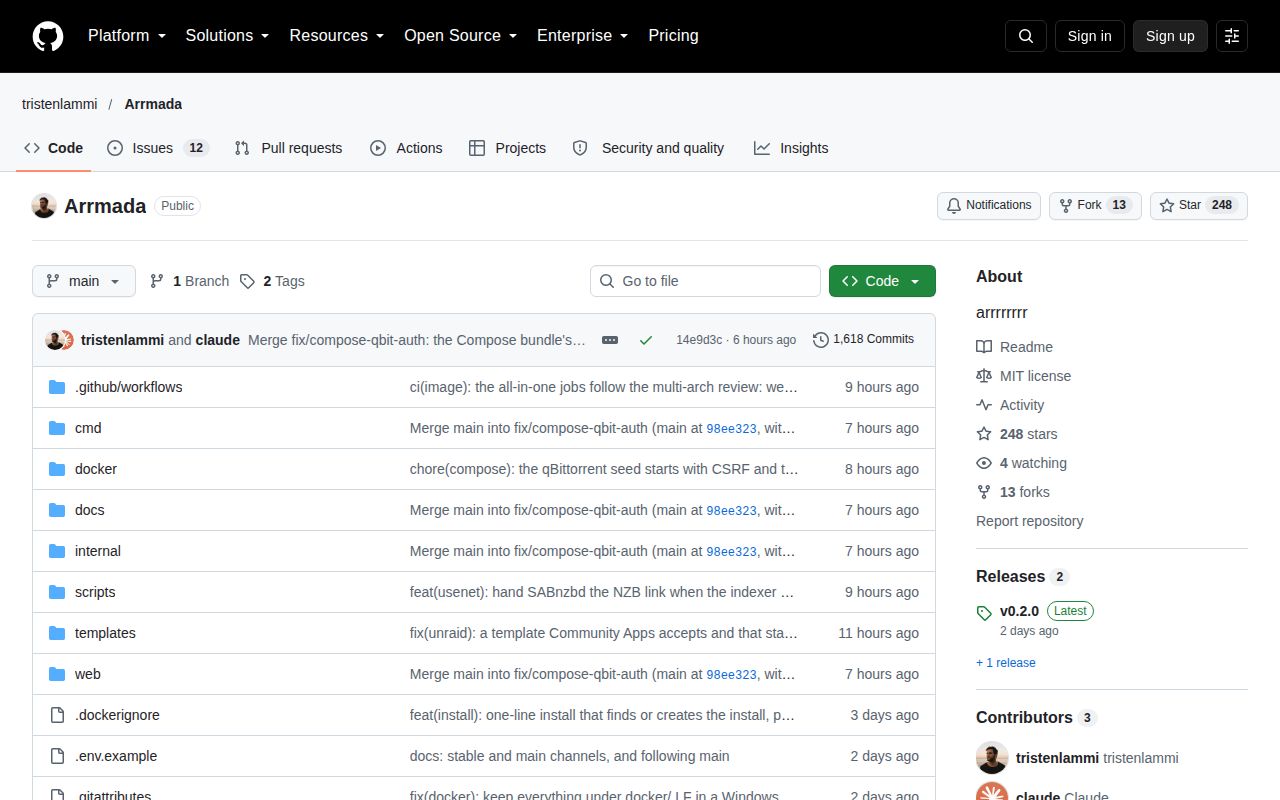
The last push was October 16, 2026, following release v0.2.0 on October 14. GitHub reported 248 stars and 12 open issues and PRs. Recent requests include mass editing lists and changes to deployment configuration. Those are current user requests, not promised delivery dates. The combination of fresh code activity and active discussion supports calling Arrmada maintained, while its own early-software warning remains relevant to adoption.
Sonarr and Radarr remain the comparisons for television and movies respectively. They replace parts of Arrmada's scope, so retaining them also means retaining separate services. With 120 passing results and 6 failures in our run, I would keep a working stack until Arrmada proves the specific replacement workflow on a trial library. Fewer browser tabs are useful only if the import, permissions, and recovery steps survive the move.