The 15-file kit controls the screen, not the game state
Codex Minecraft Gameplay is a thin bridge between a computer-use agent and a visible Minecraft window. The repository contains 15 files and about 1,766 lines of source. Its Python controller finds the game window, captures its client area, focuses it when asked, and sends bounded keyboard or mouse input. The agent must interpret the screenshot, choose an action, and inspect what changed.
That design keeps the experiment honest. The runtime does not read Minecraft memory, query an inventory API, ship a world, or include an agent model. A mined block has to look mined on the next capture. A craft has to appear in the inventory. If you want a bot that knows block coordinates and item counts directly, this project has chosen the opposite interface.
A 5-second input cap limits how far one mistake can travel
Individual holds last between 0.02 and 5 seconds. Mouse movement is also bounded, and the adapter stops if Minecraft loses focus or its window identity changes. F8 is the local interrupt. A persistent stop file, a mutex that prevents overlapping actions, cleanup releases, and a separate watchdog give the person at the keyboard several ways to regain control.
Those safeguards matter because the active desktop is the control surface. The docs tell you to keep one live input owner and to resume only after a fresh observation. They also warn that Windows must accept the release events for cleanup to work. This is sensible defensive engineering, but it cannot make an unattended desktop session equivalent to an isolated game API.
Pixel checks can stop a bad batch, but they cannot count items
The sequence runner accepts up to 32 expanded steps within a 30-second wall-time budget. A plan can require a reference region before or after input, watch regions during a hold, or demand visible progress between frames. Comparisons cover ordinary RGB pixels, bright-text masks, and red-pixel masks. Each check can inspect up to 16 rectangles from a native-size reference image.
A passing comparison has a narrow meaning. The documentation says pixel changes are stall signals, not semantic evidence of distance, collection, or crafting success. A stable panel edge may confirm that a menu stayed open while saying nothing about the item under the cursor. Tooltips, animation, GUI scale, and another window covering the game can all change the pixels being judged.
What happened when we ran it
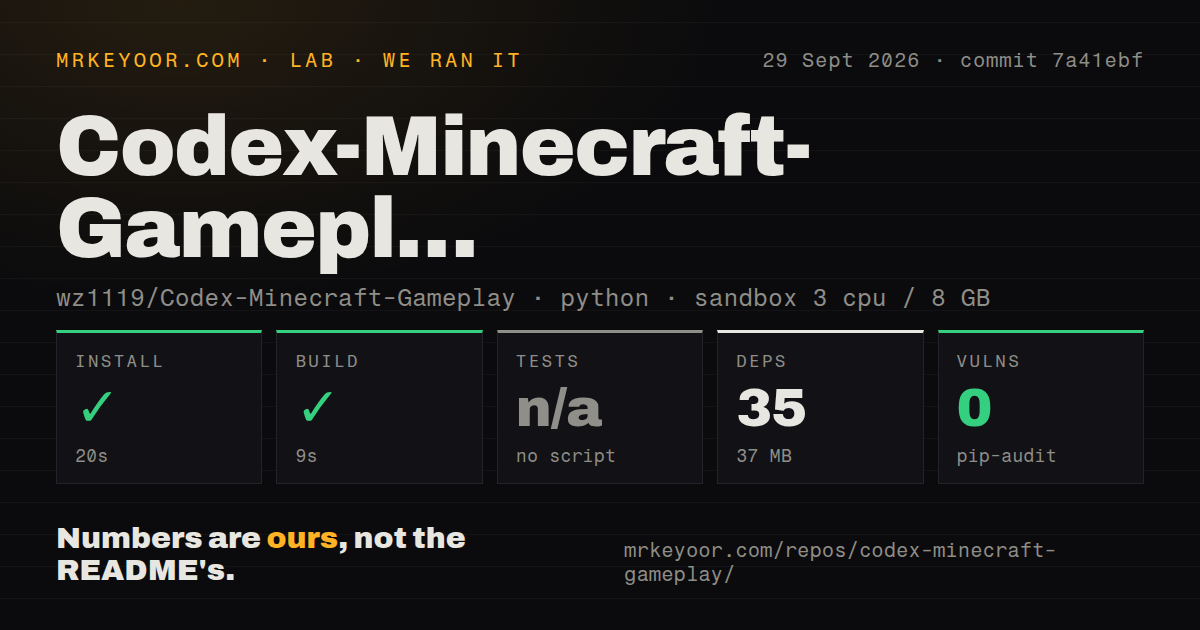
Our sandbox cloned commit 7a41ebf with 3 CPUs, 8 GB of RAM, Python 3.12 on Debian, no secrets, and no elevated privileges. Installation succeeded in 20 seconds. It added 35 packages and left 37 MB on disk, while the checkout itself occupied 0.1 MB. Pip-audit found 0 known vulnerabilities in the installed Python environment.
The build step succeeded in 9 seconds. Our harness found no tests script or target, so it skipped tests rather than reporting a pass or failure. The repository does contain mock-oriented Python test modules beside the runtime, and its contributor instructions name python -m unittest -q; the automated path we measured did not expose that as a runnable target. Our scan also found 0 CI workflow files, no Dockerfile, and no tests directory.
Windows, Minecraft, and a visible desktop are the real dependencies
The only declared runtime package is Pillow, but the practical setup is larger than a Python install. You need Windows Python, a running Minecraft client, a visible world, and an agent that can inspect captured images. The setup script registers the included gameplay skill for Codex and writes local ignore rules. It does not install Minecraft or provide model access.
Before play, the instructions call for a status check and a fresh screenshot. Multiple matching windows require an explicit handle, and a restarted game may receive a new one. Captures default to a maximum width of 1,600 pixels; sequence references use native dimensions. Menu points taken from a resized image must be converted back to the source coordinates before clicking.
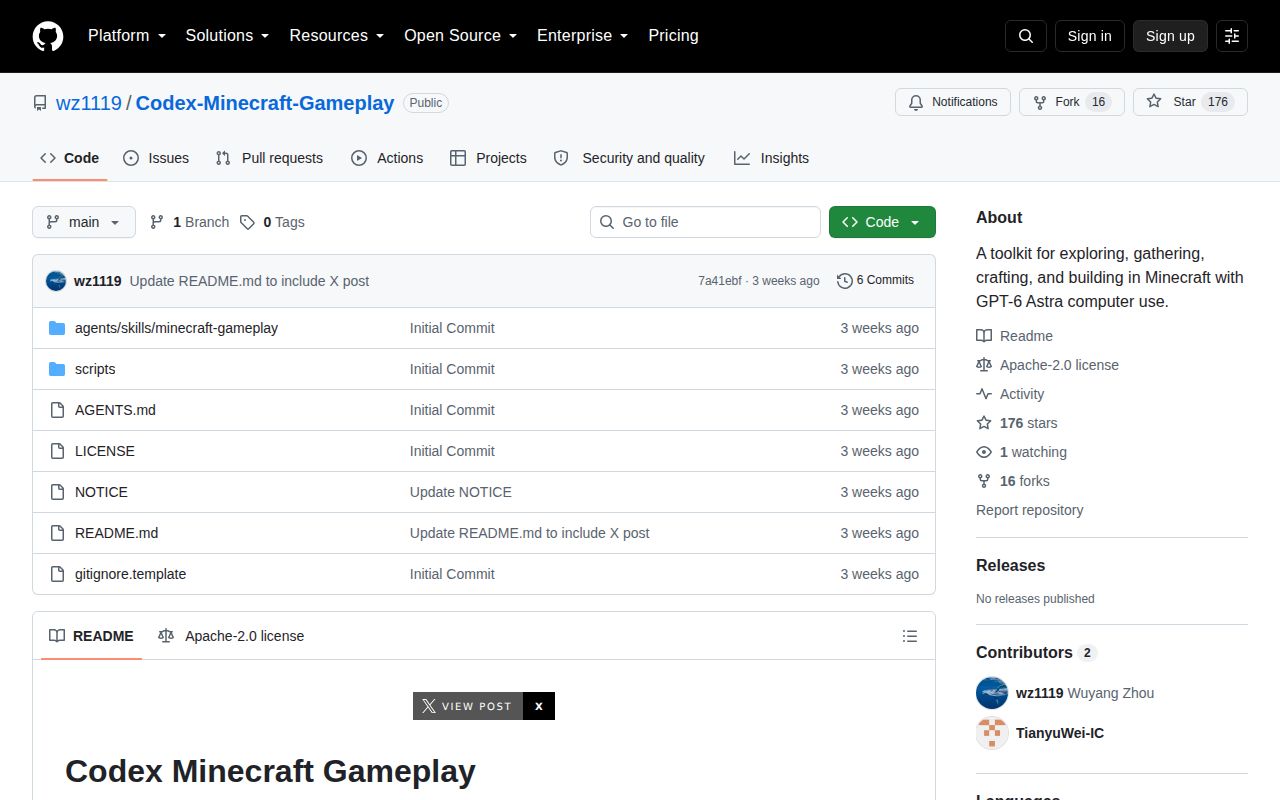
The latest code has 176 stars and no release
The repository was created on September 6, 2026, and commit 7a41ebf was pushed on September 7. GitHub showed 176 stars and 0 open issues or pull requests on September 30. There is no tagged GitHub release. That is too little public history to infer how the controller behaves across Minecraft updates, Windows configurations, or different display scales.
The empty issue queue is not proof of stability. It sits beside a one-day development window, no CI workflow, and no tagged release. The documentation is much more careful than many young agent projects, especially about what its checks cannot prove. Still, a team adopting it owns the missing compatibility record and should run the documented mock tests on its actual Windows interpreter.
Mineflayer is the better fit when exact state matters
Mineflayer exposes blocks, entities, inventory, crafting, movement, and chat through a JavaScript API. Voyager adds an LLM learning loop and reusable skills on top of a Minecraft, Mineflayer, and Fabric setup. Mindcraft packages an LLM-driven bot with several model-provider choices. All 3 alternatives operate closer to structured game state than this screenshot-first kit.
Choose Codex Minecraft Gameplay for the harder and more human-like experiment: can an agent act from the same picture and controls you use? Its 37 MB installed footprint makes that experiment cheap to start. The price is uncertainty after every action, which is why the project spends so much of its small codebase on short holds, fresh captures, explicit checks, and stopping safely.