CodeWhale puts 4 approval modes around a capable agent
CodeWhale can inspect a repository, edit files, run shell commands, and continue toward a durable goal. Its permission model is unusually visible: Plan is read-only, while Ask, Auto-Review, and Full Access progressively reduce interruptions. The TUI also keeps /undo for the last turn and /restore for an earlier workspace snapshot. These controls make the agent's authority easier to discuss than a single yes-or-no permission switch, though they do not remove the need to review commands and protect secrets.
Provider choice is the other reason to consider it. CodeWhale connects to hosted APIs and local inference through Ollama, vLLM, or SGLang, with model switching inside the session. The README says unknown model prices remain unknown instead of being shown as free, a small but useful accounting choice. Teams can keep roles as readable project files, add hooks and skills, connect MCP servers, and coordinate agents without dumping their internal instructions into the main transcript.
The 13-second npm install is the easy part
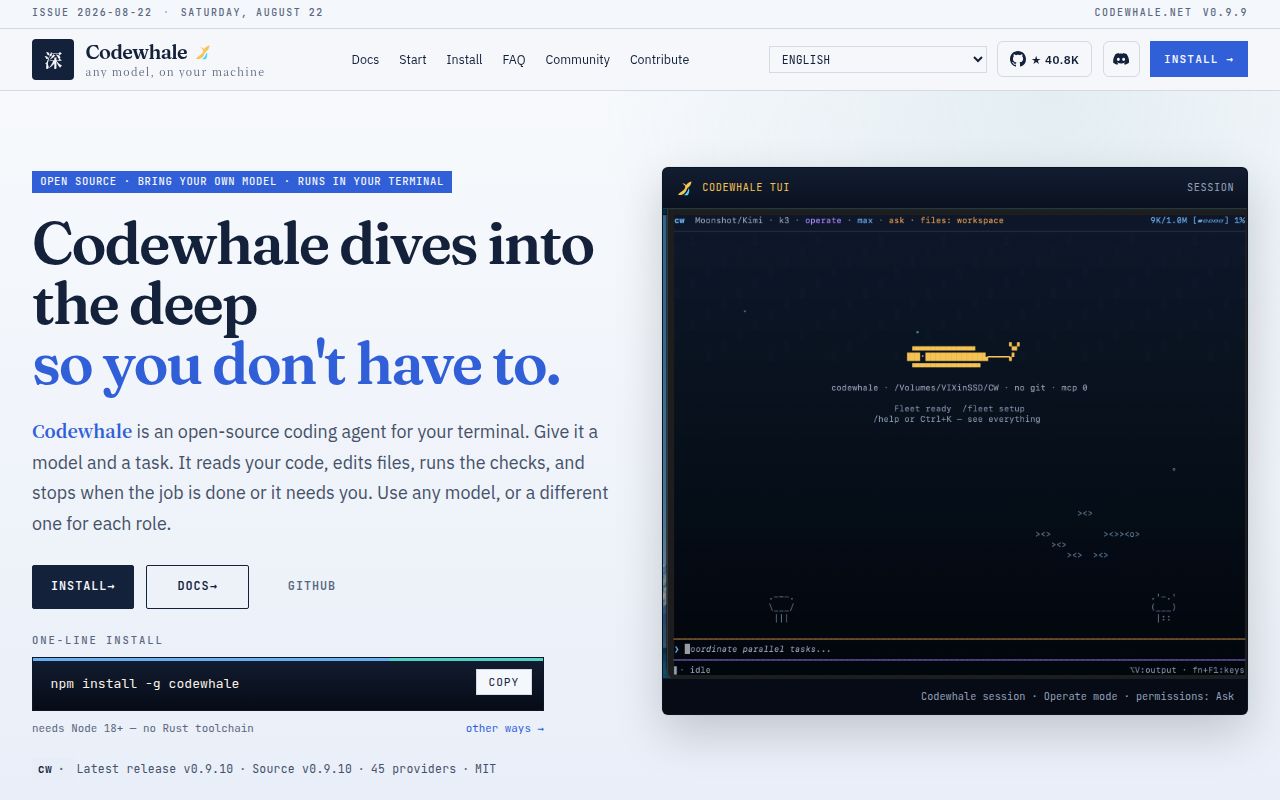
The advertised start is two commands: install the codewhale npm package globally and launch it. First run guides the provider connection or lets you stay offline. The project also publishes a Cargo crate, Docker route, Nix packaging, Scoop support, prebuilt archives, Android and Termux instructions, plus a CNB mirror. Shell completion is available for Bash, Zsh, Fish, PowerShell, and Elvish. That is better platform coverage than most young terminal agents.
A usable session still needs a model. Hosted providers require credentials and whatever billing controls that account uses. Local operation shifts the work to an Ollama, vLLM, or SGLang server and a model your machine can run. The access mode is another setup decision because CodeWhale acts on the local filesystem and shell. Optional OS sandboxing strengthens that boundary only on supported systems, so a company cannot assume the same containment behavior on every developer laptop.
What happened when we ran it
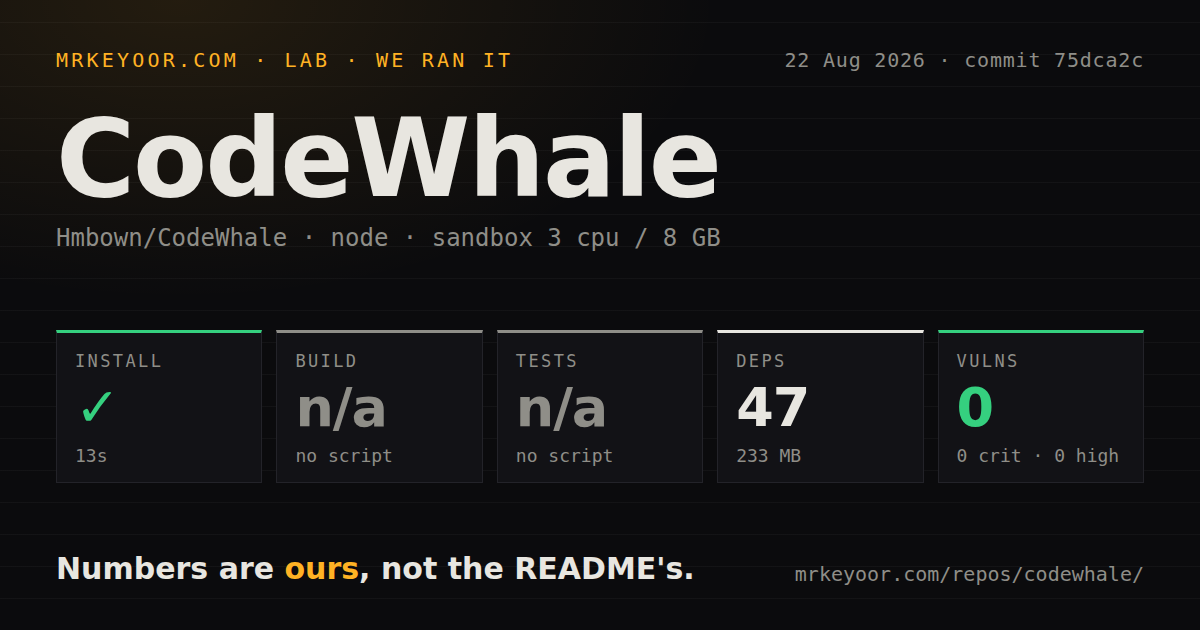
Our sandbox cloned commit 75dca2c in an unprivileged Debian container with 3 CPUs and 8 GB of RAM. The npm install finished in 13 seconds, added 47 packages, and occupied 233 MB on disk. npm audit reported 0 known vulnerabilities across all severities. The checkout itself was far larger: 1,709 files, roughly 1,011,580 lines of source, and 49 MB before dependencies.
The root package exposed no build script or target, so our harness skipped the build. It also exposed no test script or target, so tests were skipped rather than passed. That distinction matters for a tool allowed to run commands and rewrite a working tree. The repository has 25 CI workflow files and monorepo workspaces, which shows substantial upstream automation, but an npm consumer cannot reproduce a standard build-and-test check from the root scripts we found.
Long sessions come with recovery and coordination tools
CodeWhale can save sessions, maintain a /goal, and run tasks without opening the TUI through codewhale exec. Workflows can be inspected before execution. Agent teams and roles are built into the project, while MCP, hooks, and skills extend what an agent can reach. Those features suit repository migrations or debugging jobs that take more than 1 model call and need a record of intermediate state.
The size has a cost. A repository of about 1,011,580 source lines is harder for a new contributor to audit than a compact chat client, and issue activity describes ongoing decomposition of a very large TUI crate. Users mostly experience the compiled tool, yet architectural weight shows up during source builds, contribution, and debugging. The latest release is v0.9.11, published on 2026-08-23, while the last push was 2026-08-25. Development is active and still moving quickly.
Background Git probes are a current operational concern
Open issue #5617 reports that internal status probes can briefly contend for .git/index.lock. The report says the idle TUI may run about 190 Git processes per minute through overlapping 2-second and 15-second probes, and it proposes lock-free reads plus event-driven refresh. This is a detailed current report, not proof that every user will hit a failed commit, but it concerns the exact workspace CodeWhale is trusted to manage.
Teams with sensitive or heavily automated Git workflows should reproduce that behavior before adoption. Until the issue is closed in a release, try CodeWhale in a disposable clone and watch process activity during idle periods. /undo and /restore help with agent edits; they do not solve external command contention or replace a clean branch, repository backup, and normal code review. The 111 open issues and PRs also suggest checking the tracker for your provider and platform before standardizing.
Pick CodeWhale when provider freedom justifies the surface
CodeWhale offers more than a terminal chat box: 4 access modes, durable goals, snapshots, coordinated agents, MCP, hooks, and local-model routes are part of one client. That combination is persuasive for developers who switch providers or need long-running work to remain organized. The MIT license is also straightforward for internal use and contribution.
The missing root build and test targets in our npm run keep this from being an automatic recommendation. Aider is easier to understand if your desired loop is conversation, explicit files, and Git diffs. Codex or Claude Code makes more sense when one model vendor is already the company standard. CodeWhale is the better bet when provider neutrality and workflow depth are requirements, provided you validate its workspace behavior under the exact permission mode you intend to allow.