The 155-entry catalog trades coverage for editorial context
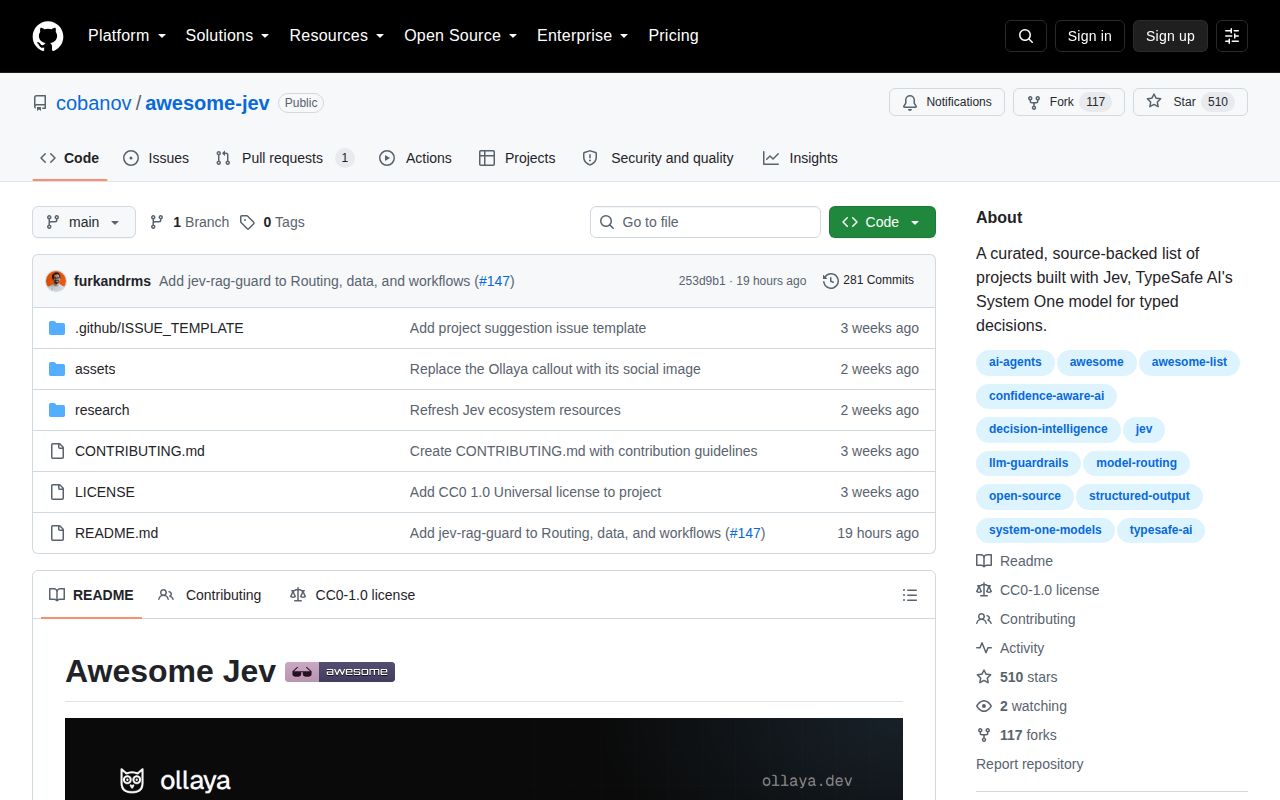
cobanov's Awesome Jev is a curated guide to Jev's official resources, provider routes, framework integrations, community clients, agent tools, local reproductions, and public evaluations. Its September 20 review reported 155 catalog records after adding 20 source-reviewed entries. That is much smaller than yibie's 570-record catalog, but the entries here often carry more context about release status, model boundaries, licensing, or the evidence behind a claim.
The trade is easy to understand. Use this list when you would rather read a paragraph explaining why an integration matters than scan 570 catalog records. Use the larger list when recall matters more and you are willing to do more filtering yourself. Neither directory replaces opening the linked repository, reading its license, and checking whether the code path you need still exists.
Official, provider, framework, and community work stay visibly separate
The guide documents 4 hosted provider endpoints, then keeps official SDKs, framework integrations, community clients, and open reproductions in separate sections. The providers are Cloudflare, Netlify, OpenRouter, and Vercel. That structure prevents a third-party experiment from borrowing authority merely by appearing near an official JavaScript SDK. Open reproductions are clearly labeled as independent.
Release status is called out when it changes the decision. The README notes that one BAML integration lives in the v1 nightly line, that default-branch code may not have reached a stable package, and that moving model aliases should be pinned for evaluation. It also distinguishes hosted Jev's text-only boundary from independent multimodal projects. These details save time because they identify which link deserves verification before you design around it.
What happened when we ran it
The lab did not install commit 72ee9f4 because GitHub reports no primary language and our scan found no Dockerfile. The supplied record therefore contains no build or test result. This is consistent with the repository's purpose: it is chiefly a Markdown catalog with research notes and assets, not an application or library.
There is no measured dependency count, disk footprint, test total, or vulnerability audit to use as a quality signal. A browser can read the repository without setup. Contributors work through normal GitHub changes, but the README does not present an executable validation command. Any install claim belongs to the linked project, and none should be transferred to this list.
The guide explains typed decisions without selling them as truth
The opening primer describes three Jev question shapes. Choice selects an option, Score evaluates ordered levels, and Noul returns a probability between 0 and 1 for yes. Application code owns thresholds, review bands, abstention, and actions. The guide then makes the essential correction: a schema-valid answer can still be wrong. It recommends validation on your own data, calibrated thresholds, deterministic checks, and human fallback for consequential actions.
That advice is more useful than another catalog entry. It tells readers how to interpret every project below it. A routing demo may prove that the wire format works while saying nothing about accuracy on your support tickets. A guardrail may return a valid probability without being safe enough to block commands. A provider listing may establish availability without proving a separate upstream model release.
Evaluation entries include limits the headline number usually drops
The September 20 research notes separate model versions, datasets, prompts, and measurement setups instead of merging them into one score. Inclusion means the evidence is inspectable, not independently reproduced. Individual summaries preserve awkward details such as synthetic samples, small pilots, private data, unequal sample sizes, or failure on some gates.
This is the section to use when designing your own evaluation. It points to raw records, per-answer explorers, source code, and stated boundaries. Do not use a listed score as a purchasing conclusion. Recreate the task with your data, pin the exact model instead of a moving alias, and define the threshold at which code accepts, rejects, or asks a human.
A featured Ollaya banner weakens the neutral-directory feel
The README gives 1 model server, Ollaya, a full-width promotion before explaining the list. Ollaya is also listed later as a local Jev-compatible server for open decision models. The placement does not make the catalog inaccurate, but it changes the tone. Readers expecting a neutral index should judge the featured project through the same source checks as every ordinary entry.
The repository itself uses a CC0-1.0 license. GitHub showed 510 stars, 1 open PR, and a last push on October 5, 2026. That open contribution proposed another agent project, while several additions had merged during the previous week. The activity is current, even though GitHub returned no published release. For a reading list, branch freshness and review history matter more than version tags.
Use both Awesome Jev lists for different stages of research
The 155-record cobanov list is best for the official path, framework status checks, and evaluations with caveats intact. The 570-record yibie catalog is better when you want more examples in a narrow application category or a coding-agent filter. Their overlap is useful: conflicting descriptions tell you exactly which source needs another look.
This repository often answers the second question after discovery: what does the linked evidence really establish? Its 155 records are manageable when you need readable context and limiting when you need exhaustive discovery. The absent runtime also means there is nothing here to deploy, secure, or benchmark. All consequential work begins after you click through.