The 570 entries are a map, not a recommendation list
awesome-jev collects public Jev projects, integrations, experiments, and discussions into one generated README. The October 6, 2026 category counts added up to 570 entries. They covered classification, guardrails, ranking, agent decisions, data labeling, evaluation, research, infrastructure, games, robotics, finance, legal work, moderation, interfaces, and related discussions. That breadth makes the list the fastest way to see how people are applying typed decisions outside TypeSafe's own examples.
The repository states the limit plainly: listing is not endorsement. Maintainers do not claim that an entry compiles, passes tests, reports reproducible numbers, has acceptable security, or carries a usable license. That warning should control how you browse. Treat each bullet as a lead with a specific use case, then open the source and perform the checks the list deliberately leaves to you.
Each entry must show a real typed-decision loop
The inclusion bar is more useful than a generic link dump. A project must publicly name Jev or System One, or visibly implement the same typed loop: supply state, ask a typed question, receive a typed answer with confidence, then accept, reject, or escalate. Generic classifiers and LLM judges do not qualify merely because their behavior looks similar. Each accepted entry belongs to exactly 1 category based on the decision Jev makes.
Descriptions must fit on one bullet line and explain the scenario, method, and practical value. Contributors are told to inspect whether code makes a real Jev request and parses the answer. They should also find a runnable check and trace any claimed number to its source. These are good editorial rules. They improve the odds that a link is worth opening, but the repository still does not reproduce the claim for you.
What happened when we ran it
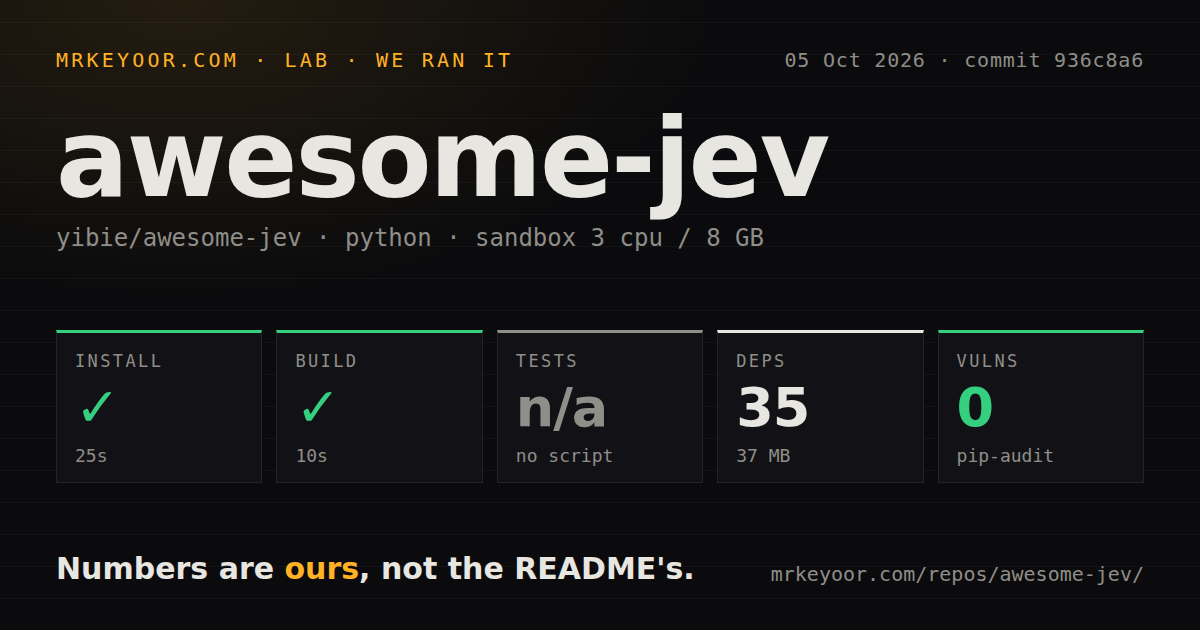
Our sandbox installed commit 936c8a6 in 25 seconds. That added 35 Python packages and occupied 37 MB. The build completed in another 10 seconds, and pip-audit reported 0 known vulnerabilities. The checkout was only 0.6 MB, with 31 files and about 2,504 lines of source. Those numbers fit the product: this is a compact set of category documents and curation scripts, not a decision engine.
There was no test script or test target, so our runner skipped tests. That is different from a passing suite. The scan found 2 CI workflow files and no tests directory. The contributing guide says the catalog workflow rebuilds the README, catches hand-edited generated output, checks tags, and reports duplicates. Those controls protect catalog consistency. Our run found no separate test target for the Python utilities themselves.
Category files make the huge README maintainable
The 238 KB README is generated from smaller category files. Contributors edit those sources and run python3 scripts/build-readme.py, while the root page acts as the current aggregate. Star badges are generated from GitHub links rather than typed by hand. Optional tags identify a supported coding agent or project type only when the linked source supports that classification. Unknown tags are dropped with an error instead of passing silently.
The agent index is particularly handy. On October 6 it listed 15 Claude Code entries, 6 Codex entries, 14 Pi entries, and smaller groups for other coding agents. That saves a reader from scanning hundreds of descriptions for their current tool. It does not make the underlying integrations equivalent. Some are plugins, some are proxies, and some are little more than documented experiments.
Bulk AI submissions receive an explicit trust penalty
The contribution policy addresses a problem most awesome lists ignore. One project belongs in one pull request, and at most 3 entries from an author are taken in a review pass. Repositories sharing the same scaffold, release day, or thin history are treated as one family. Undisclosed AI generation pauses the pending batch. The rule does not reject AI-written code. It stops volume from substituting for evidence.
That caution also appears in the published README. Readers are told to look for real calls, runnable checks, sourced figures, code depth, and a license before adoption. The scientific-pipelines category still contained 0 entries, which is better than padding the catalog with a weak match. GitHub reported no license for awesome-jev itself, so reuse beyond ordinary browsing and contribution deserves its own legal check.
Daily maintenance keeps the index useful but volatile
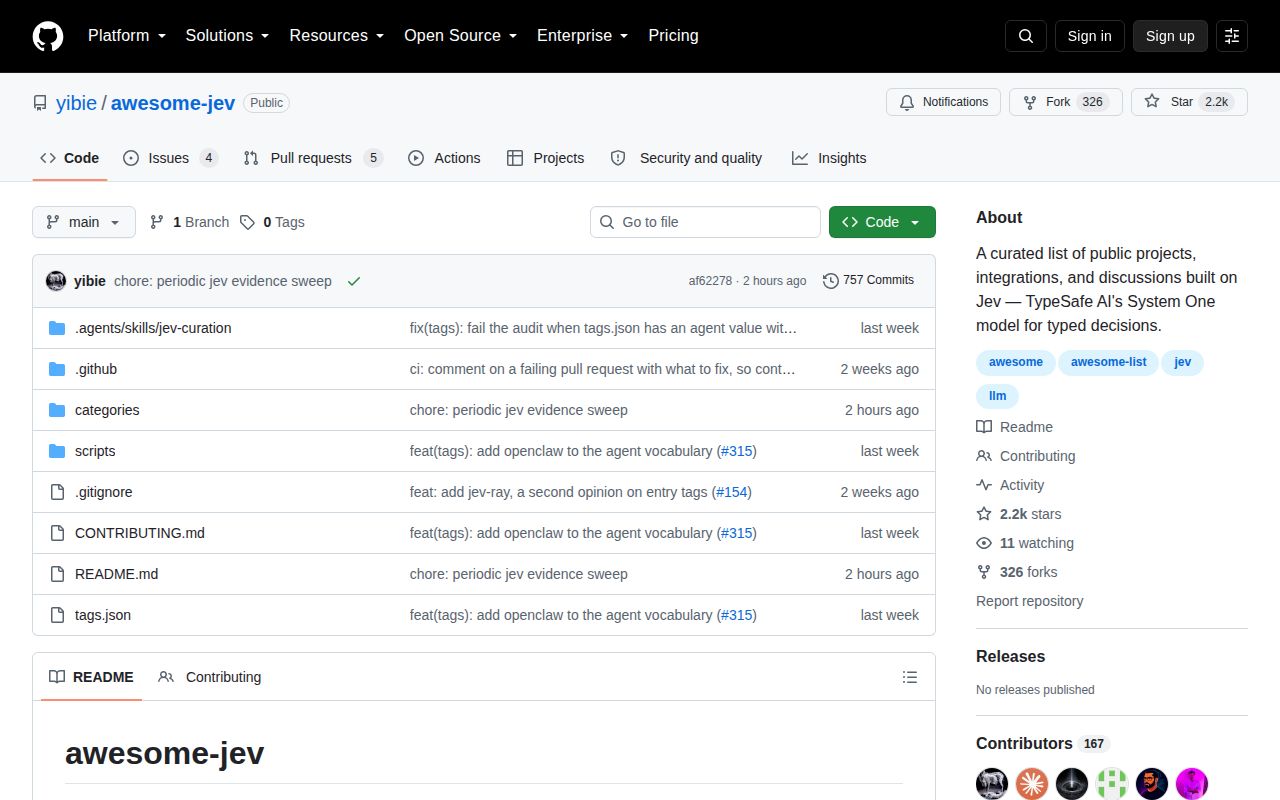
GitHub showed 2,160 stars, 9 combined open issues and pull requests, and a push on October 6, 2026. Five open pull requests from October 5 proposed new projects in browser safety, chemistry, agent decisions, CI evaluation, and runtime security. The latest-release API returned no release. That fits a generated list whose useful state lives on the default branch rather than in packaged versions.
Use awesome-jev when the question is, "Has anyone tried this decision pattern with Jev?" It is also good for learning how other teams phrase Noul, Choice, and Score questions or when they send uncertain results to a human. Once a candidate looks promising, leave the catalog and inspect that repository's code, license, history, and tests. Our 10-second build proves the index can be generated. It does not validate any of the 570 things inside it.