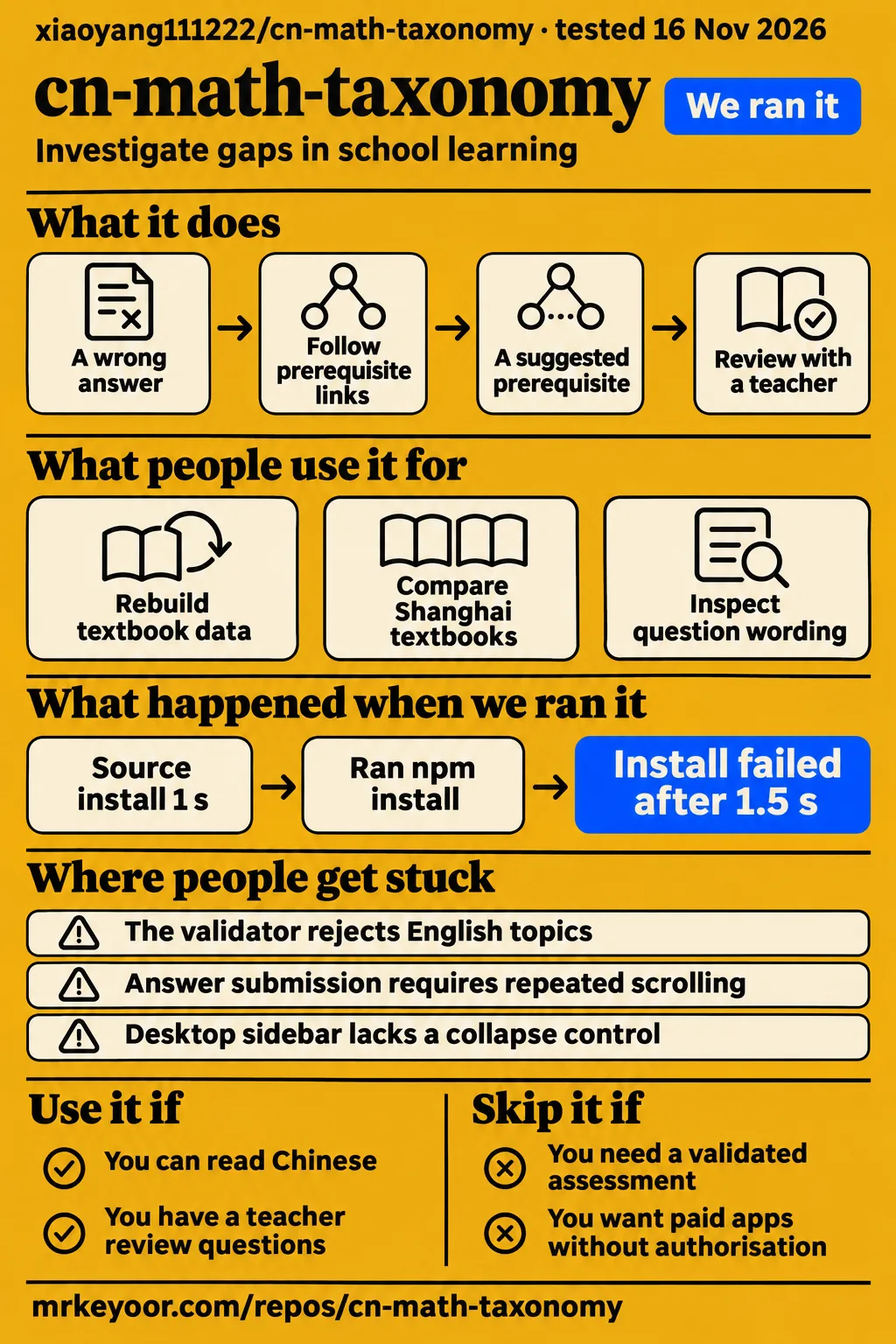
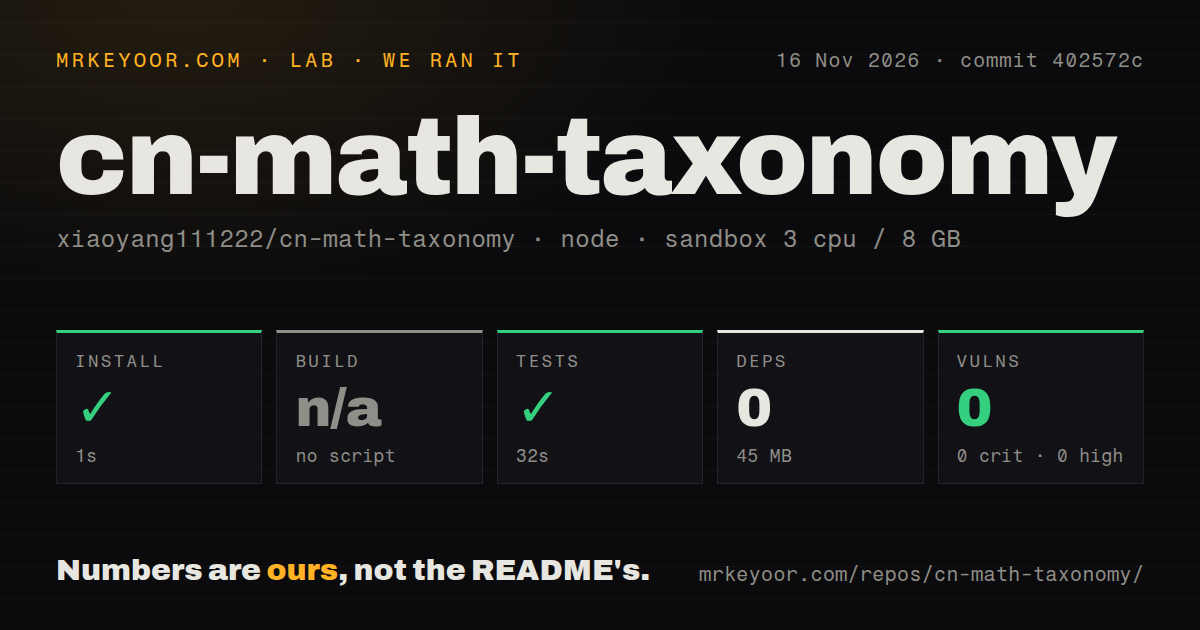

Our sandbox installed cn-math-taxonomy in 1 second and its tests passed in 32 seconds. Use it if you can read Chinese and have a teacher help review the curriculum relationships. Skip it if you want a ready-made assessment to make decisions about a child without that review. The useful question is how much of your child's actual textbook this graph represents.
A prerequisite graph for Chinese textbook sequences
cn-math-taxonomy maps Chinese school topics and follows prerequisite relationships backward when a learner answers incorrectly. The README describes mathematics paths that can reach from high school into primary school, alongside separate subject graphs. That makes it useful for examining what a topic depends on, then discussing those dependencies with a teacher. A graph supplies a proposed explanation for a difficulty; the quality of that explanation depends on its questions and edges. Project README.
For a parent, the attraction is a more specific conversation than “revise mathematics.” You can start with a topic, inspect its prerequisite neighborhood and look at the attached questions. For a developer, the reusable material is the topics-and-dependencies structure plus the diagnostic interface. The README's mathematics table lists 870 topics and 3,627 questions. Those are dataset counts, separate from the test result in our sandbox. README snapshot.
What people use cn-math-taxonomy for
A parent reports adapting the framework to Qingdao textbooks, packaging an Android app and using it with their child. That report is more useful adoption evidence than a fork counter because it describes the curriculum work required to put the framework in front of a learner.
| Who | What they did | Reported outcome |
|---|---|---|
| GitHub user caiaji | Rebuilt the Qingdao six-three mathematics dataset and prerequisites, with teacher input | Reports 542 topics, 3,252 questions, Android packaging and local test-history storage, with use by their child. Issue #4 |
| GitHub contributor songxc1995 | Compared Shanghai textbooks with upstream topics | Reports checking 160 mathematics mappings and preparing 49 English mappings; the English draft hit a mathematics-only validator. Issue #11 |
| The reporter and contributor songxc1995 in issue #8 | Audited whether primary-school prompts tested their assigned concepts | The maintainer reports correcting the submitted mismatches and duplicates and deploying two correction commits. Issue #8 |
| GitHub user SpencerLTY | Contributed mappings for Shandong's five-four system | Reports the initial contribution being merged and intends to extend the same mathematics file when second-semester books arrive. Issue #16 |
The Qingdao adaptation replaced textbook-specific data and reconstructed the prerequisite relationships. It was substantial curriculum work, rather than a different label on the upstream interface. The parent's follow-up also corrects the original feature claim: diagnosis by knowledge type was their addition, while diagnosis by grade already existed upstream. Keep that distinction if you are estimating what a regional fork needs. Parent's report and clarification.
SpencerLTY's thread offers a different boundary. The contributor described an existing wrong-answer system and possible cooperation, but the maintainer left formal business integration undecided. A merged mapping contribution is evidence of contribution handling. It is not evidence that the upstream project powers that tutoring business. Shandong contribution discussion.
What happened when we ran it
Our repository run at commit 402572c on November 16, 2026 installed successfully in 1 second and passed tests in 32 seconds. The recorded configuration was 3 CPUs, 8 GB RAM and image label lab-node:22. Those results make the checked source straightforward to examine; they say nothing about whether its diagnosis matches a teacher's judgment.
| Recorded check | Our result | How to read it |
|---|---|---|
| Repository | 451 files, approximately 99,052 source lines, 32.2 MB checked out | Scope of the checked snapshot |
| Install | Succeeded in 1 second; 0 dependencies recorded; 45 MB on disk | Repository setup result, not a browser memory measurement |
| Build | Skipped: no build script or target | No successful build is claimed |
| Tests | Succeeded in 32 seconds | No test count was supplied |
| npm audit | 0 known vulnerabilities, including 0 critical, high, moderate and low | Dependency-audit result within this run |
| Repository signals | 1 CI workflow, a tests directory, no Dockerfile | Files detected, not evidence of deployed service health |
The research pack also records a separate quickstart attempt that asked npm for cn-math-taxonomy@latest and received E404, HTTP 404 Not Found. Its log says the package is not in that registry, and the attempt stopped at installation. That failure concerns the registry route used by the recipe. The README instead documents serving the repository locally with Python's HTTP server. The pack records successful teardown after the failed attempt.
Keep these records separate when reproducing setup. The repository harness succeeded; the registry recipe failed. Download the source and follow its documented local-serving route rather than treating a package name in package.json as proof of a published npm distribution. The sandbox's image label is recorded configuration, not an independently confirmed Node or operating-system version.
Where people get stuck: correct arithmetic can test the wrong concept
Issue #8 documents questions whose arithmetic answers were correct but whose prompts failed to assess the concept they were attached to. One example, cnm_p068_q4, sat under decimeters and asked only for 10 minus 3. The explanation introduced centimeter and decimeter context that the child never saw in the question. Getting seven cannot demonstrate understanding of those units. Question audit.
That is an unusually useful bug report because it exposes a failure that ordinary answer checking misses. A program can calculate the expected answer and still accept weak diagnostic evidence. The maintainer says the submitted lists were processed, contexts restored or questions replaced, and duplicate prompts retained only at their best-fitting topic. The thread names deployed commits 1a76fb3 and a339532. Maintainer's correction report.
| Problem reported | Response in the record | Practical next step |
|---|---|---|
| Concept mismatch or repeated prompt, issue #8 | Maintainer reports deployed corrections | Review the wording and assigned topic together when contributing a new question |
| Revised Renjiao textbook order, issue #3 | Maintainer reports successive deployed volume updates; the issue stays open | Match the particular volume and revision, rather than relying on a general “updated” label |
| Shanghai English mappings, issue #11 | Contributor reports a mathematics-only validator; maintainer agrees to subject-specific validation | Look for a successful English validation result before treating the draft as accepted data |
| Restricted desktop graph and scrolling, issue #43 | Maintainer confirms the problems and describes intended changes | Check the selected revision for the controls you need; the supplied discussion ends with proposed fixes |
The textbook update thread is worth reading by volume. It records adjustments to unit placement, additional topics and question difficulty, rather than one announcement that every book is finished. The four-up mathematics example begins with a contributor comparing a printed workbook's contents against the dataset. That is the sort of edition-specific evidence a family needs before following the graph's grade assignments. Renjiao update thread.
More graph space and stable answer controls are requested
The maintainer confirms that the desktop graph's fixed sidebar lacks the collapse control available on narrow screens. In issue #43, the proposed desktop change adds a toggle and resizes the canvas. This matters when you are following several prerequisite relationships: less canvas means more navigation around the topic you are trying to understand. Desktop layout discussion.
Diagnostic answer and next-question controls are also the subject of proposed stability fixes. After the reporter clarified that submission required repeated scrolling, the maintainer described updating selection in place, moving automatically to results and keeping the next-question button visible. The supplied thread contains the proposal, not a completion report. If you plan supervised sessions, run through a long question and its explanation on the actual device before handing it to a child. Diagnostic navigation discussion.
Chinese documentation and textbook editions shape the work
The main README and the sampled contribution discussions are in Chinese; the materials reviewed here supply no separate English documentation set. The presence of an English subject graph means English is taught as a school subject, not that the product is localized for English-speaking parents. A worldwide reader needs someone who can interpret the Chinese topic descriptions, textbook names and curriculum caveats. Project documentation.
Regional mappings can reuse a concept while changing its grade, semester and unit assignment. In Shanghai, the five-four school structure and an earlier start for English create differences that a simple grade rename cannot solve. Issue #11 records optional mapping support, contribution instructions and an example, explicitly described as an incomplete comparison. Treat the mapping file as curriculum data to inspect, rather than a guarantee that every screen switches editions. Mapping design and contribution report.
Security and permission start with a static site and an NC licence
The README states CC BY-NC 4.0 and requires separate authorisation for commercial use. Paid courses, paid apps and fee-charging institutional services are its explicit examples. If your intended use is a tutoring product, resolve that permission before integrating the data or diagnostic code. Public source access is not blanket permission to resell this material. README licence notice.
For hosting, the deployment script copies the static site and data into a staging directory and invokes Cloudflare Pages through Wrangler. That route requires a Cloudflare API token and usually an account ID. It also sets a writable temporary cache fallback and warns that an upload can succeed before Wrangler exits with a local error. Check the hosted result as well as the command's exit status if that happens. This is documented script behavior, not a deployment reproduced by our repository harness. Deployment script.
The audit's zero known vulnerabilities is a useful narrow result. It does not inspect how you protect a child's exported answers or any service you add around the static pages. The Qingdao parent's local history storage belongs to their adaptation; don't assume that report describes every upstream deployment. Keeping an adaptation's features separate from the upstream project prevents both mistaken privacy promises and mistaken setup expectations. Adaptation architecture.
cn-math-taxonomy vs regional rebuilds, Marble and Kolibri
Use a mapping when the shared concepts fit and the textbook sequence changes; the Qingdao parent instead reports replacing the dataset and reconstructing prerequisites. These are two demonstrated approaches to regional compatibility, with very different maintenance costs. A mapping lets you keep shared topic identities. Rebuilding gives you control over questions and relationships but leaves you responsible for their review. Shanghai mapping approach, Qingdao rebuild.
| Choice | Evidence for choosing it | Work you retain |
|---|---|---|
| Upstream with edition mappings | Shanghai contributor and maintainer favor reusing concepts with different grade, semester and unit placement | Checking coverage and identifying genuinely missing concepts |
| Qingdao-style regional rebuild | caiaji reports replacing the textbook dataset and rebuilding prerequisites with teacher input | Maintaining the regional questions, relationships and packaging |
| Marble Skill Taxonomy | Its README describes primary-school micro-topics, prerequisites and curriculum alignment | Evaluating whether its curricula and age scope match your learners |
| Kolibri | Its README describes an offline-first teaching and learning platform | Choosing suitable content and evaluating the learning workflow you need |
Marble Skill Taxonomy is the closer alternative if your task is to work with structured curriculum data outside this Chinese textbook setup. Its README describes a prerequisite graph and alignment to sources including Common Core, NGSS and the UK National Curriculum. That is a reason to examine it, not a claim of compatibility with Renjiao or Shanghai books.
Kolibri belongs on the shortlist when the primary requirement is an offline teaching and learning platform. Its README directs users to downloads and a user guide. It answers a broader delivery question than “which prerequisite should this wrong answer lead to?” Neither alternative was compared for speed or educational outcomes in our sandbox.
What the other reviews get wrong
Repolode's 531-topic, 2,271-question description is stale beside the supplied README's mathematics totals of 870 topics and 3,627 questions. Its grades 1 through 9 framing also omits the high-school mathematics shown in that README. Use the stage table when estimating coverage, and keep mathematics counts separate from all-subject totals. Repolode description, README totals.
The CSDN review describes strict alignment with revised national standards. The README gives a narrower account: high-school entries refer to the 2020 revision and remain paraphrases, without individual rechecking against the 2025 revision. The CSDN author describes a static review sampling 30 files and explicitly excludes running the diagnostic engine in a real teaching setting. That is useful source inspection, not evidence of classroom accuracy. CSDN static review, README alignment statement.
Hysen Labs says every senior-high standard entry has a pending page reference. The README records printed-page references for 80 high-school entries on November 6, 2026. That corrects the page-reference claim without turning paraphrased entries into officially checked quotations. Meanwhile, Tao_Builds on X highlights tracing high-school difficulty back to primary school. The attraction is clear, but a social post describing that mechanism supplies no accuracy evaluation. Hysen Labs, README update, X discussion.
Questions people ask
Yes, the README describes following mathematics prerequisite edges from high school back to primary school; that is how the diagnostic is designed to navigate.
Can a wrong high-school mathematics answer really be traced back to a primary-school prerequisite?
The graph supports that traversal, according to the README. It follows the relationships encoded in its data, so a returned primary-school topic is a suggested prerequisite to examine with the learner. Our source-check results measure software execution, not the correctness of that explanation for an individual child. README diagnostic description.
When will cn-math-taxonomy update its mappings to the revised Renjiao textbooks?
The maintainer reports several updates already deployed in issue #3, including individual primary-school volumes. The thread gives progress by book rather than a deadline for the whole curriculum. Compare your particular volume against those reports and its recorded source before assuming that a revised unit is covered. Update reports.
Can cn-math-taxonomy support Shanghai textbooks and the five-four school system?
Optional mappings support different grade, semester and unit assignments. Issue #11 records the schema, contribution guidance and an example, while full mappings and site-level edition switching are separate work. The distinction matters: accepting a mapping format doesn't automatically make every Shanghai learner's diagnostic scope correct. Shanghai mapping discussion.
Can Sujiao mathematics textbooks be added?
The maintainer invites a Sujiao mapping contribution, beginning with one grade if needed. Issue #20 names data/mappings/sujiao_math.json and points contributors to the edition-mapping documentation and Shanghai example. This is an invitation to build a comparison, not a statement that Sujiao coverage is complete. Sujiao request.
Will the project accept Shanghai-specific concepts that have no upstream equivalent?
The maintainer asks for selective discussion of missing, measurable concepts rather than importing the whole list. Issue #22 requires textbook provenance and a short definition for proposed topics. Cultural reading, classroom activities and duplicates are excluded from automatic conversion into graph nodes. Missing-concept policy.
Can the mapping validator be extended to accept Oxford Shanghai English mappings?
The maintainer agrees to subject-specific English validation after songxc1995 reports that the mathematics-only check rejects English topics. The supplied reply invites a PR after that change, but contains no successful validation result. A contributor should distinguish permission to submit the English mapping from evidence that the validator change has shipped. English validator exchange.
What naming convention should regional edition identifiers use?
SpencerLTY proposes school-system, region, publisher and subject components in issue #16. A later comment says the merged mathematics contribution uses sd54_math.json, with separate English and Chinese files intended. The thread therefore supplies examples and a proposal, not one universal naming rule approved for all regions. Edition identifier discussion.
Should each textbook volume record its edition and printing, or should that metadata live separately?
The contributor proposes recording edition and printing per volume because content can change without its page number changing. The supplied thread leaves the storage choice unanswered. For a contribution, preserve the photographed or otherwise checked publication evidence and discuss where it belongs instead of presenting your preferred layout as upstream policy. Volume provenance question.
Should the Shanghai addition-table and subtraction-table activities become one topic or two?
The maintainer favors a teachable, measurable unit over mechanically splitting textbook headings. Issue #22 lists the addition and subtraction activities separately, but the general granularity guidance doesn't settle that particular pair. A proposal should explain what each question would assess before choosing how many nodes to add. Topic-granularity discussion.
Can the desktop graph sidebar collapse to give the graph more room?
The maintainer confirms the missing desktop toggle and describes adding collapse and expand behavior with canvas resizing. The supplied issue records the intended change, without a completed-fix report. Narrow-screen behavior is described separately and should not be taken as proof that desktop already has the same control. Sidebar request.
Can diagnostic answer and next-question controls remain stable and visible without repeated scrolling?
The proposed fix updates the selected answer in place, positions the page at the result after submission and keeps the next-question control visible. Those are the maintainer's stated changes in issue #43. The thread supplies a clear acceptance checklist for a future revision, rather than a recorded successful retest. Navigation fix proposal.
Can science, history and other core school subjects be added?
The current README names subjects beyond mathematics, including science and history. An earlier reply in issue #7 deferred several new subject lines, so that reply cannot describe the current subject list by itself. Read each subject's present scope and source notes rather than treating a general request for more subjects as a promise of full coverage. Current README, Earlier subject request.
What we have not tested yet
Our passing repository tests do not establish diagnostic accuracy or learning gains. We did not conduct student sessions, compare diagnoses with teachers, or measure whether following a recommended path improves understanding. The parent's child-use report establishes reported use, without a measured learning outcome. The CSDN static review also explicitly excludes classroom effectiveness testing.
We have not reproduced the Qingdao APK, completed a Shanghai or Sujiao mapping, or retested the proposed desktop and scrolling fixes. The supplied YouTube captions and Bilibili search results do not provide a relevant, attributable project walkthrough that would justify adding video-based performance claims. No pack screenshots document an interactive run of our own.
The README calls for front-line teacher review of topic granularity, mastery criteria, questions and especially prerequisite edges. It says high-school and English questions lack blind-solve checking. Its grade-nine second-semester mathematics catalogue carries unofficial, pending-verification labels, and some relationships or activity descriptions rely on inferred or third-party material. These are boundaries for educational use that a passing command cannot resolve.
Actual runtime versions require raw toolchain logs. Browser performance at scale, accessibility, network privacy, hosted deployment security and simultaneous classroom use remain untested here. Start with the child's exact textbook volume and ask a teacher to inspect a small set of questions and prerequisite links before trusting the resulting learning path.