Four JSON files hold 1,590 learning topics
Marble Skill Taxonomy packages 1,590 micro-topics, 3,221 prerequisite links, 3,261 curriculum standards, and 183 domain summaries. The topics span 8 subjects, from mathematics and science to life skills. Each topic can include an age range, a plain description, evidence of mastery, an assessment prompt, and links back to curriculum standards. The result is usable raw material for a tutor, pathway planner, standards browser, or research project.
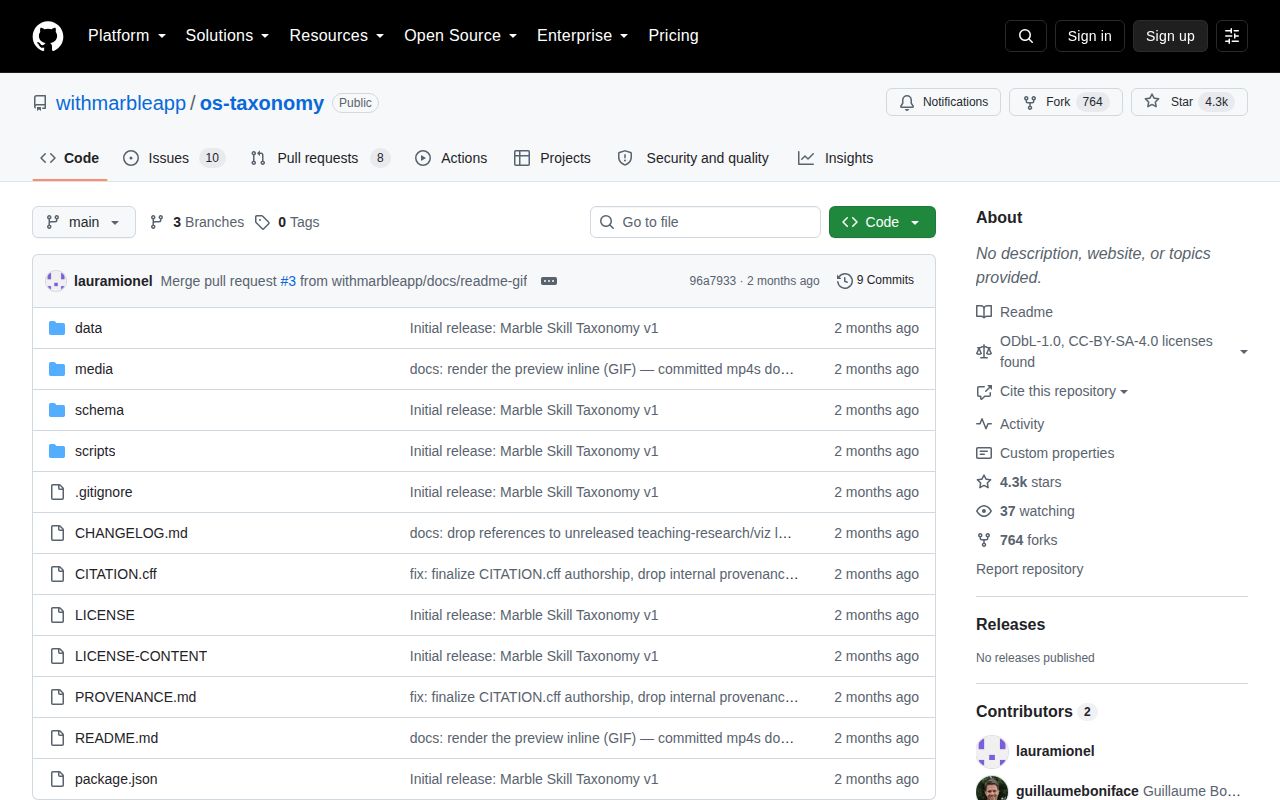
There is very little application code to understand. Our commit 96a7933 checkout contained 20 files, about 103 lines of source, and 9.2 MB of data and supporting material. The package is marked private and publishes no runtime library. You import the JSON directly or transform it into your own store. That simplicity reduces setup work, though it also means search, graph traversal, user state, and presentation all belong to the consuming product.
The 3,221 edges pass structural checks, not teaching review
The included validator checks topic IDs, allowed types, edge endpoints, standard references, declared counts, codes-only sources, and SHA-256 checksums. It catches a dangling link or modified file. It does not assess whether one concept should precede another, whether an age band is right, or whether a topic name describes its content. Although the README calls the graph acyclic, the validation script we read does not contain a cycle check.
Our repository scan found 0 CI workflow files and no tests directory. That leaves the validator as a command consumers or maintainers must choose to run. Issue 5 reports five soft edges whose prerequisite age range sits entirely above the topic it unlocks. The reporter explicitly allows that the links may be intentional. Issue 21 proposes review metadata because the current schema cannot distinguish an unreviewed edge from one checked by a person or subject expert.
What happened when we ran it
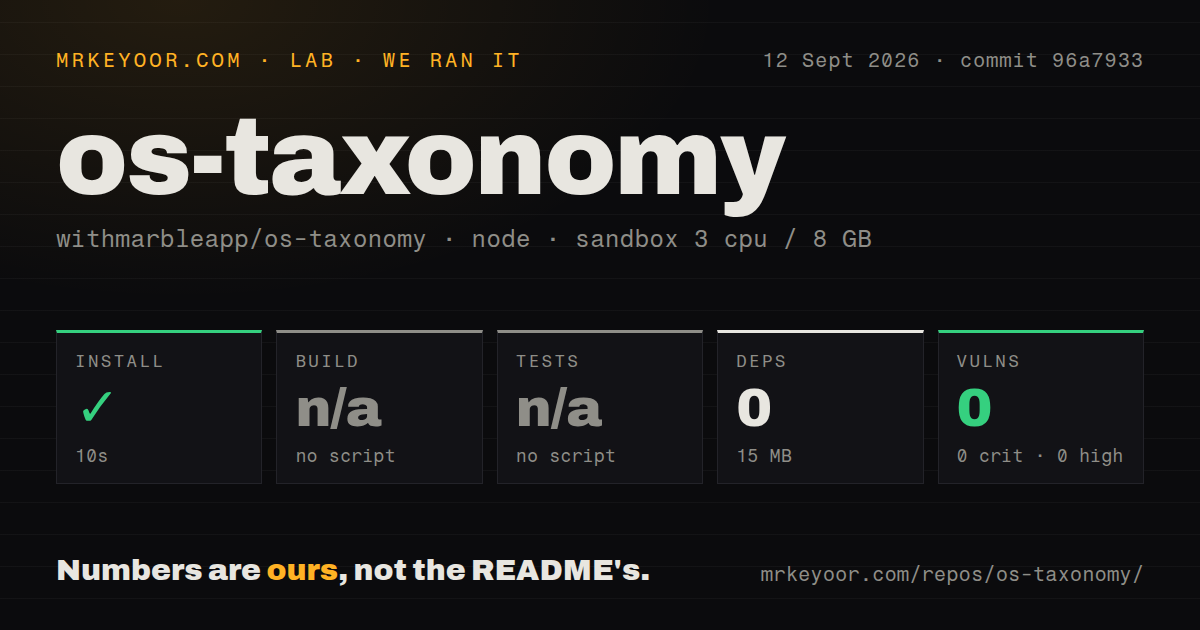
Our sandbox ran npm install successfully in 10 seconds. It added 0 packages, and disk use ended at 15 MB. Npm audit reported 0 known vulnerabilities across all severity levels. This is the rare npm repository where installation tells you almost nothing about adoption cost because there is no dependency tree, server, or generated client to maintain. The data files themselves are the product.
Build was skipped because package.json has no build script or target. Tests were also skipped because it has no test script or target. The repository does expose npm run validate, but the lab result supplied for this review does not record that command as a build or test. No Dockerfile is present. A team can inspect all 20 files without container tooling, then add its own checks around the fields and curriculum slices it plans to ship.
Three license layers follow the data into your product
The database structure, IDs, and relationships use ODbL 1.0. Marble's authored names, descriptions, evidence, prompts, reasons, and summaries use CC BY-SA 4.0. A commercial product can use the graph, but a derivative database must remain open under ODbL, and adapted authored text carries the content license. The README supplies an attribution statement. Legal review still needs to match your actual transformations and redistribution model.
The 0-vulnerability npm audit says nothing about those content rights. Curriculum standards come from separate upstream frameworks. The repository ships full UK National Curriculum text under OGL v3.0 and full Common Core text under its purpose-limited public license. NGSS, C3, and IB entries are codes-only because their terms restrict redistribution. Provenance notices are part of the integration work, especially when an interface displays official text beside Marble-authored explanations.
Fourteen conflicting names need a data audit
Issue 11 identifies 14 topic records whose names appear to conflict with their descriptions, evidence, prompts, linked standards, and dependency reasons. Examples in the report include a topic named Ratio whose other fields concern operation priority, and an Understanding angles label attached to rectangle area. The issue remains open. These are user-reported findings rather than a full audit, but they are concrete enough to test before showing the affected records to learners.
Issue 22 raises a separate alignment question for mathematics at ages 9 and 10, based on the reporter's calculation. With 0 installed packages and no test target, consumers cannot rely on a conventional suite to settle either concern. Sample records across every subject and age band, verify high-impact edges with educators, and keep a local correction layer. Stable IDs help with that work as long as you record which dataset commit each correction targets.
July code and August issues show activity without releases
GitHub recorded the last repository push on July 8, 2026, the date of the tested commit. The latest issue activity was August 28, so discussion continued after the code stopped moving. The open queue contained 10 issues and 8 pull requests when checked. Several contributions propose new curricula, data fixes, or extra tooling, which suggests interest while also showing that changes had not entered the published dataset. GitHub's latest-release endpoint returned no release.
The repository still labels the taxonomy v1, while package.json and the changelog call the initial data release 1.0.0. Its 20-file size makes commit pinning straightforward even without a GitHub release artifact. We would use the dataset behind an explicit review boundary: structural validation first, educator sampling second, product tests last. If your team lacks that editorial capacity, a smaller official framework or a domain-specific competency set is safer than treating this graph as settled curriculum.