One interface can sit over local and cloud storage
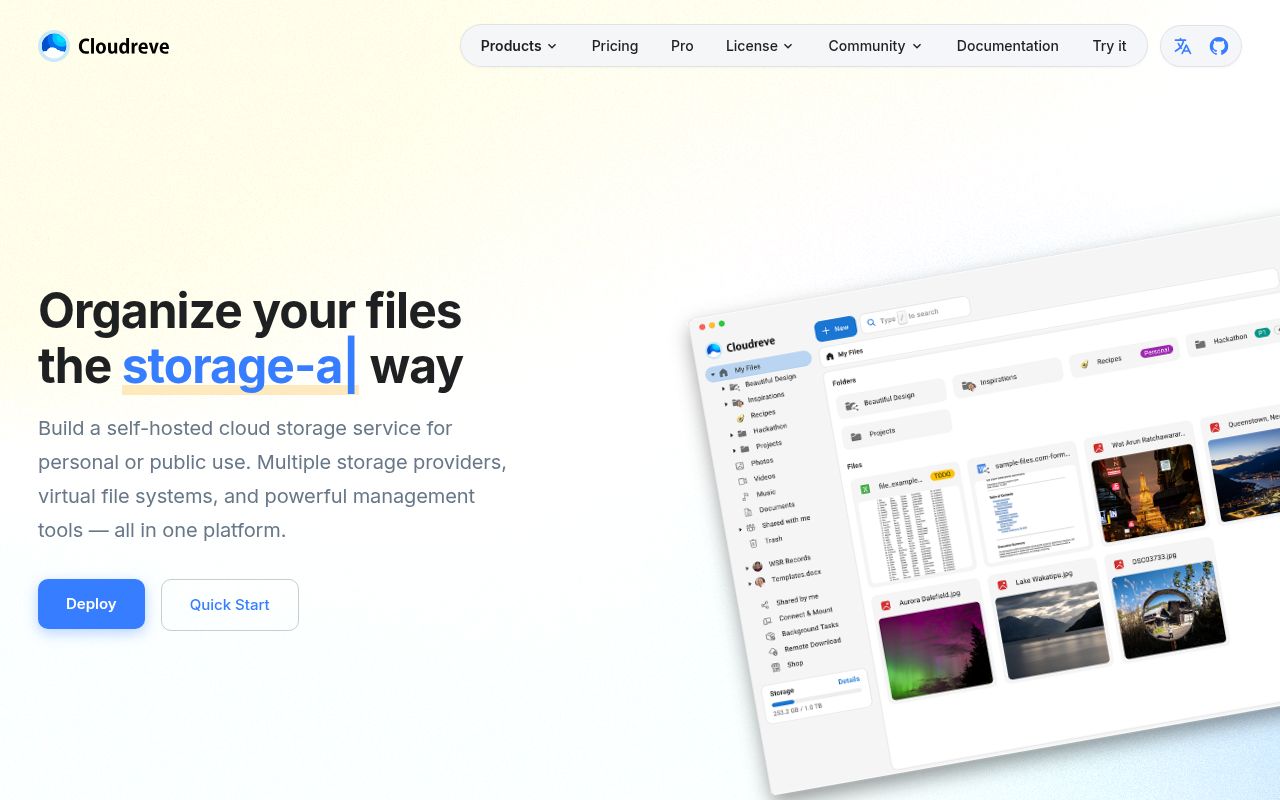
Cloudreve presents files through a browser while storage can live on the same machine, a remote node, OneDrive, an S3-compatible service, or several Chinese cloud providers. Users can upload directly to a configured provider, which can keep large file traffic away from the application server. The product also exposes WebDAV across its storage policies.
This is more than a themed directory listing. Cloudreve supports multiple users and groups, expiring share links, parallel resumable uploads, archive extraction, batch downloads, tags, and metadata search. Browser previews cover video, images, audio, EPUB, text, diagrams, Markdown, images, and Office documents through the documented integrations. Each enabled format or editor increases the amount of untrusted content the deployment must process.
Direct uploads reduce relay traffic but shift trust to storage policy
Sending uploads from the browser to the storage provider can spare the Cloudreve server from carrying every byte. It also means credentials, signed requests, CORS rules, object paths, and expiration settings become part of application security. A mistaken storage policy can expose data even when Cloudreve's own page requires a login. Test direct upload and download behavior against the exact provider, bucket settings, and proxy configuration.
The same caution applies to share links and WebDAV. Expiration dates are useful, but operators still need limits for public downloads, password rules, abuse response, and logs. WebDAV makes the library accessible to more clients while adding a long-lived authentication surface. Our 17-second build did not exercise any of those network paths.
What happened when we ran it
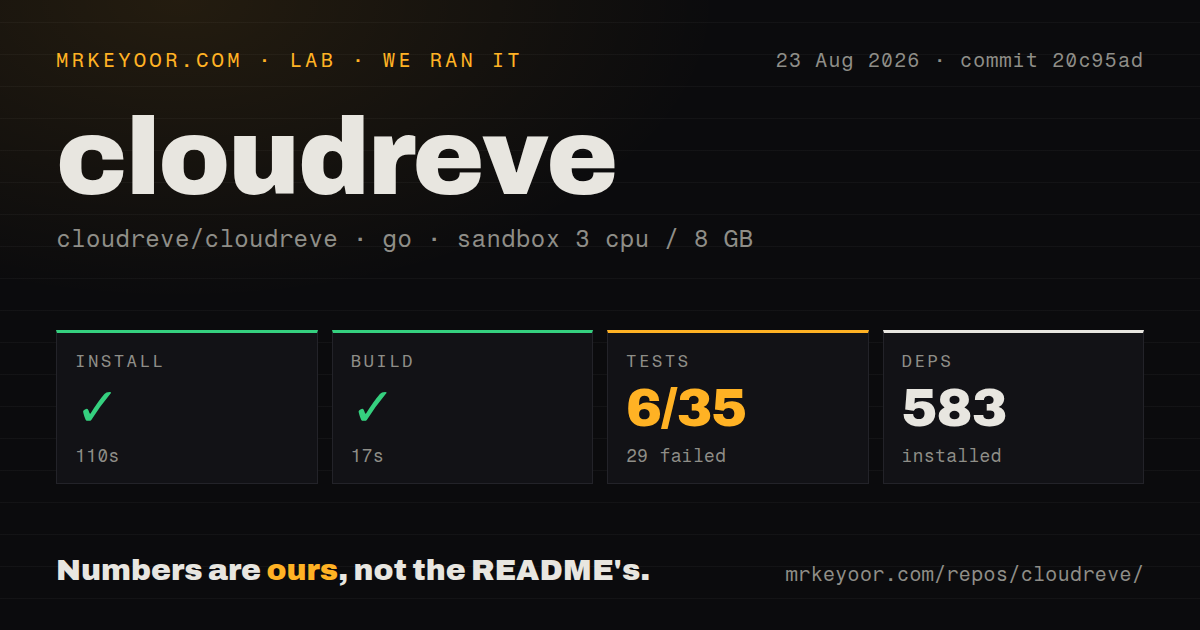
Our fresh Debian sandbox installed 583 Go packages in 110 seconds. commit 20c95ad had 1,780 files, about 263,792 lines of source, and a 17 MB checkout. The build succeeded in 17 seconds. Our scan found a Dockerfile and Compose file, no GitHub Actions workflow files, and no top-level tests directory.
The full test command ended with exit code 1 after 91 seconds. The harness counted 6 passing and 29 failing packages out of 35. In the supplied tail, pkg/request is marked as a build failure, while its ssrftest subpackage passes. Search indexing and utility packages also pass, several packages have no test files, and the overall command ends in failure.
The tail does not include the compiler messages that preceded the package summary. Calling the failure a missing library, service, or generated file would be guesswork. The safe finding is that the project compiled as a build target but did not compile or pass across the complete test command in our unprivileged Go 1.24 container. A maintainer evaluating the commit should rerun with the full log preserved.
Production means owning storage and background services
The README directs first-time users to a quick local deployment and gives production its own guide. That separation is warranted. Persistent data must survive container replacement, and every remote storage policy needs durable credentials plus a tested recovery path. A database backup without the file objects, or object storage without Cloudreve's metadata and configuration, may not restore a usable service.
Background downloads can be delegated to Aria2 or qBittorrent, with multiple nodes sharing load. Those integrations process remote URLs and write into managed storage, so isolate them, limit network access where practical, and cap disk use. Online editing and preview tools may introduce still more services. Start with file upload, download, sharing, and restore tests before enabling the convenience layer.
Community and Pro features need separate purchasing checks
Cloudreve is GPL-3.0 licensed, and its repository contains the community source. The latest release notes also identify a feature available in Pro: administrators can pin shared folders or files to a user's sidebar through group settings. That one label is enough to reject an assumption that every screenshot or release bullet belongs to the community build. Compare the needed feature list with the edition before migrating data.
Release 4.18.0 also says it fixed multiple security vulnerabilities and would disclose full details after 30 days. The note does not state their severity or affected configurations, so this review does not invent either. It does make patch tracking important for an internet-facing file service. Pinning an old container because it currently works is a poor trade when the application parses uploads and issues public links.
August activity is current despite the test failure
GitHub showed 28,609 stars, 152 open issues and pull requests, and an August 24, 2026 last push. Release 4.18.0 arrived July 15 with recycle-bin, upload, thumbnail, CAPTCHA, configuration, and security changes. The combined open count includes pull requests, while the recent push and release together show active maintenance.
Cloudreve deserves a controlled trial for people who specifically need several storage providers behind one account and sharing layer. Build success lowers the first hurdle. The 29 failing test packages raise the bar for source-based deployment, particularly because the visible tail does not explain most failures. Use a throwaway instance, connect one provider, verify upload and restore, then add users and optional workers only after that path is repeatable.