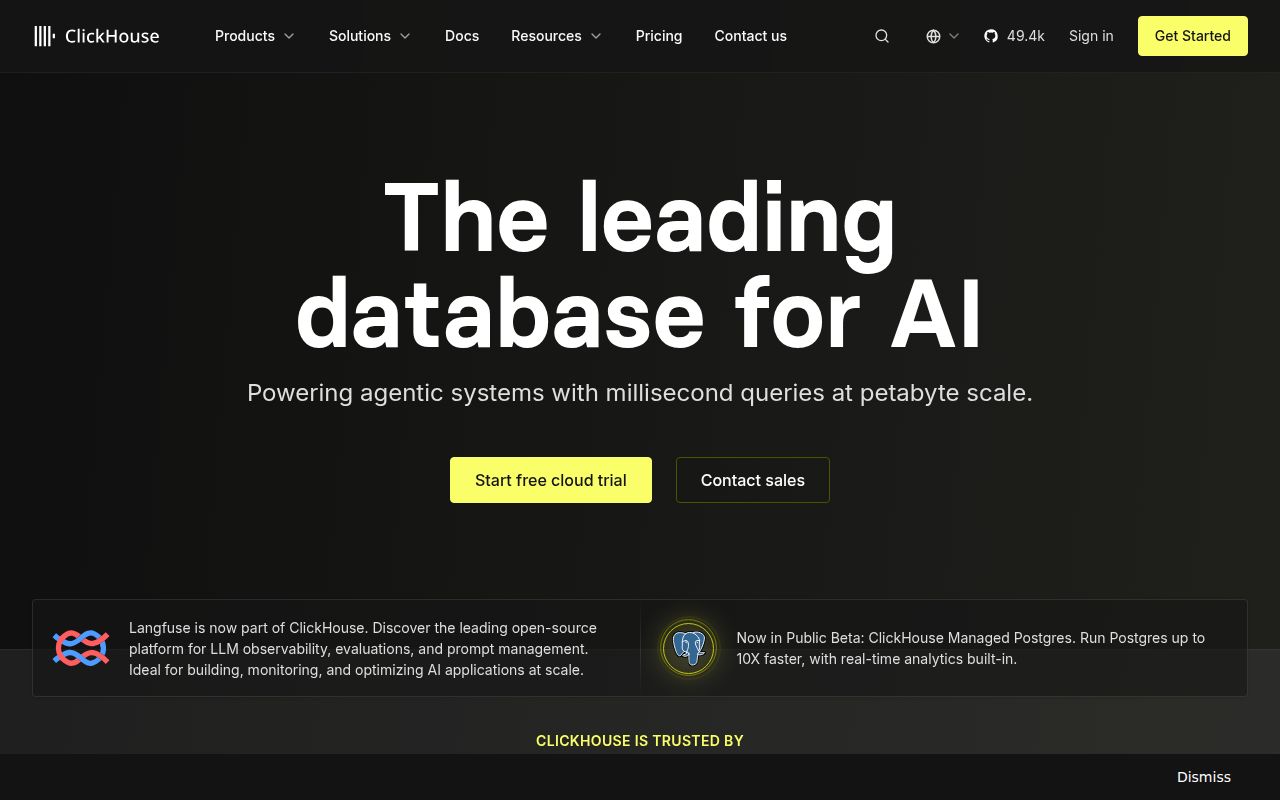
The Speed Demon of Data Analytics
When your data grows from a manageable spreadsheet to a firehose of events, your trusty PostgreSQL or MySQL server starts to buckle under the pressure of analytical queries. Simple questions like "How many users from Germany signed up last month?" can bring a traditional database to its knees. This is the exact problem ClickHouse was built to solve. It's not a general-purpose database; it's a specialized, open-source, column-oriented database management system designed to generate analytical reports from massive datasets in something approaching real-time. Think of it less as a family sedan and more as a Formula 1 car: purpose-built for speed, incredibly powerful, and requiring a skilled driver.
Blistering Speed Backed by a Thriving Ecosystem
ClickHouse's primary strength, and its entire reason for existing, is performance. By storing data in columns instead of rows, it can scan and aggregate only the data needed for a query with incredible efficiency. While the README doesn't provide benchmarks, its central claim of enabling "analytical data reports in real-time" is the foundation of its reputation. This architecture is a real step up for use cases like web analytics, observability, and business intelligence, where queries often involve aggregating a few columns across billions of rows.
What's almost as impressive as its performance is the ecosystem the maintainers have built around it. This is not a project you have to figure out on your own by digging through source code. The README is a portal to a wealth of resources. There's official documentation, a step-by-step tutorial, a YouTube channel, and even "ClickHouse Theater" for presentations. This level of investment in educational material signals a mature project with a strong commitment to user adoption.
Furthermore, getting a taste of this power is shockingly simple. The curl https://clickhouse.com/ | sh command is a testament to a developer-friendly onboarding experience. You can go from zero to a running ClickHouse instance in minutes, a far cry from the complex setup procedures of many other distributed data systems. Of course, a production cluster is more involved, but this low barrier to entry is a significant advantage for experimentation and development.
The Community is Global and Hyper-Active
Perhaps the most compelling evidence of ClickHouse's health and long-term viability is its community. The README lists an almost overwhelming schedule of meetups happening across the globe, from San Francisco and Seattle to Bangkok, Berlin, and Cape Town. This isn't just an online phenomenon; it's a physical, global movement of developers and data engineers. This extensive event list, combined with active Slack and Telegram channels, means you're never truly alone. Whether you need to troubleshoot a query, discuss architecture, or find experienced engineers, the community is a massive asset.
The project's development is also transparent and predictable, with monthly release calls broadcast on YouTube. This regular cadence, including special events like a "10 Year Anniversary" call, demonstrates a project that is not only mature but also continuously evolving in the open. The commercial entity behind ClickHouse is actively hiring, which further solidifies its position as a well-supported and growing platform, not a project at risk of abandonment.
The Price of Performance: Complexity and a Mountain of Issues
ClickHouse is not without its sharp edges. Its specialization is also its main limitation. It is an Online Analytical Processing (OLAP) database, not an Online Transaction Processing (OLTP) one. You would not run your e-commerce store's shopping cart on ClickHouse. It's designed for bulk inserts and fast, complex reads, not for frequent, small updates or single-row lookups. Using it for the wrong job will lead to frustration and poor performance.
The biggest potential red flag for a prospective user is the number of open issues: over 6,600. This is an enormous number. While it can be interpreted partly as a sign of a massive and engaged user base reporting every minor bug and feature request, it also points to the inherent complexity of the system. It suggests that you may encounter edge cases, and that the core team is stretched thin trying to keep up. For teams without deep database expertise or a budget for the commercial ClickHouse Cloud offering, navigating this complexity could be a significant operational burden. The existence of a managed cloud service itself is a hint: running a distributed, high-performance database in production is a hard problem.
Where ClickHouse Fits in Your Stack
ClickHouse is rarely a standalone solution; it's a core component of a modern data stack. It serves as the high-speed analytical engine. Data is typically fed into it from other sources. Event streams from Kafka, logs from Fluentd, or periodic dumps from a transactional database like PostgreSQL are common ingestion patterns. Once the data is in ClickHouse, it becomes the query layer for business intelligence tools like Grafana, Metabase, or Tableau, or for custom internal applications that need to surface real-time analytics to users. It excels as the "A" in a "Lambda" or "Kappa" architecture, providing the fast query capabilities that other systems lack.
In summary, ClickHouse is a beast, but a powerful one. It offers a level of analytical performance that few other open-source databases can match. The trade-off is its focused nature and operational complexity. If your core business relies on fast insights from terabytes of data, the investment in learning to tame this beast is well worth it. The incredible community and wealth of documentation ensure you have the resources to succeed. However, if your needs are simpler or transactional, stick to more traditional tools.