SQL runs beside the data instead of behind a server
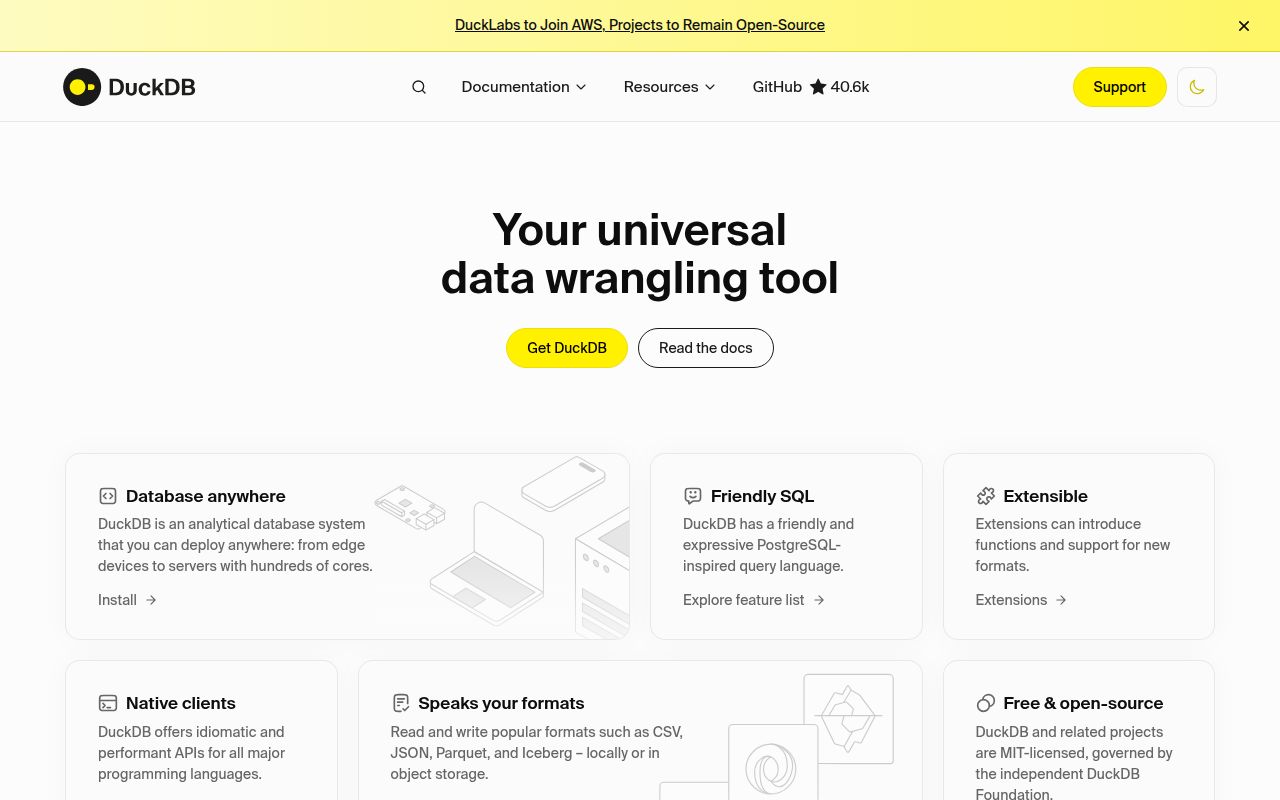
DuckDB embeds an analytical database in the process that calls it. The CLI opens it directly, and clients exist for Python, R, Java, Wasm, and other environments. A query can read a CSV or Parquet path in the FROM clause without a separate import job. That makes DuckDB well suited to notebooks, local data preparation, application analytics, and tests where installing and operating a server would add more work than the query itself.
The SQL surface goes beyond simple filters and aggregates. DuckDB documents nested and correlated subqueries, window functions, collations, arrays, structs, maps, and convenience extensions to the dialect. Python can query pandas objects, while R integrates with dplyr. The process can keep data transient or write a portable database file. None of this requires a daemon, user account, or listening port for the basic local path.
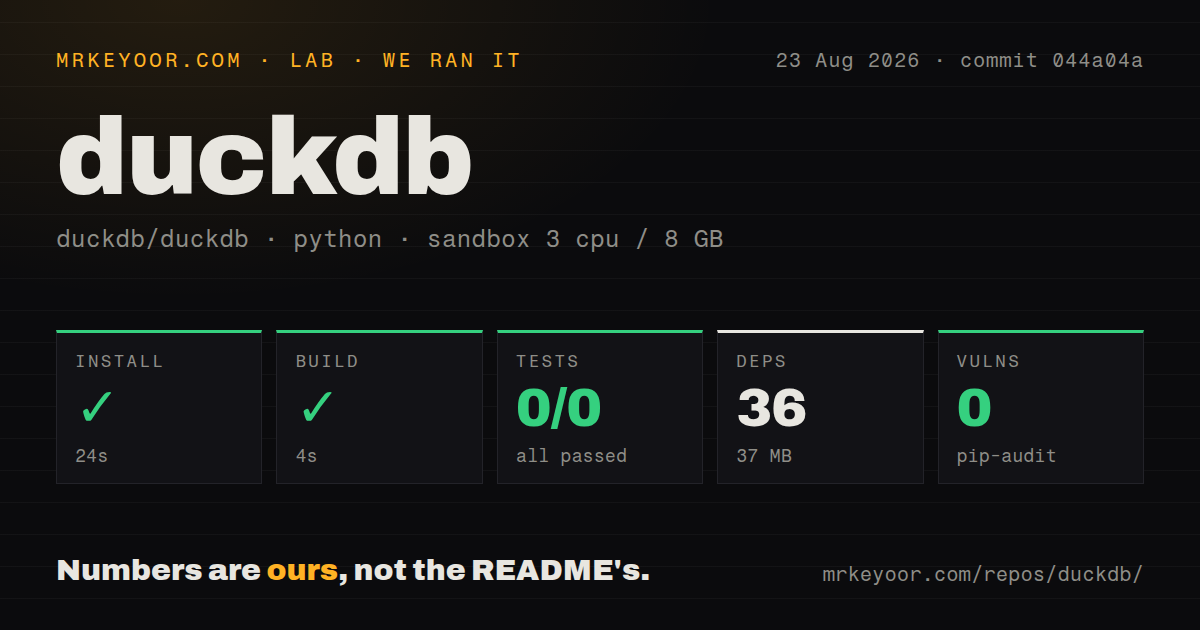
Our 24-second install covered the C API specification
The repository at commit 044a04a contained 15,242 files, about 1,214,802 lines of source, and occupied 249.2 MB. Our harness detected a Python project under api_spec/, installed 36 packages in 24 seconds, and used 37 MB for that environment. Its build completed in 4 seconds. Pip-audit reported 0 known vulnerabilities in the installed Python dependency set.
That directory is a declarative specification for DuckDB's C API. YAML modules feed a pinned generator that produces duckdb.h, the extension header, and an engine-side function table. The project README requires Python 3.12 or newer and explains how generated files are checked for drift. Our result says this generator environment installed and built. It says nothing about SQL throughput, Parquet speed, extension behavior, or compilation of the C++ database.
What happened when we ran it
Our sandbox installed the api_spec/ project in 24 seconds and built it in 4 seconds. Pytest then ended with exit code 5 after 5 seconds and printed no tests ran in 0.01s. Its count was 0 passed and 0 failed out of 0. A zero-test run is a failed test step, not a successful suite with no defects.
The checkout did contain a tests directory and 27 CI workflow files, while our scan found no Dockerfile. DuckDB's root README directs engine contributors to make unit and make allunit, which are separate from the pytest command selected for the nested Python project. We did not run those C++ targets. Any claim that commit 044a04a passed or failed the full database suite would go beyond our measurement.
One process can write, while many may read
DuckDB's concurrency model is clear. One process can open a database in read-write mode and use multiple writer threads inside that process. Several processes can open the same file in read-only mode. The documentation says automatic multi-process writes are not a primary design goal, although an application can coordinate writes itself. This differs from a server database that accepts independent remote writers and owns their coordination.
Within a single process, appends do not conflict and optimistic concurrency control handles updates. Two threads changing the same rows can still produce a conflict that the application must retry. This model fits bulk ingestion and analytical transformation far better than a transactional web backend with many small edits. DuckDB can analyze that application's exports or replicas without becoming its system of record.
Direct file queries still depend on file and server behavior
Reading Parquet and CSV by path removes a staging step, which is often the appeal. Remote access through extensions adds another boundary. Open issue 25028 reports DuckDB 1.5.5 rejecting a public JSON API whose HTTP 206 response has inconsistent range headers. The reporter's workaround is to download the file before querying it. That case is specific, but it shows that SQL syntax cannot normalize every remote server's HTTP behavior.
Extensions also change what ships in the process. DuckDB uses them for formats, cloud access, and specialist functions such as spatial queries. Release v1.5.5 contains many extension bumps alongside engine fixes. Pin the DuckDB release and extension set, record where extensions come from, and exercise the exact file formats and endpoints used in production. A query engine embedded in your application shares its upgrades and failure domain.
An active release line still needs workload-specific tests
GitHub recorded 40,686 stars, 794 open issues and pull requests, and a last push on August 26, 2026. Release v1.5.5 arrived July 22 as a bug-fix release. Its notes include out-of-bounds fixes, a temporary-memory deadlock fix, storage and Parquet corrections, extension updates, and a concurrent ALTER and INSERT crash fix. The combined open count includes pull requests, so 794 is not a bug total.
A fresh open issue for v1.5.5 supplies a query that reportedly crashes when spatial functions, a correlated subquery, LEFT JOIN, GROUP BY ALL, and null rows meet. One narrow report does not outweigh the project's maturity, but it is a reminder to keep regression queries for the SQL shapes you depend on. DuckDB is easy to try and often the right embedded analytical engine. Production confidence still comes from testing your files, extensions, concurrency pattern, and queries.