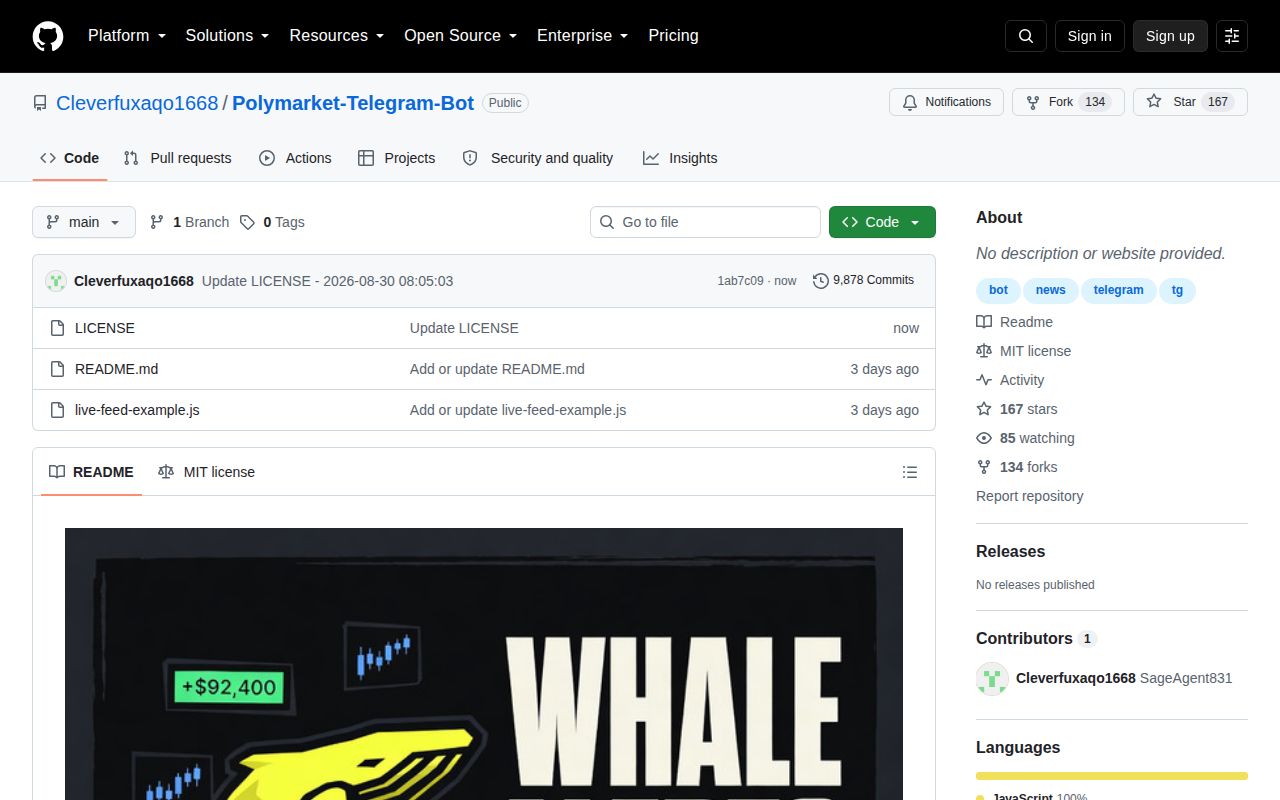
commit 8ea5e5c contains 3 files, not the advertised bot
commit 8ea5e5c contains 3 files: a 6,091-byte README, a 1,064-byte MIT license, and a 1,674-byte JavaScript example. There is no Telegram bot source, order executor, wallet implementation, database layer, test suite, package manifest, or deployment configuration. That distinction decides this review. The README describes a functioning hosted service, while the repository gives developers no way to inspect or operate the system behind it.
The README promises personal whale alerts, one-tap orders, copy trading, deposits and withdrawals, live sports, trade history, 10 interface languages, and a public channel for trades over $100,000. None of those claims is represented in the published code. The README itself labels the feed file as a small standalone example and says it does not contain the bot's business logic, filters, or Telegram integration.
What happened when we ran it
Our fresh Debian sandbox had 3 CPUs and 8 GB of RAM, but there was no supported ecosystem for the lab to execute and no Dockerfile. We therefore have no install, build, or test result for commit 8ea5e5c. This is a finding about the repository's contents, not evidence that the hosted Telegram service works or fails. The checkout simply does not supply a runnable bot for the lab to evaluate.
JavaScript appears as the primary language because the repository has one .js file. Without a package.json, lockfile, Node.js version, start command, or dependency declaration, even that example lacks a reproducible installation path. The README links to demo/live-feed-example.js, while the file in commit 8ea5e5c sits at the repository root. A reader following the documented path lands on a missing file.
The 1,674-byte demo watches buys and cannot place them
The 1,674-byte example connects to Polymarket's live WebSocket endpoint, subscribes to activity and orders_matched, parses messages, and ignores every side except BUY. It multiplies size by price and prints trades worth at least $50,000. That is useful as a compact feed sketch. It has no Telegram API call, user account, configurable filter, persistence, market-order request, signature, or error recovery beyond logging.
Connection handling is similarly narrow. The script pings every 15 seconds, terminates a connection after a missed pong, and reconnects 5 seconds after a close. Its error handler only prints the message, and there is no retry limit or shutdown hook. Those choices are acceptable in an example. They cannot support the README's stronger claims about instant signing, live account balances, sports scores, ten-language menus, or automatic copy trading.
The 3-file checkout leaves server-held keys unauditable
Across the 3-file checkout, the highest-risk feature has the least evidence. The README says each user's private key and seed phrase are encrypted and stored on the server, tied to the account, with access protected by a personal PIN. It does not identify the cipher, key derivation method, secret store, database, backup policy, operator access rules, or recovery design. The absent implementation prevents an independent review of any of them.
A PIN can control access through a bot interface, but it does not explain what protects wallet material on the server. Developers considering the hosted service would need answers about encryption keys, logging, process isolation, database access, incident response, and withdrawal authorization before depositing funds. The README moves its fuller security explanation into the bot's Terms screen. That keeps material risk information outside the 6,091-byte public document and outside version control.
The August 2026 push has no public issue or release trail
GitHub showed the repository was created on August 27, 2026 and last pushed on August 30, 2026. It had 167 stars and 134 forks when fetched, so attention arrived quickly. Health cannot be judged from those counts and a recent push alone. Issues are disabled, discussions are off, and the latest-release endpoint returned no release, leaving no public place to examine bug handling, security reports, upgrade notes, or user support.
The MIT license covers the files that are present. It does not make the missing bot source available under that license. Likewise, a zero count for issues and pull requests does not mean a clean defect record when the issue tracker itself is unavailable. The young repository may change, but the current decision must rest on commit 8ea5e5c and the 3 files a buyer can inspect today.
The 3-file gap makes official clients the safer starting point
The 3-file gap is large enough that rebuilding around public components is the practical route for developers. Polymarket's real-time data client exposes subscriptions for trade and price messages, including authenticated user streams. Its TypeScript SDK is the current official package family for API work. The Rust CLI can browse markets without a wallet and supports trading after explicit wallet setup, while warning that the software is experimental.
None of those projects gives you this README's polished Telegram flow in one step. They do give you code paths that can be reviewed, configured, and tested before money moves. Treat Polymarket-Telegram-Bot as a link to a hosted product and a tiny feed snippet. For self-hosting, security review, or wallet automation, the absent implementation should stop the evaluation.