The useful part is the diagnosis, not the install command
Claude Style Patch starts from recognizable writing failures. It calls out sentences that announce a point before making it, paragraph-opening fragments, unclear pronouns, abstract nouns where verbs would be clearer, and several compressed ideas packed together. Those are concrete editing targets. A team can discuss whether a response has an unclear antecedent; it cannot do much with a vague request to sound better.
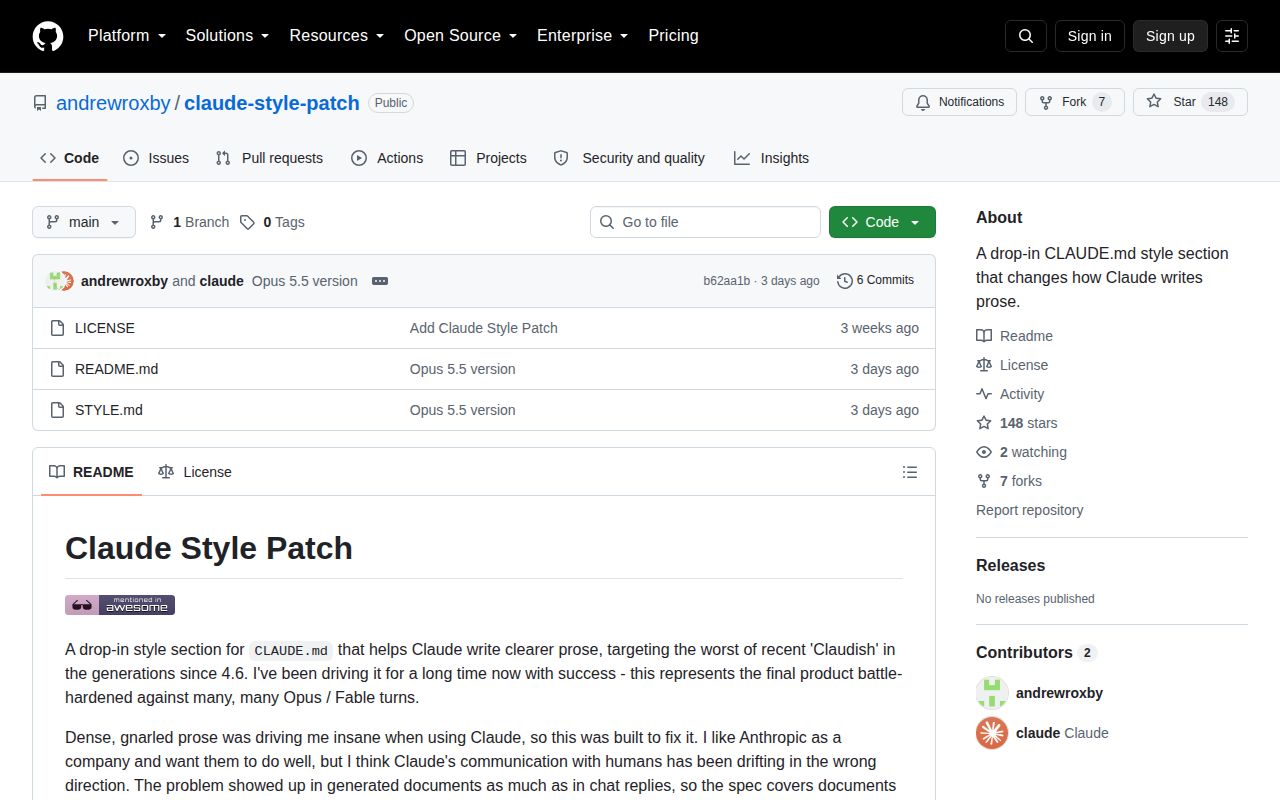
The artifact is one STYLE.md file of 9,739 bytes, plus a README and 211-byte CC0 license. The README estimates the instructions at roughly 1,500 words. That is long enough to shape a session and long enough to compete with project rules, task context, and retrieved files. Read all of it before placing it in a global config that affects every Claude Code repository.
The rules favor plain sentences and restrained structure
The guide asks Claude to use concrete nouns, active verbs, clear antecedents, and natural transitions. It discourages colon-hinged clauses, ornamental endings, repeated summaries, and metaphors left unexplained. For documents, it favors scannable headers, short bullets, and tables for direct comparison. Code comments should describe current behavior instead of recording abandoned approaches.
These choices form a real editorial taste, not a neutral quality standard. The file prefers mostly short declaratives and even recommends a numbered hierarchy for complex responses. That can help design notes and technical explanations. It may flatten a personal essay, marketing page, legal memo, or support conversation. The patch partly handles this by telling Claude to honor the target genre before applying its defaults.
What happened when we ran it
commit b62aa1b exposed no supported language ecosystem and no Dockerfile, so the lab had no install, build, or test command to execute. This is expected for a repository containing three text files. There is no binary, package manifest, hook, or test harness whose output could show that the rules improve prose.
That leaves a different verification job. Copy the file into a temporary project, choose a fixed set of real prompts, and compare blind reviews of output with and without the patch. A useful check would score clarity, factual retention, fit to genre, and editing time. The repository provides no such corpus or rubric, so claims about improved output remain the author's experience rather than a result another team can reproduce.
The append command is simple but not idempotent
The documented installation pipes raw STYLE.md into ~/.claude/CLAUDE.md with >>. It needs no account and takes one shell command. It also appends another copy every time it runs. There is no start marker, end marker, version number, duplicate check, backup, or removal command. A repeated setup can silently make the instruction stack longer and more contradictory.
A safer manual adoption is to download or open STYLE.md, select the rules your team agrees with, and place them under a named project section. Commit that project file so changes receive code review. For a global installation, add clear markers around the block and keep a source commit beside them. Updating then becomes replacing one known section rather than appending 1,500 more words.
Hard style rules can create new verbal tics
The README gives a good warning from the author's own use. An earlier rule discouraged common connectives and named 'so' as an alternative, after which Claude began opening many inferential sentences with that word. The current patch reframes its guidance as defaults applied with judgment. It also acknowledges that compliance drops in long, abstract threads and suggests reminding Claude to follow the style rules closely.
The file still contains tensions worth editing locally. It warns against dense wording while using terms such as 'nominalizations,' 'antecedents,' and 'Tractatus numbering.' It discourages colon-heavy construction but relies on detailed exceptions. There are also small copy errors, including 'antetheses' and 'its not.' None ruins the idea. They do show why copying an editorial policy should begin with an editorial pass.
Deterministic linting covers the rules that must hold
Prompt instructions can influence a first draft. They cannot certify that a final document obeys a rule, especially when the README itself says long threads degrade compliance. If your team merely prefers fewer announced points or clearer pronouns, that uncertainty may be acceptable. If documentation cannot ship with banned terms, passive constructions, or an invalid heading pattern, add a checker.
Vale is the stronger alternative for team policy because its rules can fail locally and in CI. Humanizer fits a separate rewrite step with a broader list of AI-writing habits. Claude Style Patch is most useful between those approaches: a permissively licensed source of precise editorial preferences. Start with the 4 or 5 rules that solve problems your team has actually seen, then add more only when reviewed output justifies their context cost.
September activity shows a new, lightly discussed project
The repository was created on September 8, 2026 and pushed on September 28. GitHub showed 148 stars, 7 forks, and no open issues or pull requests on October 1. Its two closed issues were automated promotion or listing notices rather than user reports. There are no GitHub releases or changelog.
That record is enough for a copyable CC0 document, but not evidence of broad model testing. The README says the current text was tuned for Opus 5.5 after earlier use with Opus 4.8 and Fable. Model behavior changes, so keep the patch in normal review like any other prompt dependency. The right unit of adoption is a rule you can defend, not a file you appended once and forgot.