Ten modules turn Claude Code features into a learning path
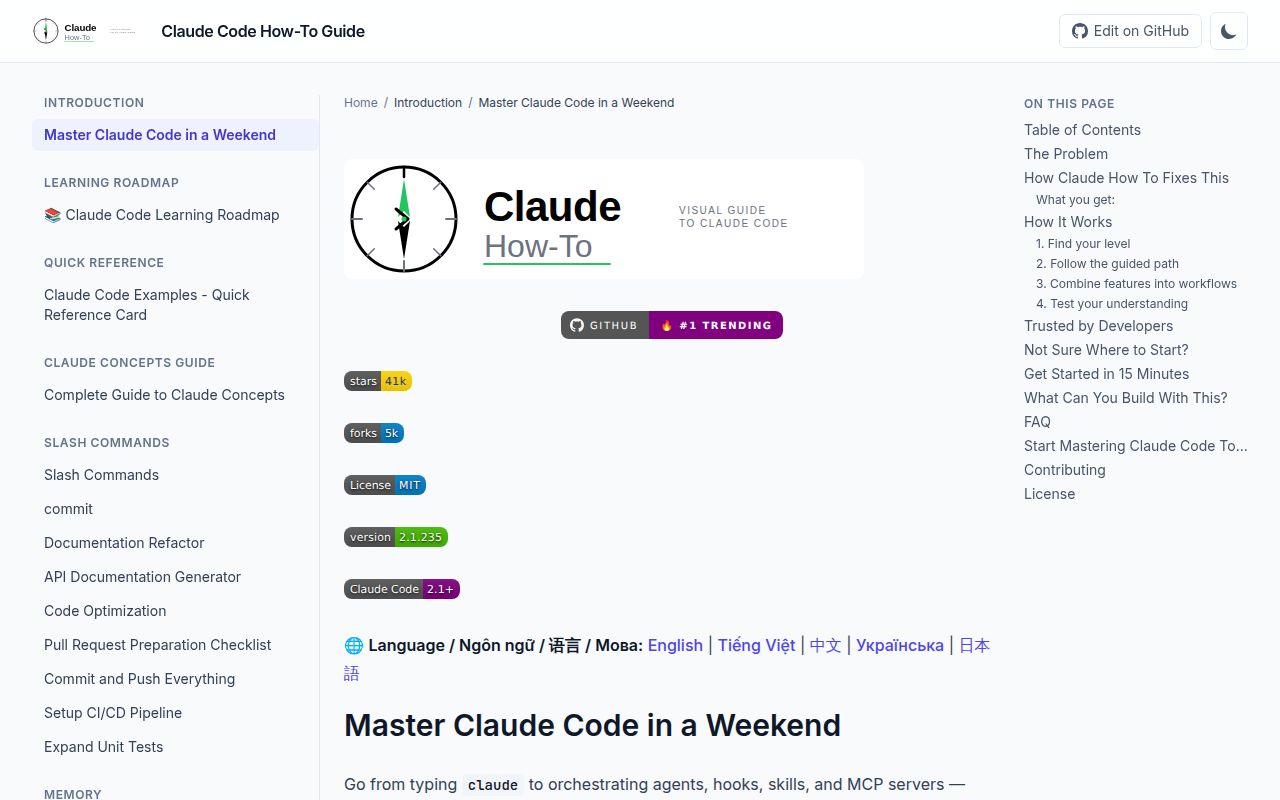
Claude How To arranges 10 modules around a sensible progression: commands and memory first, then checkpoints, CLI use, skills, hooks, MCP, subagents, advanced features, and plugins. The distinction matters because Anthropic's official material is organized as a reference. This repository behaves more like a course. Its roadmap includes a self-assessment, suggested entry points, time estimates, exercises, and checks for understanding. A developer who keeps opening documentation tabs without building a mental model will get more from this order than from another feature index.
The repository is mostly English, with Vietnamese, Chinese, Ukrainian, and Japanese editions linked from the front page. It also contains Mermaid diagrams and an EPUB builder for offline reading. The README estimates 11 to 13 hours for the complete path, while its shortest introduction starts with copying one command and a CLAUDE.md template. Those estimates come from the project, rather than our lab, so treat them as curriculum guidance. The useful promise is the sequence and the examples, not a guaranteed weekend transformation.
The 665 files are useful raw material, not a turnkey product
Our measured checkout contained 665 files, roughly 12,165 lines of source, and occupied 15.5 MB before installation. Inside are sample slash commands, several CLAUDE.md files, skill folders, subagent prompts, MCP JSON, hook scripts, and three example plugin bundles. That range makes the repository good material for a team workshop. Pick one behavior, read the explanation, copy the nearest example into a disposable project, and inspect what it can read or execute before keeping it.
Copying every folder would be a poor adoption strategy. A pre-tool hook can block or permit actions, an MCP configuration can expose external systems, and deployment examples include scripts for deploy, rollback, and health checks. The guide itself tells readers not to hardcode credentials and to test configurations locally. Follow that advice literally. A template is evidence of a file shape and an intended workflow. It has no knowledge of your repository permissions, release process, secret store, or failure policy.
What happened when we ran it
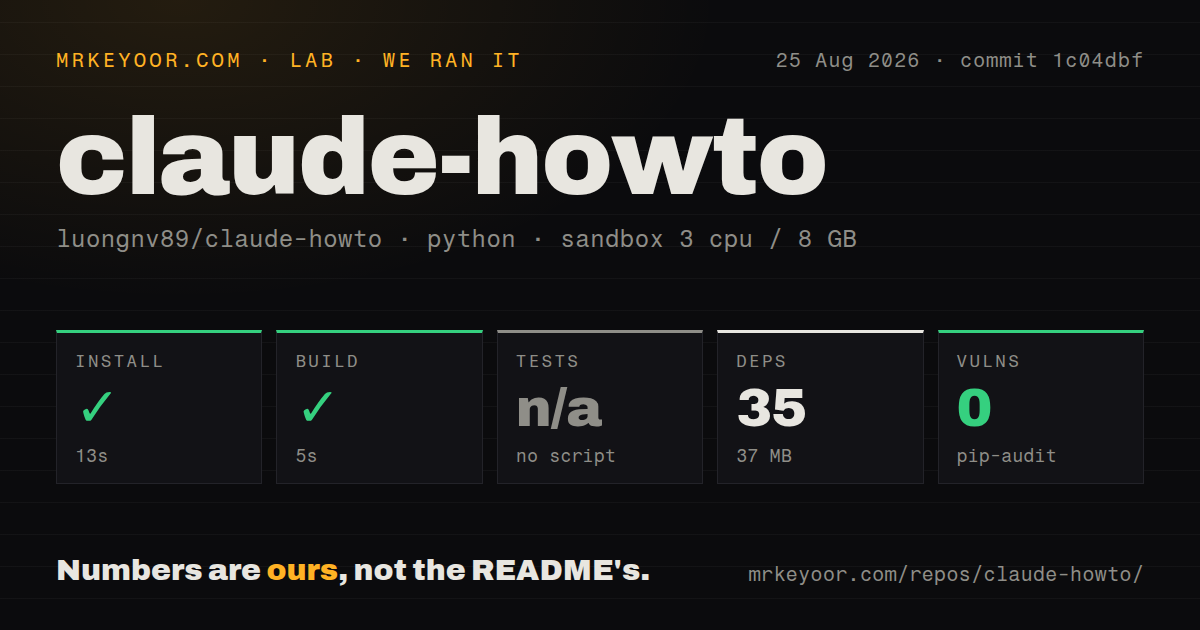
Our sandbox installed Claude How To at commit 1c04dbf in 13 seconds, adding 35 packages and consuming 37 MB on disk. The build succeeded in 5 seconds. This was a fresh unprivileged Debian container with 3 CPUs and 8 GB of RAM, so the result shows that the repository's Python tooling is cheap to set up on an ordinary development box. Pip-audit reported 0 known vulnerabilities in the installed environment.
Tests were skipped because our runner found no test script or target. The measured signals also found 4 CI workflow files, no Dockerfile, and no tests directory through its standard detector. There is an important wrinkle: the README has a testing section that points humans to pytest commands under scripts/tests/. That means the project documents tests, while the generic project entry point did not expose them to our harness. We cannot claim a passing suite from this run, and adopters should run the documented checks explicitly when changing the Python builders.
One open issue shows why settings need a second source
Open issue 176 reports 2 concrete errors in the skills lesson. It says the guide reverses personal and project skill precedence, then describes skillOverrides as controlling which copy wins even though the setting controls visibility. The report links the official skills documentation, names the affected English and translated files, and explains how an earlier accuracy pass introduced the regression. For a tutorial whose examples can alter developer-wide behavior, this is a material problem rather than a spelling mistake.
The same issue history also shows people checking the material carefully. A related quiz report was challenged because the quiz had preserved the right order while the lesson was wrong. Recent closed work includes fixes for memory and checkpoint quiz conflicts, plus a sync to Claude Code v2.1.245 on August 26, 2026. The lesson is straightforward: use Claude How To to understand how pieces connect, then verify any precedence rule, permission mode, hook event, or settings key against Anthropic before rollout.
August maintenance is active even though release tags lag
GitHub recorded a push on August 26, 2026, and the repository had 41,199 stars plus 29 open issues and pull requests when fetched. We counted 15 open issues and 14 open pull requests in that combined total. A same-day merged pull request synced the documentation to Claude Code v2.1.245, while several August reports dealt with accuracy across lessons and quizzes. That is current maintenance and current scrutiny. The star count alone would say much less.
The latest GitHub Release endpoint told a different story: v2.1.160 was published on June 2, while the README labeled itself v2.1.245 on August 25. A stale release tag does not make the guide abandoned because commits and issue work continued after it. It does make Releases a weak way to choose a snapshot. Pin a commit if your team teaches from the material, and review upstream changes before refreshing a shared internal copy.
Choose the course for orientation and verify the copied configuration
The 10-module path is the reason to use Claude How To. Beginners get an order, intermediate users get concrete files, and team leads get examples they can discuss instead of inventing every convention from scratch. The templates cover enough of Claude Code to expose how memory, commands, skills, agents, hooks, plugins, and MCP interact. That makes the repository a better teaching aid than a random collection of tips.
Its weak point follows from the same breadth: Claude Code moves faster than a multi-language guide can be checked line by line. Our 13-second install and 5-second build make local inspection easy, but the skipped test step provides no assurance about the prose or copied settings. Adopt a small section at a time, keep permissions narrow, and place official documentation beside any lesson that controls credentials, command execution, or configuration precedence.