Chatbox puts several model providers behind one desktop history
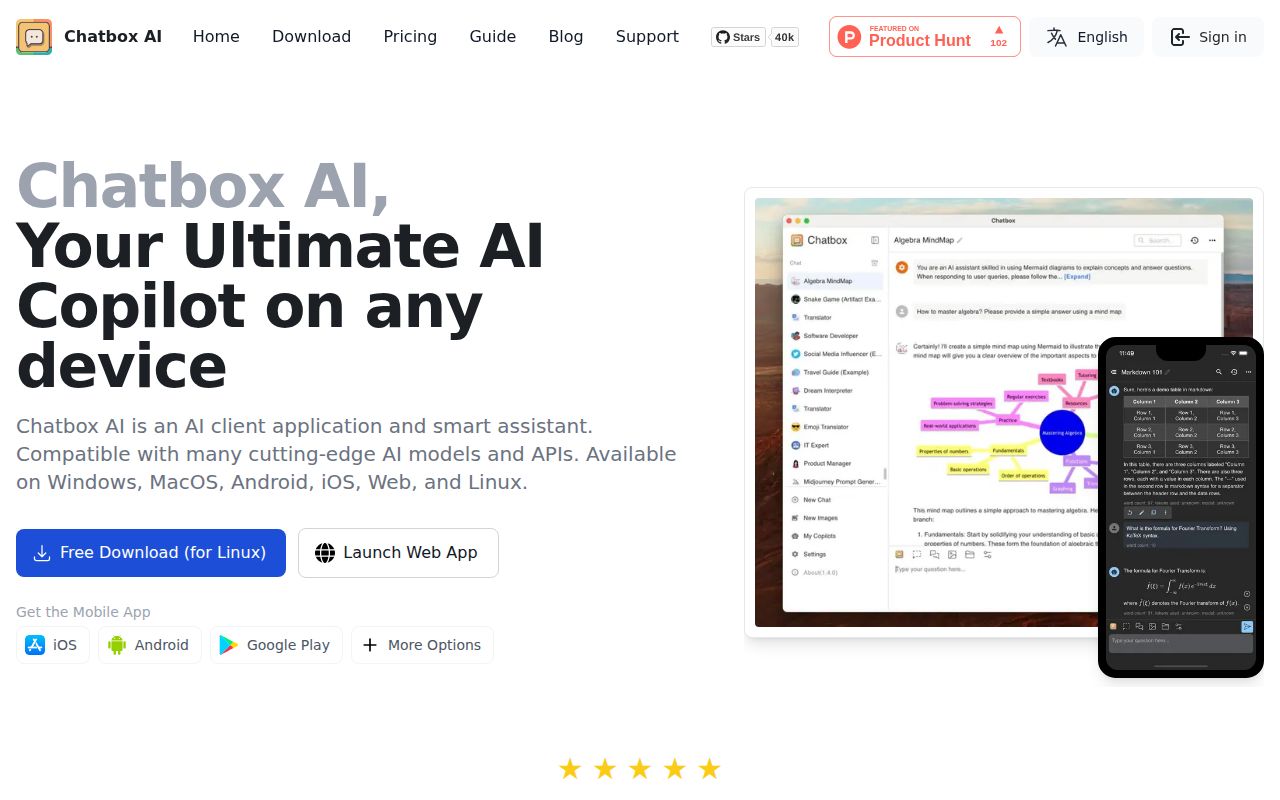
Chatbox is a client, not a model. It gives Windows, macOS, Linux, web, iOS, and Android users one interface for OpenAI, Azure OpenAI, Anthropic, Google, Ollama, and other configured services. Conversations are stored on the device, replies stream into the interface, and the renderer handles Markdown, syntax-highlighted code, LaTeX, and generated images. A prompt library and message quoting make repeated work less awkward than switching among several provider websites.
The English README links a Simplified Chinese version, and the application lists 9 interface languages. Desktop minimums are Windows 10, macOS 11, or an AppImage-compatible Linux distribution based around Ubuntu 20.04 or newer. Release v1.22.3 arrived on August 9, 2026, while the latest repository push was August 14. Issues were still being updated through August 25, so the older push date does not by itself indicate an abandoned project.
Local history does not make remote models local
The README says application data remains on the device. That is useful for conversation organization and reduces dependence on a vendor-hosted chat-history page. It does not keep a prompt offline when the chosen provider is OpenAI, Anthropic, Google, Azure, or another hosted API. The request must reach that service to get an answer. Users should evaluate each provider's retention, training, region, account, and billing terms separately from Chatbox's local storage claim.
Ollama changes that boundary by serving models on hardware the user controls. It also adds operating requirements: the Ollama service and a suitable model must already be installed, reachable, and sized for the machine. Chatbox provides the conversation interface; it does not make a large local model fit into limited memory. Teams handling sensitive data should test network behavior, disable unused providers, and control where API keys and exported conversations are stored.
Community Edition and pro synchronization need watching
This repository is the GPLv3 Community Edition. The README says code is regularly synchronized from the pro repository to this one and vice versa. That statement is more transparent than pretending the editions are unrelated, but it creates questions buyers should answer: which features live here, what account or service terms apply elsewhere, how quickly fixes arrive in each direction, and whether a workflow depends on a commercial component.
GitHub showed 1,256 open issues and pull requests together, not 1,256 verified defects. Recent reports covered multi-monitor fullscreen behavior, image uploads to a DeepSeek model, a missing delete button, LaTeX rendering, and work-mode persistence. A request asked for remote HTTP servers in the MCP registry, while another pull request preserved empty MCP environment variables. Those specifics show a wide desktop and provider compatibility surface where regressions can be narrow, platform-specific, and visible to end users.
What happened when we ran it
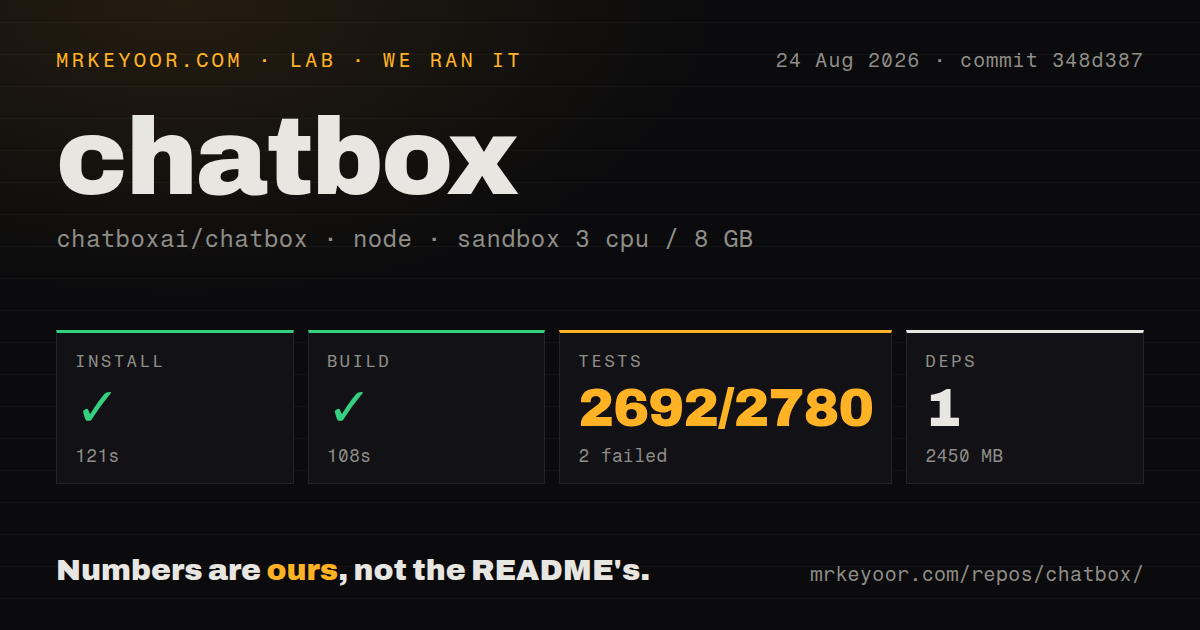
Our sandbox cloned commit '348d387' into a 25.3 MB checkout with 1,413 files and about 215,224 source lines. On Node 22, pnpm installation succeeded in 121 seconds. The harness counted 1 installed package, while the completed workspace occupied 2,450 MB on disk. The production build succeeded in 108 seconds. That is a large source dependency footprint for a desktop client, even though end users normally download a packaged installer instead.
The test command ran for 83 seconds and exited 1. Vitest reported 2,780 tests: 2,692 passed, 2 failed, and 86 were skipped. The shown failure came from the context-management integration suite. A fallback path was expected to return 3 messages after tool cleanup, but 'toHaveLength(3)' failed. The supplied tail does not show the actual returned count or identify the second failure, so we cannot describe either one more precisely.
Our scanner found a tests directory, pnpm monorepo workspaces, no Dockerfile, and 0 CI workflow files. The lack of detected GitHub workflow files means we found no repository-local CI signal in that standard location; it does not prove maintainers run no external automation. For contributors, 2 failures among 2,780 tests are close enough to make the failures worth investigating, not close enough to call the suite passing.
Desktop convenience brings platform maintenance
The development guide supports Node 20 through 22 and pnpm 10 or later. Commands separate development, production building, current-platform packaging, all-platform packaging, linting, and Vitest. Electron code is split among the main process, renderer, preload layer, and shared utilities. A UI change must work across light and dark themes, while native packaging needs testing on each operating system the release claims to support.
That burden explains why desktop clients can feel polished on one platform and stumble on another. A same-week issue reported fullscreen covering the Windows taskbar on a dual-monitor setup. Provider compatibility changes independently: an API can add a model or image input shape without the client understanding it. Pin a client version for managed fleets, test automatic updates, and keep a provider's official interface available as a fallback during compatibility gaps.
Choose Chatbox for personal multi-provider use
Open WebUI is the better comparison for a central server shared through browsers. LobeChat also favors a web workspace and self-hosting. Cherry Studio competes more directly as a multi-provider desktop application. Chatbox stands out when one person wants downloadable clients, local conversation storage, model choice, and familiar rendering without operating a shared service.
The decision hinges on where control belongs. An individual can configure keys, select Ollama for local work, and accept client updates. A company usually wants central provider policy, identity, audit, retention, and credential handling, which a distributed desktop setup makes harder. Our 108-second successful build and 2,692 passing tests support a serious trial, while the 2 context failures and active platform reports argue for testing the exact operating system and provider workflow before rollout.