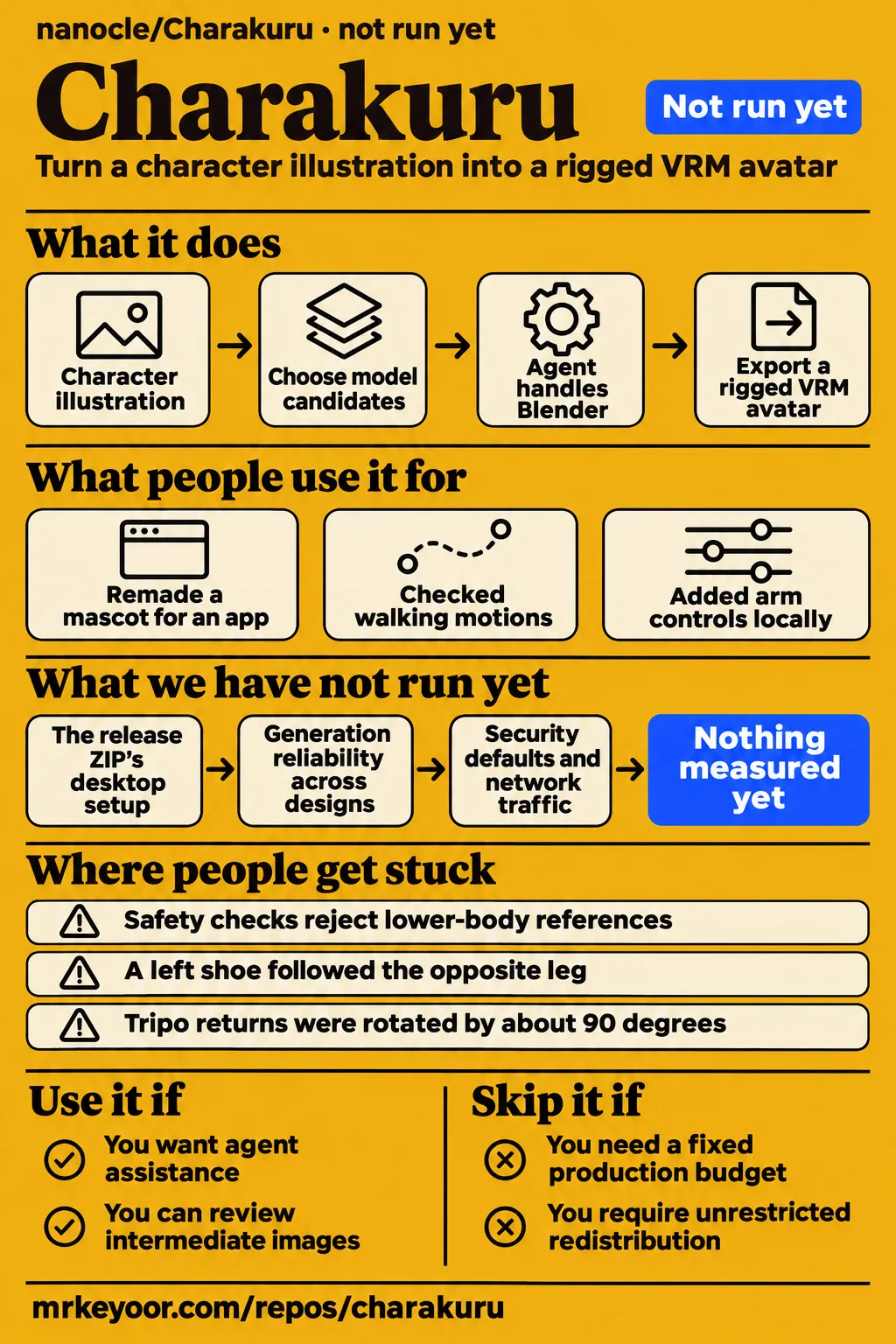
Charakuru has produced moving VRM characters in creator reports, including a chess-app mascot that needed four correction rounds before its first export. Try it if you want to turn an existing illustration into an avatar and can judge the results at each checkpoint. Skip it if you need a fixed production budget or an avatar ready for streaming immediately. Our sandbox never reached avatar creation.
What people use Charakuru for
Creators use Charakuru to turn their own character art into models they can pose, inspect and continue editing. The useful part is the division of work: you choose the appearance, while an agent handles operations in Tripo and Blender. These accounts show what that arrangement has achieved:
| Creator and task | Reported result | What matters for your decision |
|---|---|---|
| dttr_2000 remade Sora for a 3D chess app | Exported a first VRM after four rounds of clothing and deformation corrections, then worked on expressions. | A working body still left facial work and application binding. |
| AIこぐま built Neon Hoshiumi | Prepared images, generated the model, adjusted proportions and checked walking and other motions. | The creator also corrected the arms and face-to-neck connection. |
| AIこぐま added arm controls locally | Width and height sliders moved the mesh and bones together and survived saving and reloading. | Those sliders were a private modification, not a standard distribution feature. |
| Nano created Haro Win | Tripo's sponsored page presents a rotatable VRM with humanoid rigging and hair and outfit physics. | The example's expression slots are empty. |
Sora is the most instructive account. The character wears a blazer over a vest and skirt, and walking exposed interactions that a still image concealed. Fixing skirt clipping led to a vest hem following the legs. Another adjustment made the skirt interfere with the vest. The creator kept pointing out visible problems until the fourth round produced movement they considered practical. That is a credible reason to try Charakuru, provided you expect to participate.
The Sora and Neon articles are AI-translated accounts. Neon's article also promotes Tripo referral benefits, while Haro Win appears on the sponsor's own site. Their details are useful evidence of particular workflows. Read them with those incentives and translation boundaries in mind.
What happened when we ran it
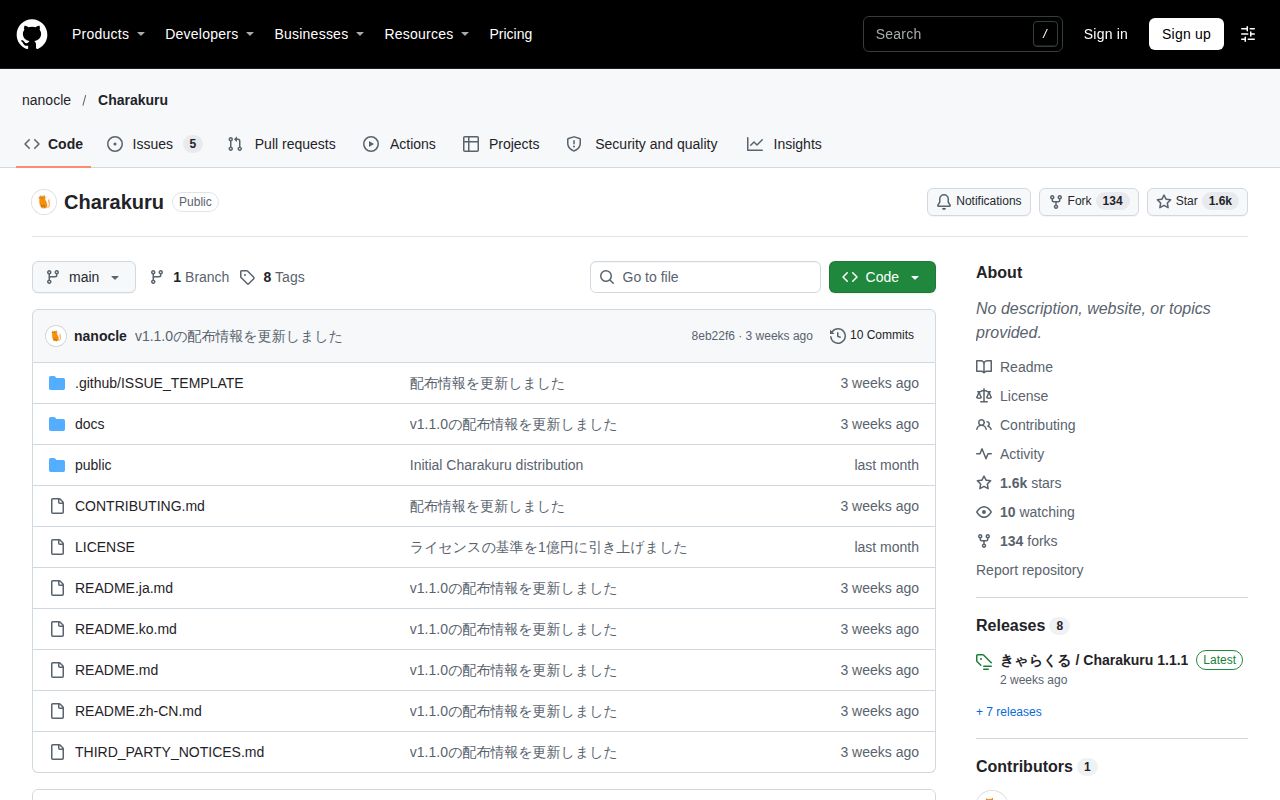
Our November 13 sandbox did not run Charakuru at commit 8eb22f6: the harness detected no supported ecosystem, recorded language as null, and found no Dockerfile. The configured resources were 3 CPUs and 8 GB RAM. Those are sandbox settings, not a measured hardware requirement for making an avatar.
| Recorded attempt | Outcome | What it tells you |
|---|---|---|
| November 13 repository harness | Not run: no supported ecosystem, language null, no Dockerfile. | No install, build or test result was produced. |
| November 14 hands-on safety step | FAILED: none of compose.yaml, compose.yml, docker-compose.yaml or docker-compose.yml existed. | The lab's rule required a Compose file and stopped the attempt. |
| November 14 teardown | Teardown: ok. | Cleanup completed after the blocked attempt. |
The November 14 run summary says the project was deployed with its own Docker Compose and ports bound to 127.0.0.1. That summary conflicts with the explicit failed safety step. We treat this as a blocked attempt, with no successful deployment demonstrated by the supplied records. There is no avatar task or answer-quality result to report.
The README explains an important mismatch: GitHub's automatic source archive contains documentation rather than the runnable kit. Users are told to download the dedicated release ZIP. Our checkout-based harness therefore cannot settle whether the documented desktop workflow works. Its refusal is a finding about this evaluation path, not proof of a broken product. The image is recorded as n/a, and actual runtime versions require raw toolchain logs.
Where people get stuck: handoffs, clothing and facial work
The issue tracker describes failures at specific handoffs, so match your symptom to the reported stage before accepting a general update recommendation. A closed issue can mean a procedural change, an upstream merge or a proposed future improvement. The distinction matters when your paid generation work is already underway.
| Symptom and report | Response in the record | Resolution status |
|---|---|---|
| Issue #13: clothed lower-body references rejected | v1.0.4 grouped clothing, legs and shoes into a complete lower-body reference. | Later comments report refusals in v1.0.4 and v1.1.0, including HTTP 400 and moderation_blocked. |
| Issue #16: Smart UV returns exceed restore_uv tolerance | A reporter retested the official v1.0.5 function with the same upper-clothing return and a synthetic checker material. | Geometry, face and UV checks passed; the synthetic full-function diagnostic also passed. |
| Issue #19: returned models face the wrong direction | Nano changed v1.1.1 instructions to enter Y=90° at upload and inspect orientation. | Maintainer-reported procedural remedy. |
| Issue #10: a shoe follows the opposite leg; sleeves appear to lack sway | v1.0.4 added separated-foot reference instructions and improved SpringBone registration, persistence and exported-motion checks. | Maintainer-reported improvements, with the reported shoe's outcome left unresolved. |
| Issue #1: Computer Use cannot identify the local browser URL | The reporter continued image work through dedicated scripts. | Workflow workaround; the browser errors themselves persisted. |
| Issue #8: windows sandbox failed | Nano reproduced a Codex sandbox-preparation failure and later linked an upstream merged fix. | Upstream merge, without a successful Windows-app retest in the extract. |
Issue #16 deserves careful reading. The original report used diagnostics to predict a distance-gate failure before running the complete assembly. Later comments include real calls to the unmodified restoration function, followed by the v1.0.5 retest. That progression supports a specific improvement in UV restoration. It does not turn a checker-material diagnostic into a finished textured avatar.
For a visible clothing problem, describe the pose and point to the affected area. Sora's creator used arrows on images to communicate defects the agent missed. Keep a record of custom changes too: that account describes repairs outside the standard kit, including mesh handling and bone placement. An attractive final clip can hide how much intervention produced it.
Repeated generation makes the credit estimate slippery
Nano relays approximately 800 Tripo credits per character in issue #12, explicitly as another user's estimate rather than a spending cap. The kit's download price therefore tells you little about the budget for a finished character. Your agent and image-generation usage are separate from Tripo's credits.
The Sora author reported 180 Tripo credits, with candidate generation covered by a trial quota. That makes the result unsuitable as a normal per-character allowance. Put the trial next to the number whenever you use it. Issue #12 also records a request for clearer plan and credit guidance, closed with documentation work still outstanding in the maintainer's reply.
For several characters, I would budget by stage and record retries rather than multiply a promotional example by the batch size. Keep candidate generation, texturing and rigging costs distinct, and record whether credits came from an introductory offer. This is an accounting recommendation, not a cost model measured on our machines. It helps you find out whether a second attempt consumed more because of your character's design or because you repeated an entire stage.
Security and rights: local work still uses outside accounts
The README says Charakuru's app runs locally while image generation and Tripo use your own accounts. Local operation therefore includes external service access. The documented workflow gives the agent browser control and access to Blender, so use artwork you have permission to process and pay attention to the accounts active in that browser.
Issue #8's temporary suggestion was an unelevated Windows sandbox, which the maintainer described as less isolated. I would not treat weaker isolation as an ordinary setup requirement. Keep that workaround attached to its specific error and follow the upstream application's current guidance rather than changing permissions because an unrelated workflow step failed.
The kit is source-available under restrictions. The README requires advance contact before redistribution or integration that provides kit code to users. A separate written agreement is required for business use when annual revenue or cumulative funding reaches ¥100 million. Read those conditions before putting Charakuru inside a commercial service. Permission to modify your private copy and permission to redistribute that copy are different decisions.
English documentation exists, but older tutorials need dating
Charakuru has English documentation and supports English, Japanese, Korean and Simplified Chinese in its interface and standard requests. Nano is a Japanese developer, and many detailed issue discussions and creator accounts in this research are Japanese. An English reader can start with the tutorial, then use the issue's version and stage to locate relevant discussion.
The current tutorial says copied requests and agent reports follow the selected language. ArtRealmAI's earlier write-up describes Japanese requests even with an English interface, which reflects an older state. Set the language before copying a fresh request. Old Windows requests also used start, while updated requests use begin to avoid the documented blocked-by-policy problem.
Version labels need the same care. The live release endpoint returned v1.1.1, published November 2, 2026, while the README's download example still names v1.1.0. The repository's last push was also November 2. The issue responses and release describe continuing work, rather than evidence of abandonment. Neither that activity nor GitHub attention measures how reliably your particular character will finish.
Charakuru vs VRoid Studio and direct Blender editing
Choose Charakuru when adapting your illustration through repeated visual review appeals to you; the creator accounts support a workflow comparison rather than a measured quality winner. The alternatives below come from those accounts, so the recommendation follows the kind of control you need.
| Route | Evidence in the creator accounts | Pick it when |
|---|---|---|
| Charakuru | Sora and Neon reached exported VRMs through generation, review and corrections. | You want agent assistance and can approve the appearance throughout. |
| VRoid Studio | dttr_2000's earlier handmade Sora poorly resembled the illustration; the author blamed their own technique. | You prefer working on the character yourself and want to evaluate that approach against your drawing. |
| Direct Blender editing or a modeler | AIこぐま names these options when detailed shape control matters. | Exact geometry is worth learning the tools or commissioning the work. |
| Manually assembling Tripo, an agent and Blender | Charakuru packages the handoffs the README assigns to its app and Skills. | You already maintain a workflow and want to own its steps. |
dttr_2000's VRoid comparison is particularly easy to misuse. One creator's difficulty reproducing their mascot says something about that attempt, not the upper limit of VRoid Studio. AIこぐま's discussion of Blender and modelers likewise supplies no price comparison. Decide whether you want to direct an agent or edit the model, then compare the actual results for your design.
What the other reviews get wrong
Nav Toor's post calls Charakuru open source, but the README's redistribution and business-license conditions make source-available the accurate description. That changes the recommendation for anyone planning to bundle the kit. Being able to inspect code does not grant unrestricted redistribution.
ArtRealmAI's earlier article says expressions are absent and requests stay Japanese. The tutorial and expression documentation have since changed. Expression creation arrived in v1.1.0, and v1.1.1's release notes report a fix for expressions missing from exported VRMs. Creating a facial shape, exporting it and connecting it to an application's controls are separate steps.
The one-minute Instagram promotion provides no timing method. Sora's correction history and the documented human checkpoints are better planning evidence. Likewise, ArtRealmAI's game-ready conclusion runs ahead of Tripo's own Haro Win example: that page describes separate Unity and VRChat SDK work and says the sample was not converted or uploaded. Its approximately 101,600 triangles describe that example, not a universal Charakuru output size.
The single-project-file description also needs qualification. The README tells you to keep the whole folder, including VRM and Blend files, when moving work. Preserve editable production data rather than assuming a project.charakit file is a complete handoff. v1.1.1's release notes add that updating the kit alone does not change an already finished VRM.
Questions people ask
Tripo download access is the first purchase decision, and expression compatibility is a separate decision after export. These answers refer to the reported workflow and named versions, so you can distinguish an official step from a creator's private repair.
Can I finish a Charakuru avatar on Tripo's Free plan, or when do I need Pro?
Nano says the Free plan's download restriction prevents the agent from starting its model work. Choose a plan that allows the required downloads before committing to generation. Sora's author moved to Pro for that reason. The relevant requirement is access to exported models, not merely having credits displayed in your account.
How many Tripo credits should I budget for one completed character?
Use the maintainer-relayed estimate of approximately 800 credits as an allowance to investigate, not a cap. Retries and character design change consumption. The reported 180-credit Sora benefited from a trial quota and excludes the cost of its agent and image-generation work.
Can a lighter Codex model such as GPT-6 Luna make avatars reliably while saving credits?
Issue #12 contains a request for that comparison, followed by Nano proposing stage-specific quality and success-rate evaluation. It supplies no tested recommendation for the lighter model. Record successful completion and correction effort alongside credit use if you compare agents yourself.
What officially supported step should I take when clothed lower-body reference generation is rejected?
Use the updated complete lower-body grouping introduced in v1.0.4, and report a continuing refusal with the kit version and affected stage. Issue #13 includes later refusals despite that grouping. The record supplies no dependable further official recovery procedure. Do not mistake a creator's design change for a general fix.
Can I restore Smart UV coordinates without moving the original vertices when the returned geometry exceeds the distance tolerance?
The strongest official-function follow-up is issue #16's v1.0.5 retest, which passed geometry, face and UV checks. An independent UV-transfer prototype preserved the original geometry, but it was a local experiment. Use the official updated path first and retain the original model for comparison rather than treating that prototype as a supported recipe.
Is Charakuru's triangular mesh output intentional?
Yes. In issue #5, Nano explains that the workflow converts to triangles because Tripo's segmentation does not separate quad meshes as required. A triangular result is therefore expected in that workflow, rather than evidence that the selected export setting was ignored accidentally.
What settings or recommended method let Computer Use operate Charakuru on Windows?
Issue #1 supplies a script-based way to continue that image stage, rather than a setting that repaired Computer Use's URL identification. The reporter already had manual browser access and saved permission. Treat the sandbox-preparation error in issue #8 as a separate failure with its own upstream remedy.
Does Charakuru support ARKit-compatible expressions for apps such as Warudo?
Issue #6 records a request for ARKit-compatible expressions, not a completed compatibility result. Charakuru has expression authoring, while Sora's application required additional binding. Check the destination app's required names and behavior against your actual export before promising a tracking setup.
Can I adjust the arms' positions while looking at the model on screen?
AIこぐま demonstrated width and height sliders in a private local copy. The report says they moved bones and mesh together and preserved textures and sway settings through saving. Those controls should be treated as a local modification, not a feature promised by the official kit.
What we have not tested yet
Our lab produced no completed avatar, installation benchmark or runtime-quality measurement. We have not tested the release ZIP's desktop setup, generation reliability across different designs, security defaults, network traffic or whether an exported face tracks correctly in Warudo. The conflicting November 14 summary cannot replace a successful run.
The research also leaves total cost and elapsed production time unresolved. No controlled comparison covers setup, retries, human review and the destination app together. The Smart UV checker-material success leaves real texture quality and full assembly outside that diagnostic's scope. Issue #19's updated orientation procedure, issue #10's sleeve behavior and the Windows sandbox fix need successful user retests tied to an installed version.
There is no demonstrated ARKit compatibility matrix, and Haro Win supplies no successful VRChat conversion, upload or mobile-performance result. Promotional clips and referral-backed accounts do not provide a general success rate. For a buying decision, the next useful evidence is one complete character made from the release ZIP, with its paid steps recorded and its face and body working in the app you intend to use.