Short answer
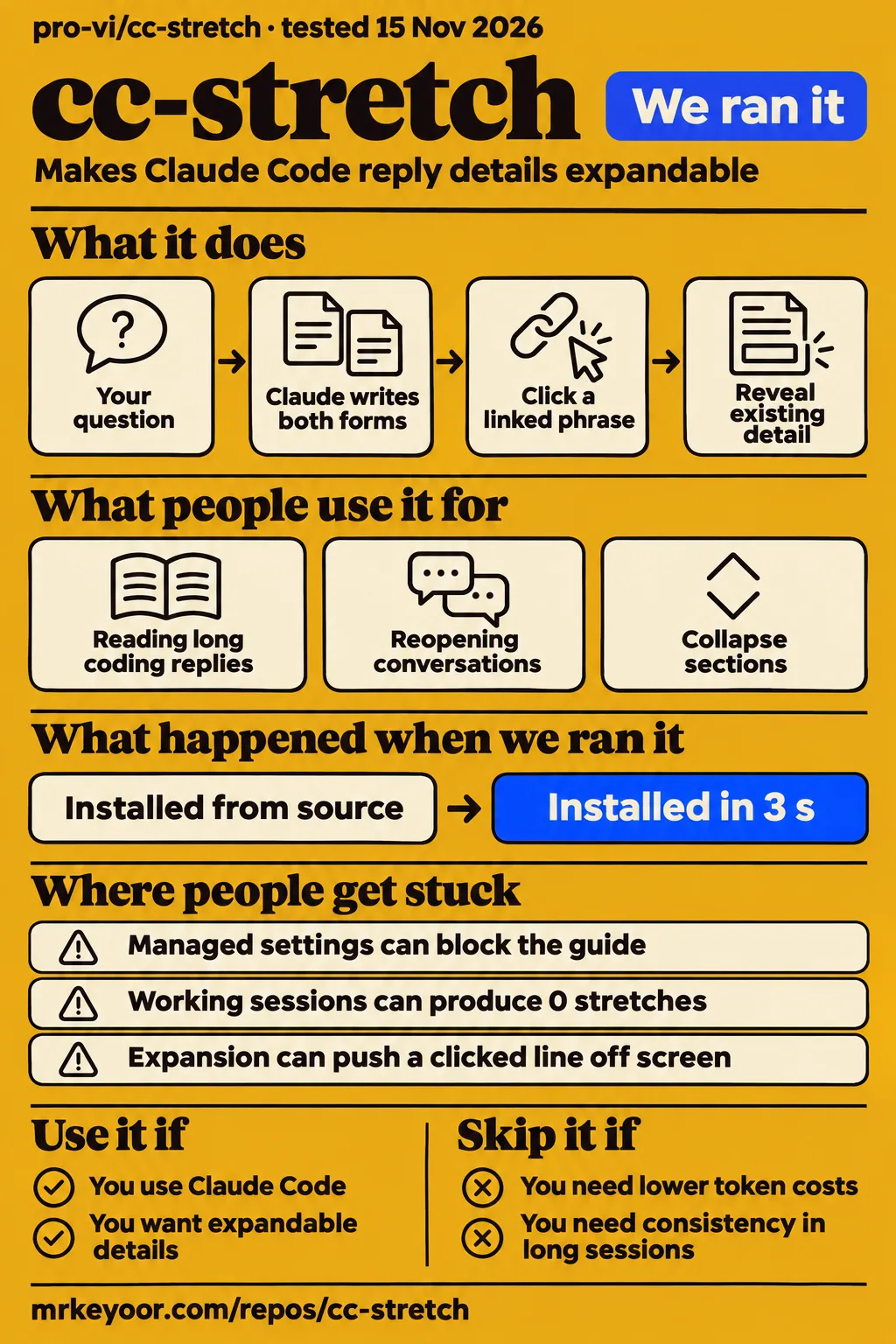
cc-stretch makes Claude Code replies expandable, while the README says token costs stay about the same. Use it if you want a short initial answer with explanations available where you click. Skip it if you need lower token costs or your organization's managed settings block its guide. Our run at commit ae13b90 installed dependencies in 3 seconds, then stopped at a test command whose first executable, claude, was missing.
The cc-stretch README describes replies that start with short linked phrases. Clicking a phrase reveals its longer form; clicking « closes it. Claude receives information about which stretches you opened. This gives the adoption question a concrete shape: would selecting individual explanations help you read the replies you already receive? The supplied latest-release metadata names v0.5.6, while our measured checkout was commit ae13b90.
What people use cc-stretch for
The author measured 69 coding replies, and issue reporters describe clickable replies on Linux and Windows and section folding in a fork. These uses connect the interface to named workflows: reading long coding explanations, reopening earlier conversations and reducing sections to individual findings. The table keeps the reporter and configuration beside each outcome so readers can distinguish the original plugin from changes made in a fork.
| Who used it | What they did | What they reported |
|---|---|---|
| pro-vi, the author | Compared 69 replies from four personal coding projects | The initial view contained 17% of baseline words and about two-thirds of the most important points. Author measurement |
| The reporter of issue #14 | Used cc-stretch 0.4.0 with Claude Code 2.1.302 in an Orca terminal pane on an Ubuntu cloud VM | Opening, closing and reporting opened stretches worked, including restored conversations. Linux report |
| SirHig | Used cc-stretch 0.5.2 with Claude Code 2.1.304 in Windows 11 PowerShell | Stretches rendered, opened and closed on click. Windows report |
| kylesnowschwartz | Made section-level folding a daily default in a fork | The fork kept a closing summary visible and collapsed sections to individual findings. Fork report |
The Linux report describes an obstacle before its successful interaction. Initially, every stretch appeared open because Claude Code started on its main screen. After fullscreen was active, opening and closing worked, including stretches restored from an earlier conversation. The prompt hook also reported what the reader had opened. The maintainer subsequently added the configuration to the README, giving other users a specific setup and symptom to compare with their own.
What happened when we ran it
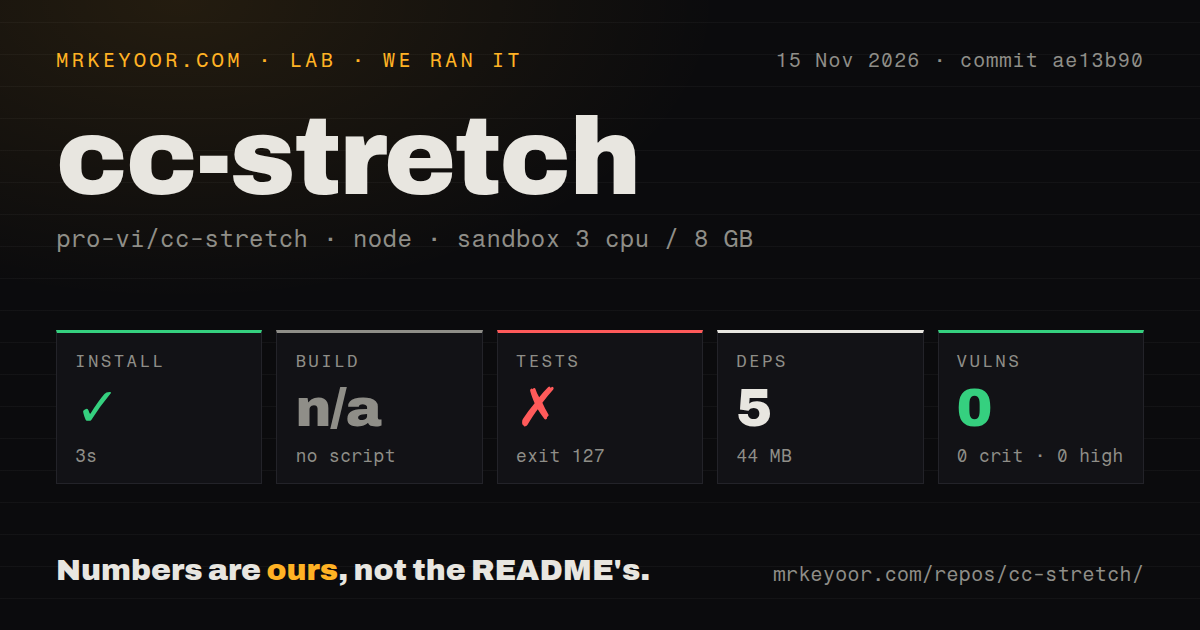
Our run at commit ae13b90 on November 15, 2026 installed dependencies in 3 seconds and failed tests with exit 127 after 2 seconds. The log ended with sh: 1: claude: not found. A separate hands-on attempt failed its safety step because none of its accepted Compose filenames existed. The following table preserves both the checkout measurements and the separate runner's recorded steps.
| Recorded check | Result | What it means |
|---|---|---|
| npm install | Succeeded in 3 seconds | The record lists 5 dependencies and 44 MB on disk |
| Build | Skipped, no build script or target | The harness recorded no build execution |
| Tests | Failed, exit 127, after 2 seconds | The shell printed sh: 1: claude: not found |
| npm audit | 0 known vulnerabilities | Critical, high, moderate and low severity totals were all zero |
| Repository scan | 77 files, about 12,791 source lines, 2.8 MB checked out | The scan found a tests directory, 0 CI workflow files and no Dockerfile |
| Separate hands-on safety step | Failed because no Compose file existed | The runner required a Compose file before proceeding |
| Separate hands-on teardown | teardown: ok |
Cleanup completed according to its record |
The test command was claude plugin validate . && claude plugin test .. The shell stopped at the first executable. The sandbox configuration recorded 3 CPUs, 8 GB RAM and image label lab-node:22. Installing checkout dependencies and installing a plugin within a Claude Code session are different operations: the README's user instructions begin inside that session and then select the terminal's fullscreen renderer.
The separate hands-on run summary says the project was deployed with its own Docker Compose, with every port bound to 127.0.0.1. Its detailed safety step instead records failure because compose.yaml, compose.yml, docker-compose.yaml and docker-compose.yml were absent. The recorded outcome is the safety failure. The hands-on teardown record reports teardown: ok.
Where people get stuck: four symptoms need different diagnoses
Issue #3 distinguishes fully open stretches, stripped links, missing instructions and model noncompliance. These symptoms can look similar while occurring at different stages: choosing the renderer, drawing the reply, delivering the guide or following that guide. The diagnostic table names the versions attached to the older working-session report and keeps its outcome separate from the renderer fix announced in cc-stretch 0.3.4.
| Symptom and source | Explanation in the record | Action and recorded outcome |
|---|---|---|
| Everything appears open although fullscreen is configured, issue #3 | Claude Code can start on its main screen despite the saved setting | The maintainer recommends CLAUDE_CODE_NO_FLICKER=1; issue #14 reports the same fullscreen-start problem |
| New replies are short but unclickable, restored replies work, issue #3 | On Claude Code 2.1.300, the streaming filter removed markup before finished-reply rendering | The maintainer says cc-stretch 0.3.4 renders from original text and fixes this case |
| Plugin loads but replies contain no stretch markup, issue #1 | A desktop reporter using Claude Code 2.1.299 attributes missing guide injection to empty e.surfaces |
The reported failure occurs before Claude writes stretch markup |
| Ordinary replies despite the guide, issue #3 | gitsacha tested cc-stretch 0.3.4 through 0.3.6 with Claude Code 2.1.301 | Five live sessions of 17 to 34 replies each contained 0 stretches; fresh explanation sessions produced them |
The restored-reply clue led to a specific correction in issue #3. Claude Code 2.1.300 passed finished-reply text through a path where the plugin's streaming filter had already removed long forms. Restored replies avoided that filter. The maintainer says cc-stretch 0.3.4 draws from original text, making manual removal of the classic.MessageDisplay hook unnecessary for that symptom. Updating addresses that recorded rendering defect.
The same thread's working-session report concerns cc-stretch 0.3.4 through 0.3.6 with Claude Code 2.1.301 on macOS, using Ghostty and cmux in fullscreen. gitsacha reports 0 stretches across five sessions containing 17 to 34 replies each, despite the guide being present. A fresh explanation session produced stretches. Those configurations and outcomes belong together when using the report to decide what kind of conversation to try.
Other issues concern the content being drawn. In issue #21, the maintainer reproduced a cc-stretch 0.5.3 failure where a code fence ending beside the stretch's closing braces hid subsequent content. The fix was ported into 0.5.4. The same discussion reports expansion pushing a clicked line off screen when the transcript was pinned to the bottom. In issue #4, users object to stretches becoming headings and to changed meaning; the maintainer says a proposed guide change was tried and reverted.
The 83% headline describes initially visible words
The author's sample contained 69 replies from four coding projects, with 17% of baseline words visible before expansion. That is the basis of the 83% shorter-skim headline. The README also says the initial view retained about two of every three most important points and that the author's replies run long. These figures describe the author's comparison of visible text, including the important points left behind expansion links.
The cost mechanism is separate. The README says Claude writes every level up front, so a reply costs about as many tokens as before. Opening a normal stretch reveals the detail already generated in that reply. For someone choosing between reading the full response immediately and opening selected passages, the useful distinction is between generated text and visible text: cc-stretch changes how much of the generated explanation appears at first.
The deepen proposal in issue #11 describes another interaction: requesting fresh detail about a section whose existing stretches are fully open. Its author says a press makes another model query and grows the answer inside the section. RaimundOstrowski reports using deepening about 5-10% as often as ordinary expansion and generally finding it sufficient without adding context. That experience describes the prototype fork's extra query, rather than ordinary expansion.
Managed settings can stop the guide reaching Claude
The supplied README says managed settings and Team or Enterprise accounts can keep cc-stretch's guide out of Claude's system prompt. It names the built-in cc-plugin-sec-default plugin and the debug message prompt.compose bypassed by cc-plugin-sec-default. According to that README, replies stay plain in this situation, and cc-stretch displays an explanatory dim line at the prompt after the first affected reply.
The README's managed-settings explanation also says cc-stretch does not send the guide through another route to get around that control. It directs changes to the organization's administrator through managed settings. This identifies why reinstalling an already loaded plugin or changing the renderer addresses a different problem: those steps concern installation and display, while this behavior concerns delivery of instructions to the model.
The fork author in issue #21 describes an output-style approach after dropping per-prompt guide injection. With collapse rules placed first and a worked example included, the author reports section collapse in 12 of 12 long replies across Sonnet and Opus on a managed Mac. The fork still adds its phrase guide through prompt.compose; the reported section behavior comes from the output style's own rules.
cc-stretch vs its output-style fork, deepen prototype and plain replies
Upstream cc-stretch reveals existing detail, the output-style fork collapses sections, and the deepen prototype requests additional text. These choices answer different reading needs. Someone who wants an entire section reduced to its finding has a reason to examine the output-style fork; someone who reaches the end of an explanation and wants more has a reason to examine the deepen proposal or write a follow-up prompt.
| Choice | Why choose it | Supplied evidence |
|---|---|---|
| Upstream cc-stretch | Open selected phrases to reveal detail generated with the original reply | The README documents nested stretches and reporting which ones were opened |
| kylesnowschwartz/cc-stretch | Collapse each section to one finding and retain a visible closing summary | The fork author describes daily use and the output-style result in issue #21 |
RaimundOstrowski/cc-stretch, feat/deepen |
Request fresh detail inside a fully expanded section | Issue #11 describes an additional model query in a prototype |
| Ordinary full replies and follow-up prompts | Read the explanation immediately and supply another question explicitly | The README distinguishes skim and full replies; issue #11 describes the follow-up alternative |
The output-style fork report names cc-stretch:bottom-line-stretch and describes keeping section headings and the closing summary outside expandable reasoning. The deepen proposal places a separate control beside a fully open stretch because that action costs a model call. Choose between them by the behavior you want: section summaries, access to existing detail or a request for additional explanation.
What the other reviews get wrong
The supplied README documents desktop expansion and collapse, while older coverage says desktop stretches always show open. Claude Code Review and Pivot Build both contain that older description. The correction is to describe the README's desktop interaction alongside the versioned report in issue #1: on bundled Claude Code 2.1.299, SirHig reported missing guide injection and ordinary long replies. Display behavior and delivery of the guide are separate parts of the account. Coverage record, Pivot Build record.
The Windows warning also has a later outcome. SirHig reported working native Windows 11 PowerShell clicks with Claude Code 2.1.304 and cc-stretch 0.5.2, and the maintainer closed issue #1 on that evidence. Older directory text and the supplied YouTube material point Windows users toward WSL. The current supplied README includes the PowerShell report, so the older blanket warning should be replaced with that named configuration. Windows discussion.
The supplied Claude Mods snapshot calls 0.5.1 current; issue #21 records the later 0.5.4 fence fix, and supplied repository metadata names latest release v0.5.6. Older descriptions of tool-call folding also describe historical plugin behavior: the maintainer says commit fbecb65 removed the tool-group hook. These details matter when a directory promises behavior that a user expects to find in the plugin today. Directory snapshot, tool-group explanation.
The documentation's promise that readers never lose their place has a reported counterexample in issue #21: expansion near a bottom-pinned transcript pushed the clicked line off screen. The supplied synthesis also identifies the YouTube explainer's description of condensing output into a summary sentence. The README describes a different mechanism, with Claude writing short and long forms together. Those distinctions replace broad promises with the actual interaction and the reported scrolling symptom.
Questions people ask
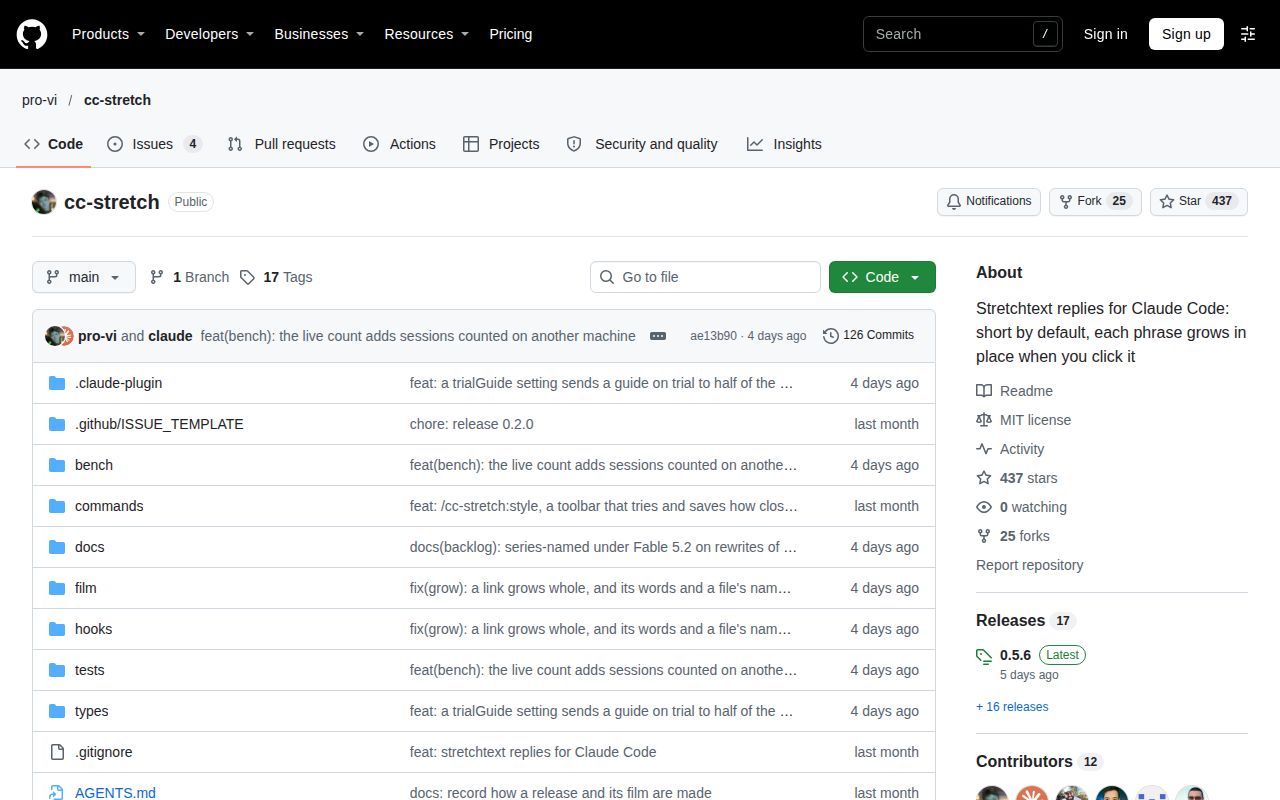
cc-stretch is a Claude Code plugin with its repository at pro-vi/cc-stretch on GitHub. The README describes opening and closing details in place, terminal fullscreen requirements and installation inside an existing session. The questions below come from the supplied search intents and research synthesis, including the issue reports about new replies, desktop instructions, Windows clicking and long working conversations.
What is cc-stretch, and where is its GitHub repository?
cc-stretch makes Claude Code reply details expandable through linked short phrases, and its repository is pro-vi/cc-stretch. The README's interaction description says clicking a linked phrase grows it in place and clicking « shrinks it again. Claude is told which parts were opened. The generated reply therefore contains both the short view and the detail the reader can reveal.
How do I install cc-stretch?
The README installs cc-stretch inside a Claude Code session and then switches the terminal to fullscreen. It says the fullscreen command restarts and resumes the session. These are the documented user commands; our dependency-install measurement concerns the repository checkout. The README installation instructions also describe updating through the plugin interface or the shell command claude plugin update cc-stretch@cc-stretch.
/plugin install cc-stretch --marketplace pro-vi/cc-stretch
/tui fullscreen
Why does cc-stretch produce no short text even when fullscreen is enabled?
Claude Code can start on its main screen despite a saved fullscreen setting, according to the maintainer in issue #3. The README says CLAUDE_CODE_NO_FLICKER=1 forces fullscreen in the listed affected setups. The issue #3 discussion also distinguishes missing instructions from replies that contain stretch markup but draw incorrectly. Begin with whether stretches are fully open, absent or short but unclickable.
Why do restored replies work while new replies are not clickable?
The maintainer says cc-stretch 0.3.4 fixes a Claude Code 2.1.300 path that stripped markup before finished-reply rendering. Restored replies avoided the streaming filter, which explains why reopening a conversation changed the result. The renderer explanation in issue #3 directs users to update and restart Claude Code instead of manually removing the classic.MessageDisplay hook for this particular symptom.
Does cc-stretch work on native Windows, or do I need WSL?
SirHig reports working clicks in native Windows 11 PowerShell with Claude Code 2.1.304 and cc-stretch 0.5.2. The maintainer closed issue #1 after that report and added the configuration to the README. The earlier issue began with failed clicks on Claude Code 2.1.300. Keeping both version numbers explains why the later result changes an older blanket recommendation to use WSL.
Does cc-stretch work on Linux?
Issue #14 reports expansion, collapse and restored replies working on Ubuntu through Orca with Claude Code 2.1.302 and cc-stretch 0.4.0. The reporter also says the prompt hook recorded opened stretches. Initially the session had started on the main screen, so stretches appeared open without links. The Linux Orca report says the README's fullscreen-start explanation matched that obstacle, and the maintainer added the successful setup.
Why does the desktop app load cc-stretch but still produce plain long replies?
SirHig attributes a Claude Code 2.1.299 desktop failure to prompt.compose skipping the guide when e.surfaces was empty. The plugin loaded, but replies contained ordinary long text. That desktop report in issue #1 concerns instruction delivery. The README separately describes desktop links that open and close stretches, so loading the plugin and supplying the model's guide are distinct steps in the reported behavior.
Why does Claude stop writing stretches in long working sessions?
gitsacha reports this with cc-stretch 0.3.4 through 0.3.6 and Claude Code 2.1.301, despite the guide being present. Five live sessions containing 17 to 34 replies each produced 0 stretches; fresh explanation sessions produced them. The working-session report in issue #3 describes macOS, Ghostty and cmux in fullscreen. It gives a concrete reason to include an ongoing working conversation when evaluating the interaction.
Can cc-stretch work with managed settings that skip prompt.compose?
The upstream README says its guide is blocked in the managed configuration it describes, while a fork author reports section folding through an output style. In issue #21, that author dropped per-prompt guide injection and placed collapse rules first with a worked example. The reported 12-of-12 result concerns the fork's section rules; its phrase guide still uses prompt.compose and is skipped on the managed setup.
Can every section collapse to one line while the closing summary stays visible?
kylesnowschwartz's fork describes exactly that behavior through cc-stretch:bottom-line-stretch. Its author says the style collapses each section beneath its heading to one finding and keeps the closing summary outside every stretch. The fork discussion in issue #21 also describes using it as a daily default. This is the concrete alternative to examine when section-level reading is the interaction you want.
Can I ask for more detail inside a fully expanded stretch?
The feat/deepen prototype proposes an additional model query focused on a fully open section. Its author distinguishes that control from opening existing text because a press costs a model call. The proposal in issue #11 says the answer grows inside the section in stretchtext format. Ordinary expansion reveals text generated with the original reply; the prototype requests another explanation after that available detail is open.
What kinds of paragraphs benefit from deepening, and does that query need extra context?
The prototype author says deepening generally felt sufficient without adding context and reports using it about 5-10% as often as expansion. The maintainer's questions in issue #11 ask which paragraphs invite deepening and whether readers want to supply context. The reply describes the author's preference rather than naming a category of paragraph. A useful comparison would use a section you actually want explained further.
What we have not tested yet
Our sandbox stopped before interactive Claude Code testing, and the separate hands-on attempt stopped at its Compose safety check. Expansion, collapse, keyboard navigation and restored conversations therefore remain untested by us. The supplied pack contains no screenshot records or completed interactive question-and-answer tasks from that attempt. The Compose prerequisite belongs to that runner; the README's installation route uses an existing Claude Code session. The image label lab-node:22 does not establish actual runtime or operating-system versions.
The supplied evidence does not establish whether gitsacha's cc-stretch 0.3.4 through 0.3.6 behavior with Claude Code 2.1.301 persists in v0.5.6. Windows, Linux, desktop and fork outcomes belong to their named reporters, rather than our execution. The desktop guide diagnosis and bottom-pinned scrolling report have no confirmed general remedy in the supplied records; the maintainer says the scrolling problem had not been reproduced. We have not reproduced the README's managed-settings diagnostic line, the output-style approach or the deepen prototype.
Reading time, comprehension, token usage, accessibility and productivity were not measured in our run. The author's 69-reply comparison is an author measurement of visible words, rather than an independent performance study or a universal 83% reduction. The dependency audit's 0 known vulnerabilities is a scan result, rather than a review of plugin hooks, permissions or data handling. The supplied material contains no release-note extract supporting claims about what v0.5.6's diagnostic line was tested on.
For a practical next step, take an explanation from an ongoing working conversation, read its short view and then open every stretch. Compare the initially visible answer with the details that affect your decision, and continue the same conversation. That exercise matches the adoption question raised by the supplied reports: whether selective reading helps in your normal work after the initial demonstration, with your Claude Code version, plugin version and renderer.