Lite's fallback makes it the better starting point
Caustic Volume gives you a small tank scene in Lite and a larger sandbox with more simulation and lighting controls. The README says Lite switches to a CPU renderer when WebGL 2 is unavailable or three.js cannot load. I would start there if your goal is understanding the effect or showing it on an unfamiliar machine. The fallback offers a documented path beyond a failed graphics initialization.
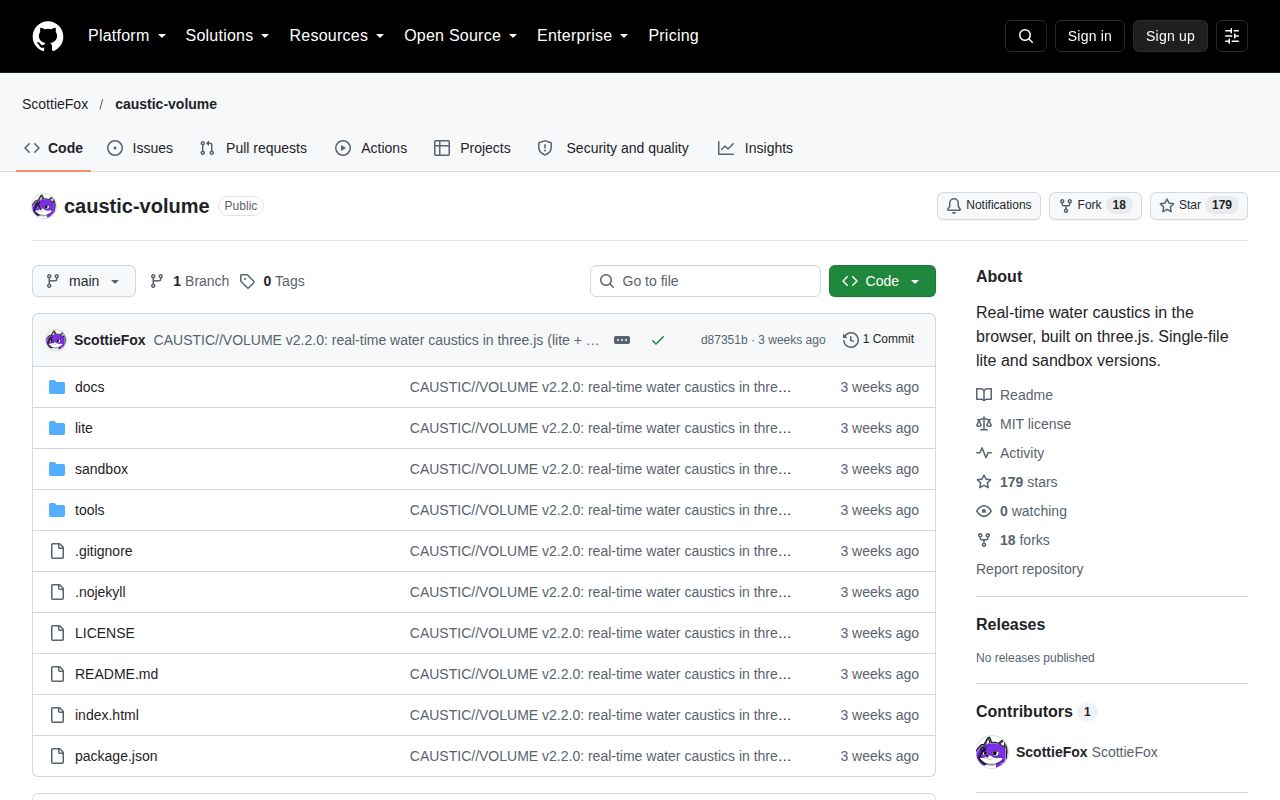
Our checkout was 1.5 MB, with 36 files and about 7,499 source lines. The distinction between the versions is useful: Lite concentrates on water and a duck, while the sandbox adds creatures, ink, sand, and more elaborate light. Choose the amount of code that matches what you want to learn.
What happened when we ran it
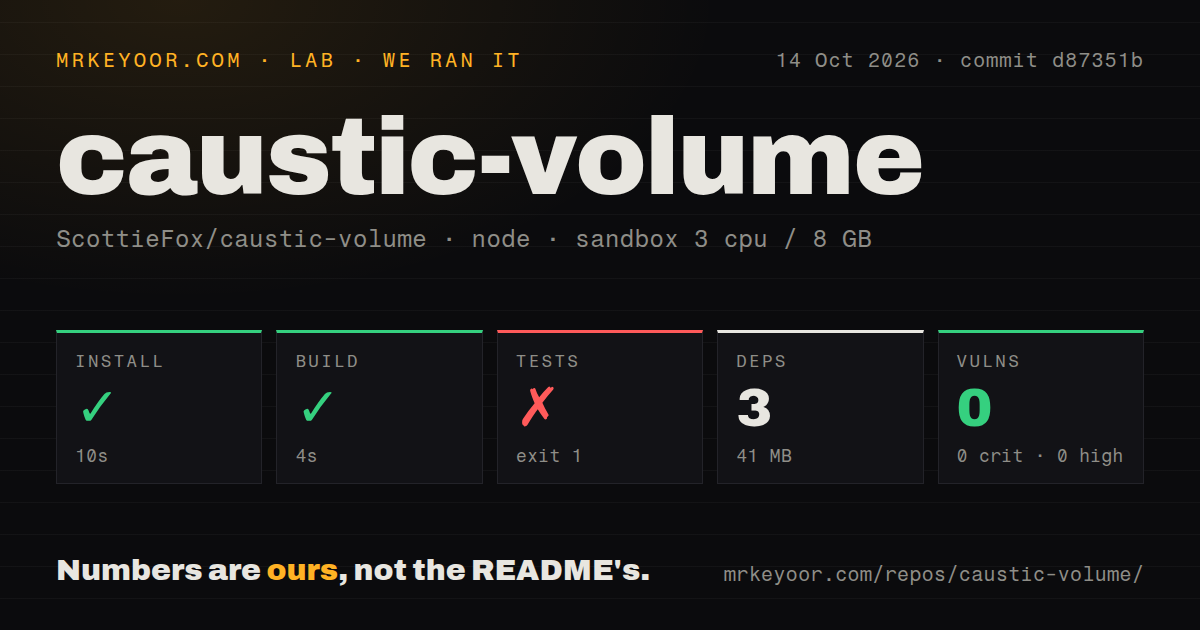
Our sandbox installed Caustic Volume commit d87351b in 10 seconds, adding 3 packages and occupying 41 MB. The build passed in 4 seconds. We ran the October 14, 2026 job in a fresh Debian container with 3 CPUs, 8 GB of RAM, image lab-node:22, no secrets, and no elevated privileges. Npm audit reported 0 known vulnerabilities in the measured environment.
The test step failed with exit 1 after 6 seconds. Its supplied log tail asked for npx playwright install and pointed to tools/test-lite.cjs, including the browser-launch location. The tail also printed Node.js v18.20.8, despite the lab image's name. The record doesn't explain that difference. It supplies no passing browser check and no basis for claiming that the scene rendered successfully in our container.
That failed step is narrower than a finding that the water renderer is broken. The log asks for browser installation, and the development instructions explicitly include a Playwright Chromium installation step. Our result shows that the measured environment did not complete its browser check. It doesn't show what would happen after following that prerequisite, and we haven't substituted a guessed result for a rerun.
The browser path differs from the developer workflow
The README tells viewers to open either version's HTML file directly. It says the normal renderer loads three.js from jsDelivr and needs an internet connection on first load. That distinction matters for a lesson or presentation on a disconnected machine. A downloaded HTML file still has an external script dependency. Lite's CPU renderer is the documented fallback if that import cannot complete.
The 3 packages in our npm installation belong to the developer environment we measured. They don't make npm a requirement for someone opening the existing scenes. Conversely, opening a scene successfully would not prove its browser-check tooling is ready. Viewing the scenes and modifying them need different preparation.
The full sandbox has a harder graphics requirement
The browser-support section requires WebGL 2 with float render targets for the sandbox. It directs unsupported users toward Lite. That is a clear boundary for anyone considering a decorative effect on a public page: visitors won't all have the GPU capability or browser configuration of the machine on which you developed it. A capable desktop demonstration is insufficient evidence for broad device support.
Our 4-second build offers no frame-rate or GPU memory measurement. The README describes adaptive resolution in Lite and quality presets in the sandbox, but those mechanisms still need device checks. Look for readable controls, acceptable interaction, and sensible behavior when rendering capability disappears. If the effect is secondary to the page's purpose, decide what visitors should see while the graphics are unavailable.
The source explains the effect instead of hiding it
Lite's documentation connects the moving surface to the focused light on the tank floor. It describes sampling water height and slope, refracting rays, and accumulating the resulting light pattern. The controls let a reader change waves, add ripples, and switch illumination. That combination makes the project useful study material: the source and the visible controls refer to the same parts of the simulation.
The complete measured source was roughly 7,499 lines, so start with a narrow modification before adopting the sandbox. Changing a light or disabling an object gives you a smaller question than transplanting the whole scene. The sandbox's module map names the water simulation, photon tracing, and post-processing files. Use that map to locate the effect you need, rather than carrying every creature and control into a different application.
MIT terms permit reuse, while packaging remains your work
The README's license section identifies MIT terms and asks copies to retain the copyright and license notice. That supports commercial adaptation without a project-specific subscription. The shipped unit is still a standalone scene. If you need a component in an existing application, plan how you will initialize it, release graphics resources, and reconcile its controls with your page.
The build passed in 4 seconds, but it joins sandbox modules into the existing HTML page. That result doesn't establish a reusable component API. Three.js itself is the more direct foundation when you already know the scene you want to build. Caustic Volume is useful when its particular water and light implementation gives you source worth learning from or adapting.
September activity leaves support history thin
GitHub recorded a push on September 26, 2026, with 179 stars and no open issues and PRs when checked. The issue endpoint returned no entries, and there was no latest release entry. The recent push establishes activity, while the empty discussion record gives little evidence about how rendering problems are handled across devices. Neither observation justifies declaring the project abandoned or broadly validated.
Our scan found 0 CI workflow files, and the measured browser step did not pass. Keep the project in the study-and-adapt category until your target browsers render the version you intend to use. For a first experiment, Lite offers the smaller scene and the documented CPU route. Try the larger sandbox when its extra lighting and simulation are the reason you're opening the source.