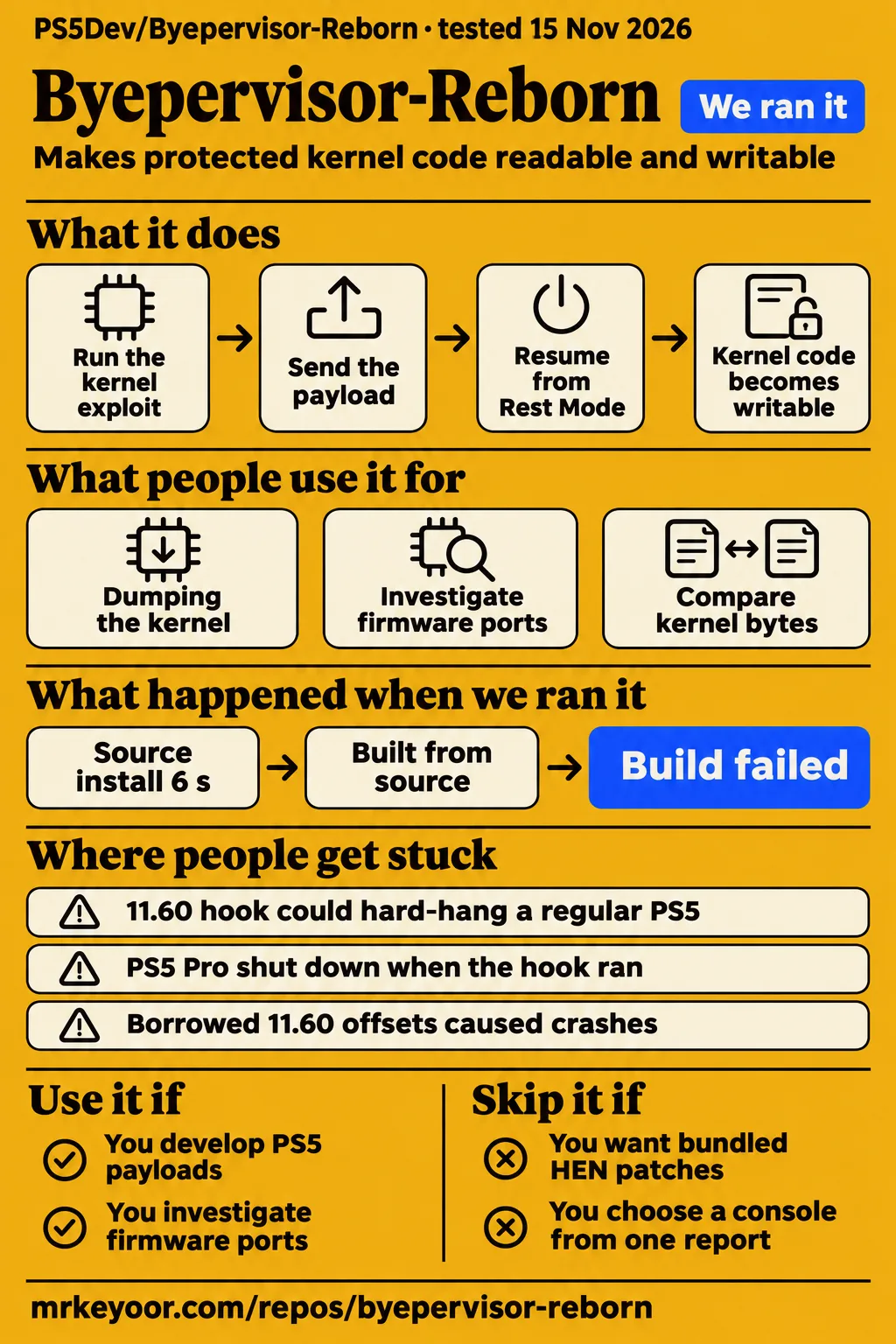
Byepervisor-Reborn is a developer base exploit for PS5 that ships without HEN or other patches. Its documented outcome is readable and writable kernel code after an existing kernel exploit and a Rest Mode/resume cycle. Use it if you develop payloads or investigate firmware ports; skip it if you want a finished homebrew package. Our review connects the measured SDK build failure with attributed console demonstrations, firmware-port work and crash reports. Byepervisor-Reborn project scope
Kernel code becomes readable after resume
Byepervisor-Reborn is designed to disable execute-only protection and enable writes to kernel code after resume. The README says the payload prints the first eight bytes of kernel .text in a notification to demonstrate that result. For a developer, those bytes are the documented observable endpoint before further inspection or patching. A console waking from Rest Mode is a different event from receiving that success notification. README kernel-access demonstration
The README describes a window during S3 resume when startup_mp initializes the other application-processor cores under an insecure nested-page-table configuration. Shellcode can then obtain read/write access to the hypervisor's address space, including virtual-machine control blocks. The project credits theflow0 with initially finding the bug and links Sonic ISO's writeup. This resume mechanism explains why the execution instructions require an earlier kernel exploit and a loader that continues running after wake. README mechanism and attribution
What people use Byepervisor-Reborn for
Michael Crump reports readable kernel bytes on a regular PS5 running firmware 13.60; issue contributors report Pro troubleshooting, hook hardening and firmware-port development. These are distinct tasks with distinct outcomes. The table keeps the person, setup and result together so a developer can follow the report closest to their own work. The PKG experiment uses additional early builds, while the porting report concerns address discovery and resume-component development.
| Person and task | Reported outcome | Practical use |
|---|---|---|
| Michael Crump ran the payload on a regular PS5, firmware 13.60 | Readable kernel .text bytes and the expected cookie after resume | Compare the visible output with Crump's console demonstration |
| Michael Crump tried additional early PKG builds on firmware 13.60 | He reports installation and launch | Follow Crump's separate PKG experiment |
| gangg111 tested a PS5 Pro, firmware 13.60 | A clean boot without conflicting autostart payloads worked | Investigate issue #6's resident-payload diagnosis |
| sbauwow and gzimbric tested the hardened 11.60 hook | The thread reports validation on two independent regular consoles | Read issue #9's hook-hardening report |
| chuvadenovembro developed a 12.40 port | Measurement tooling worked while resume-component validation continued | Study issue #5's address-discovery work |
Crump reports testing the payload on a regular PS5 running firmware 13.60. His description gives the first eight kernel .text bytes as e8 6b 5d 4f 00 00 00 00 and the cookie as 0xcafedead00001337. He reports using Payload Manager for the early demonstration and identifies elfldr as the project's recommended loader for continuing after resume. Those details give readers a concrete output and loader to compare with another report. Crump's output and loader description
What happened when we ran it
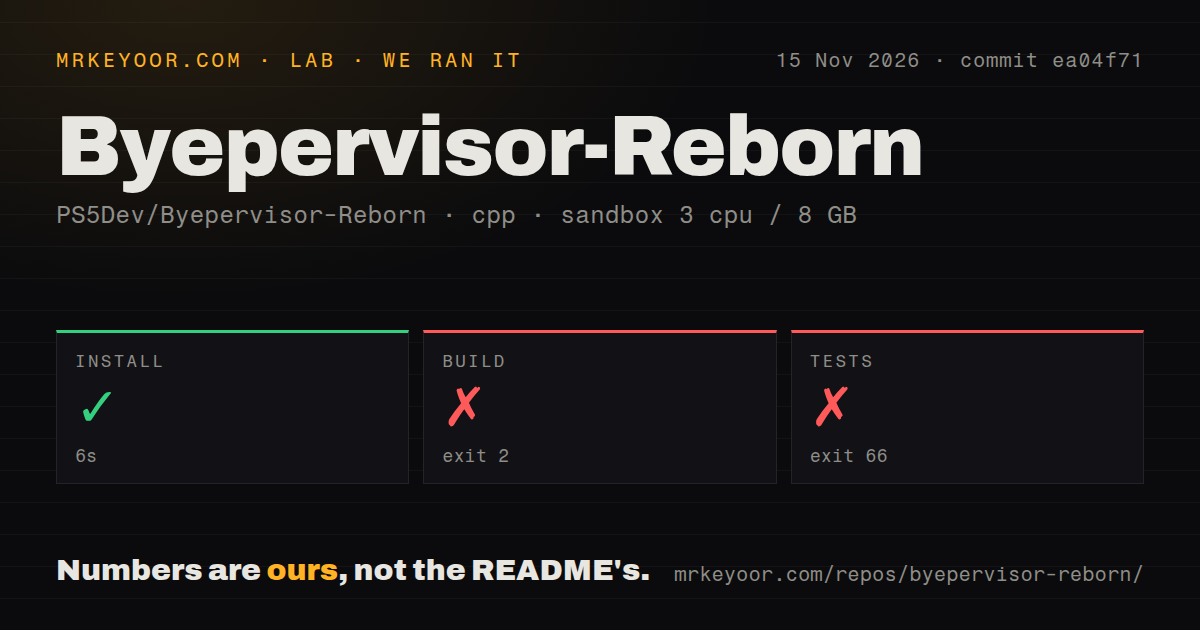
Our November 15, 2026 run used commit ea04f71 and stopped at a build error naming an undefined PS5_PAYLOAD_SDK setting. Installation succeeded, while the build and test commands failed with different outputs. The recorded sandbox had 3 CPUs, 8 GB RAM and the image label lab-cpp:1. The measurements below describe the source-harness attempt, including its repository scan, rather than an attributed console demonstration.
| Recorded step | Result | Log or recorded boundary |
|---|---|---|
| Install | Succeeded, 6 seconds | The install step completed |
| Build | Failed, exit 2, 4 seconds | Makefile:23: *** PS5_PAYLOAD_SDK is undefined. Stop. |
| Tests | Failed, exit 66, 7 seconds | no test target |
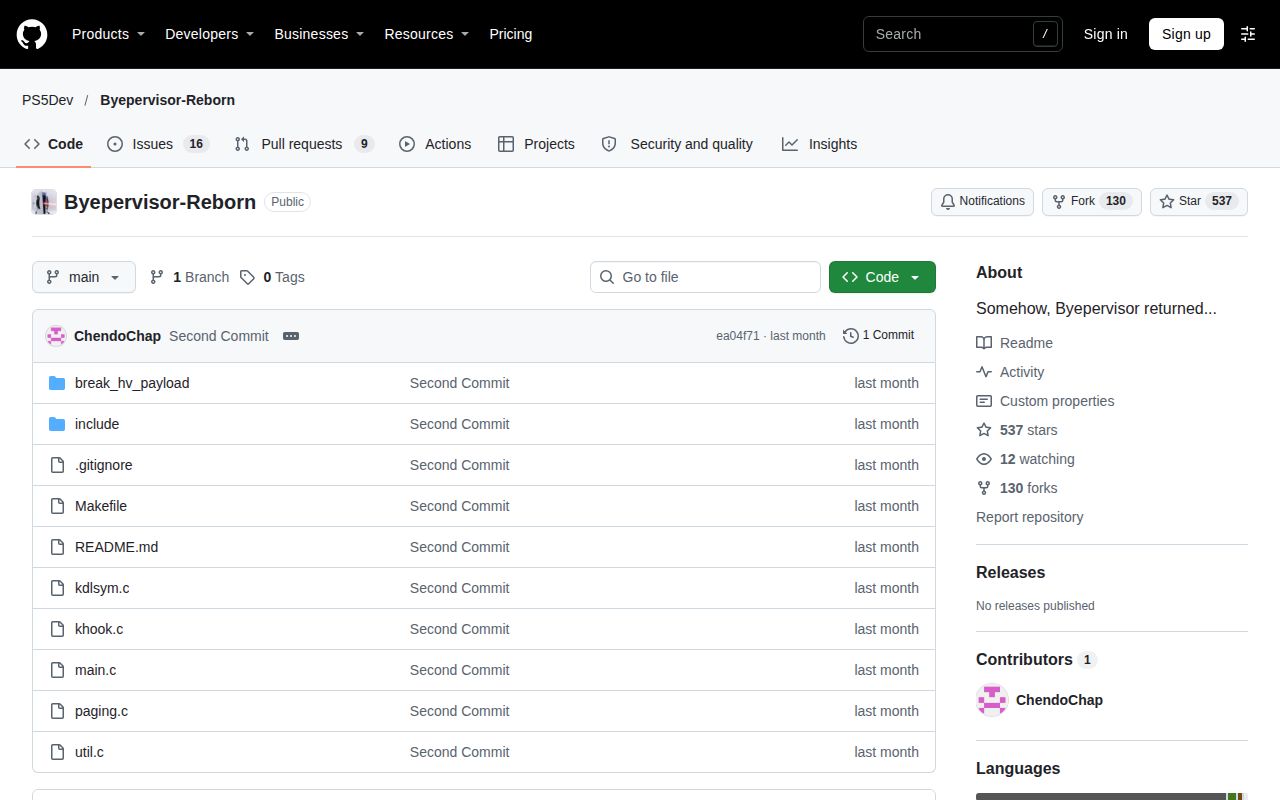
| Repository scan | 20 files, about 1,764 source lines, 0.1 MB checked out | 0 CI workflow files, no Dockerfile, no tests directory |
Our build failed with exit 2 after 4 seconds. The final build log names PS5_PAYLOAD_SDK, and the README identifies the PS5-Payload-Dev SDK as the build dependency. The test command instead printed no test target. Installation, compilation and the attempted test command therefore have separate recorded outcomes. The successful installation step supplies no passing compilation or test result, and the logs give no further package or compiler diagnosis.
The separate November 15, 2026 deployment-harness safety step failed because none of compose.yaml, compose.yml, docker-compose.yaml or docker-compose.yml existed. Its generic run record nevertheless claimed deployment through the repository's own Docker Compose, with every port bound to 127.0.0.1. Teardown reported "teardown: ok". The specific safety failure is the retained outcome; the harness's "unsafe repo" label refers to its Compose-file requirement.
Where people get stuck: separate the hang from the resume
Issue #9 reports an 11.60 hang before Rest Mode, whereas issue #26 describes standby followed by a return to the home screen. Record the last completed stage: hook installation, standby entry, wake or the kernel-byte notification. That stage determines which thread describes the same symptom. A shutdown before standby and an ordinary wake without the expected result require different descriptions, even when both prevent completion.
| Symptom and reporter | Thread outcome | Relevant distinction |
|---|---|---|
| sbauwow, regular PS5 11.60, hang after arming | Hardened hook reported shipped in PR #7 at 340ed30 | The report records 0/5 before and 2/2 after hardening, with validation on two independent units. Issue #9 |
| gangg111, PS5 Pro 13.60, shutdown when the hook ran | Reporter resolved a resident-autostart-payload conflict | The final diagnosis replaced the earlier Pro-address-handling suspicion. Issue #6 |
| Base PS5 13.60, freeze and shutdown before Rest Mode | Reporter denied using autoloaded payloads after a commenter suggested them | The thread records an open failure. Issue #14 |
| Frozen screen and shutdown, including firmware 13.40 | Users reported continued failure after following instructions | The thread records the symptom and unsuccessful attempts. Issue #15 |
| niallod55, PS5 13.60, normal standby followed by home screen | Reporter encountered this while trying Sonic ISO's Linux launcher | Standby occurred before the missing success notification. Issue #26 report |
Issue #9 reports the hardened hook in PR #7 at commit 340ed30, hardware validation on two independent regular 11.60 consoles, and 0/5 before versus 2/2 after hardening. The earlier report describes a hard hang within seconds of arming, including loss of network access and manual power cycling. Its initial symptom record counted 3/3 fires. Keep those initial observations separate from the later before-and-after attempt counts. Issue #9 symptom and hardening evidence
gangg111 reports that a clean boot without other kernel-patching payloads worked on the same PS5 Pro. The final diagnosis names autostart payloads, particularly kstuff, after earlier discussion of Pro-specific addresses and an IST experiment. Issue #14 records a different response: its base-console reporter explicitly denied autoloaded payloads. The successful change on one console therefore supplies a troubleshooting lead, while the other thread retains its own reported conditions. Pro clean-boot resolution, base-console reporter's response
Firmware support needs a build and an evidence label
The original README lists 13.60, 13.20 and 13.00, with 13.00 marked untested. Subsequent reports concern particular forks, revisions and consoles. An offset addition identifies address work; a kernel dump identifies a different outcome; a successful resume identifies another. The table retains those labels so readers can choose a relevant source without treating every firmware mention as the same kind of compatibility result.
| Firmware or branch | Supplied evidence | Record type |
|---|---|---|
| Original 13.60 | README listing, Crump's regular-console report and gangg111's Pro report | Listed implementation and attributed console results. Crump's report, Pro report |
| Original 13.20 | README listing | Documented implementation. README firmware list |
| Original 13.00 | README explicitly says untested | Upstream-qualified listing. README firmware list |
| Hardened 11.60 | PR #7, commit 340ed30, validation reported on two regular consoles | Hook-revision hardware report. Issue #9 |
| 12.40 research | Working measurement tooling; resume validation in progress | Port-development report. Issue #5 |
| 11.40 research | cupid-blip reports discovering offsets and dumping the kernel | Address-discovery and dump report. Issue #28 |
| 9.60 research | Missing text locations and hard panics during diagnostic reads | Port investigation. Issue #13 |
| EchoStretch fork | Issue #3 points to added 12.xx and 13.xx offsets | Fork-specific offset report. Issue #3 |
The 12.40 discussion separates checked kernel-data locations from the kernel-text symbols and instruction gadgets needed by the resume chain. A contributor describes an instruction oracle for examining candidate instructions. In the 11.40 thread, borrowed 11.60 structural offsets caused crashes before the author reported discovering the correct offsets and dumping the kernel. Both discussions concern finding firmware-specific executable-code locations, rather than substituting a nearby firmware number into an existing table. 12.40 address work, 11.40 discovery report
Firmware 9.60 research encountered hard panics during direct reads of the hypervisor loader through DMAP, and the reporter stopped those reads. A separate 13.40 contributor offered hardware testing but said they lacked the kernel exploit needed to dump the kernel or hypervisor. Reddit user OneVariation7352 also reported a crash on 12.60 after reading compatibility claims. These are reported obstacles at different stages of porting and execution. 9.60 diagnostic failure, 13.40 testing offer, 12.60 crash report
PKG and Linux reports concern additional software
Crump reports installing and launching PKGs on firmware 13.60 using additional early test builds. Separately, the supplied X synthesis describes pLinux5-NG as targeting newer firmware through Byepervisor-Reborn, with current support limited to 13.20 and full functionality described as experimental. These accounts concern downstream software. The base repository's README describes kernel access and explicitly says it ships without HEN or other patches. Crump's early-build PKG report, supplied pLinux5-NG announcement, base repository scope
Issue #10 records a package installation followed by a launch error: a firmware 13.2 user installed Hollow Knight Silksong but encountered an error when running it. A reply attributed the error to absent FPKG support at the time. That report preserves both stages of the attempt, rather than treating installation as a successful launch. Crump's separate account specifically reports both installation and launch using the additional early builds. Issue #10 package outcome, Crump's reported outcome
Loader choice and kernel execution are part of setup
The README requires a kernel exploit chain and elfldr before sending byepervisor.elf. It says the payload relies on elfldr to continue after resume and suggests setting USB power to Always in Rest Mode settings. Follow the notifications after sending the payload. These are the project's execution instructions, and they make the loader and Rest Mode configuration useful details to include when describing a console result. README execution instructions
The build notes identify the PS5-Payload-Dev SDK and say the entire break_hv_payload component runs in supervisor/kernel mode. A useful development record should name the build, firmware, console model, loader and resident payloads alongside the output. Issue #6 supplies a concrete reason to record the last item: changing the resident-payload state on the same Pro console preceded the reporter's successful kernel-byte and cookie output. README build notes, issue #6 setup change
Byepervisor-Reborn vs EchoStretch's fork and waiting for kstuff
Issue #3 directs firmware-offset requesters to EchoStretch's fork; Reddit user Visible_Garage6377 prefers waiting for downstream kstuff work. Those choices address different tasks. A developer investigating offsets has a repository lead, while someone seeking a patch stack has a stated reason to wait. The original README supplies the baseline: a developer foundation that follows an existing kernel exploit and leaves additional patches to the user.
| Choice | Evidence behind the comparison | Pick it when |
|---|---|---|
| Original PS5Dev repository | README describes the base exploit and original implementation list. Project README | You want to study or extend its protected-kernel access |
| EchoStretch/Byepervisor-Reborn | Issue #3 points offset requesters to the fork. Fork recommendation | You are investigating firmware-specific offset changes |
| Wait for downstream kstuff work | Visible_Garage6377 preferred waiting for arksama, EchoStretch or drakmor's new kstuff. Reddit user's comparison | Your goal is a downstream patch stack |
| Existing kernel exploit alone | The README places the kernel exploit before Reborn. Execution sequence | Your task ends at the access supplied by that earlier stage |
An issue #3 commenter reports that EchoStretch added 12.xx and 13.xx offsets in his fork. Reddit user Visible_Garage6377 preferred waiting for new kstuff from arksama, EchoStretch or drakmor. The first statement directs developers toward offset changes; the second records a user's preference about development stage. Choose the relevant investigation path from those descriptions, then read the specific repository or downstream release evidence for the capability you need. Offset recommendation, waiting preference
What the other reviews get wrong
ONE Jailbreak's opening describes coverage from 6.xx through 13.60, while the original README gives a shorter implementation list and says older firmware may require different gadgets. The article later supplies qualifications, so the correction concerns its opening's breadth. The bug's possible reach and an implemented firmware list answer different questions. For a console decision, retain the firmware, branch and observed outcome attached to each report. ONE Jailbreak opening, README porting requirements
Wccftech's October 13, 2026 coverage describes a developer foundation and prospective features. Crump's additional-build PKG report and the experimental pLinux5-NG announcement add downstream developments to that account. The README's 99.9% stability expectation also differs from user observations: NoIntroduction625 reported roughly 50% success and no luck with the SMP/kstuff versions tried, while issue #9 reports improvement after hook hardening. Each result belongs to its stated software and setup. Wccftech launch coverage, PKG report, Linux announcement, Reddit experience, hook-hardening result
Questions people ask
Byepervisor-Reborn's documented immediate result is readable and writable kernel code after resume. The README places an existing kernel exploit before that step and supplies no HEN patches. The community questions below cover that capability, the exploit's origin and firmware-specific work. Their answers use the project instructions and attributed reports, with the original implementation list kept separate from offset research and downstream software.
What does Byepervisor-Reborn actually unlock for PS5 users?
The README describes readable and writable kernel code after resume, demonstrated by a notification containing the first eight bytes of kernel .text. Developers can use that access for dumping or patching the kernel. Crump's regular-PS5 13.60 report supplies an example of the displayed bytes and expected cookie. The documented access is the starting point for further patches supplied separately. README outcome, Crump's demonstration output
What can Byepervisor-Reborn do beyond the existing kernel exploit?
Reborn targets hypervisor restrictions after the existing kernel exploit supplies the entry requirement. The README describes shellcode gaining read/write access to the hypervisor's address space during the resume window, including access to virtual-machine control blocks. Its instructions place the stages in order: run the kernel exploit chain, reach elfldr, send byepervisor.elf and follow the notifications through the Rest Mode/resume sequence. README mechanism and execution order
Is Byepervisor-Reborn a complete jailbreak or a developer tool?
The README calls Byepervisor-Reborn a base exploit intended for developers and says it ships without HEN or other patches. Readers seeking package launching need the evidence for an additional build or patch stack. Crump's account reports installation and launch with additional early test builds on firmware 13.60; that is a separate software experiment from the base repository's documented kernel-access demonstration. README intended audience, additional-build PKG report
What is a PS5 hypervisor in simple terms?
The hypervisor is the layer whose protections this payload targets after kernel access. The README explains the exploit through a resume-time window with an insecure nested-page-table configuration, allowing read/write access to the hypervisor's address space. In this workflow, kernel access comes first. Reborn then addresses protections around the kernel code that developers want to inspect or change, with the kernel-byte notification serving as the documented demonstration. README technical summary
Where did Byepervisor-Reborn come from?
The PS5Dev README credits theflow0 with initially finding the bug and links Sonic ISO's S3-resume writeup. It describes subsequent discoveries with LLM assistance and compares the Rest Mode route with an earlier Byepervisor variant. These are the project's stated credits. The Reborn repository's own summary and execution instructions describe the implementation reviewed here, including the prerequisite kernel exploit and the post-resume notification. README attribution and mechanism
Does Byepervisor-Reborn support firmware 13.00?
The original README lists 13.00 as untested, alongside 13.60 and 13.20. That qualification belongs to the original implementation entry. The README separately discusses the bug's possible reach to older firmware and the gadget changes some versions may require. For a 13.00 investigation, start with the explicitly qualified entry rather than interpreting the broader vulnerability range as an equivalent hardware result. README firmware list and porting notes
Can firmware 12.20 offsets be added?
Issue #3 requests 12.20 offsets, and a commenter points to EchoStretch's fork for added 12.xx and 13.xx offsets. The original README describes porting as adding an offset header and switch cases in kgadget(), kdlsym() and rawoff(). It also says differing gadgets can require more extensive changes. The issue therefore supplies a repository lead, while the README identifies the general implementation work involved. Issue #3 offset request, README porting instructions
What offsets and testing are still needed for a firmware 12.40 port?
Issue #5 distinguishes checked kernel-data locations from the kernel-text symbols and instruction gadgets needed for the resume chain. Its later update reports working measurement tooling while resume-component and safety-check validation continued. The contributor's instruction-oracle approach addresses candidate executable-code locations. That distinction explains why completing the data-offset side is a separate milestone from completing the resume-time component of this particular port. Issue #5 port-development discussion
What is the status of Byepervisor-Reborn support for firmware 9.60?
Issue #13 records port investigation with missing kernel-text entries and hard panics during direct reads of the hypervisor loader through DMAP. The reporter stopped those reads and described the symbols and gadgets still being sought. The thread's concrete result is diagnostic progress alongside an abandoned probing approach. Its data-side observations and executable-code questions remain separate parts of the reported firmware work. Issue #13 port investigation
How can developers find the missing firmware 11.40 gadget offsets?
The issue #28 author reports discovering the 11.40 offsets and dumping the kernel after earlier crashes with borrowed 11.60 structural offsets. The thread identifies differing kernel-text locations as the problem with that borrowing approach. Developers investigating 11.40 can use that reported outcome as a lead, alongside issue #5's explanation of why data offsets alone do not supply executable-code symbols and gadgets. Issue #28 outcome, issue #5 address distinction
Does Byepervisor-Reborn support the full firmware range suggested by broad video headlines?
The original README lists implementations for 13.60, 13.20 and an untested 13.00, separately from the bug's potential reach down to 6.xx. It says older versions can require different gadgets and that modified 14.00 support is not supplied. Those statements describe different levels of implementation work. Use the specific firmware entry and linked development report when choosing a branch to investigate. README support and porting statements
Is a PS5 Pro worth choosing over a Slim for the latest jailbreak?
Issue #6 reports a successful clean-boot result on one PS5 Pro running firmware 13.60 after removal of conflicting autostart payloads. Its subject is troubleshooting an existing console: the reporter obtained the expected kernel bytes and cookie on the same unit that had shut down. The report is useful for comparing resident-payload conditions on a matching setup, rather than assigning purchasing value to either console model. Issue #6 Pro troubleshooting result
What we have not tested yet
Our sandbox stopped before producing a working payload, and we did not run Byepervisor-Reborn on PS5 hardware. The hardened 11.60 hook, Pro workaround, fork offsets, downstream PKG builds and Linux launcher remain attributed reports. Neither the hook's before-and-after attempts nor Reddit's roughly 50% account supplies a representative success rate. Reboot persistence, Linux dual boot, comparative Pro-versus-Slim buying value and a security audit are unresolved by the supplied evidence.
The missing-Compose safety failure and contradictory deployment record do not establish a running application. The pack contains no screenshot records or hands-on task-answer records. Actual compiler and operating-system versions require raw toolchain logs; lab-cpp:1 is an image label. The supplied 11.40 follow-up gives an outcome without a reproducible discovery method, and fork offset reports do not demonstrate successful resume on every listed firmware. Open crash and package-launch reports retain their unresolved status.
All four rating dimensions remain N/A because the evidence does not support numerical judgments about supported-environment setup, documentation completeness, community support capacity or operational maturity. Rendered layout, resolved links, related links, recommendation modules and template behavior also fall outside this supplied-text review. For a developer continuing the investigation, the useful next step is to identify the exact target-firmware branch and read its resume result together with its loader and resident-payload conditions.