BRUTAL's Box2D 2026.10.1 package declared 484 native entry points, and an issue reporter found 64 missing from its shipped native library. Calling those missing functions produced EntryPointNotFoundException, according to the report. That is the adoption question this review addresses: whether the particular bindings your game needs are available in the packages you choose, rather than how many libraries appear in the framework's feature list. Box2D issue #16
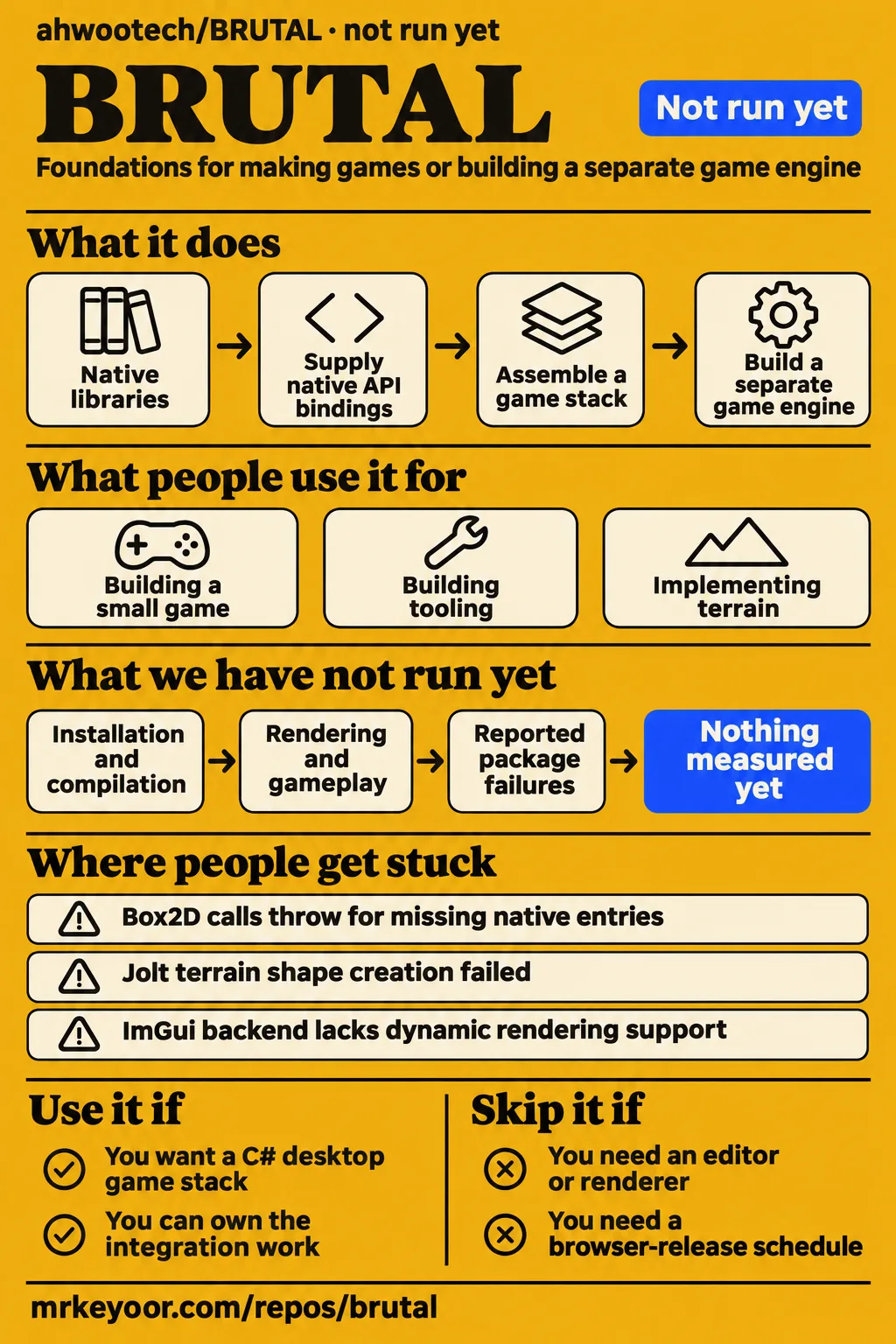
ahwootech/BRUTAL is a C# framework for developers who want to assemble a game stack or build a separate engine. Use it when that control is part of the project and you can own the integration work. Choose another route when you need an editor, scene graph or supplied renderer. The README explicitly excludes those systems, so their absence is a product decision rather than an unfinished feature implied by this review.
What people use BRUTAL for
Developers describe using BRUTAL for small games, multiplayer physics, tooling and terrain, while a maintainer reports Android application testing. These reports give a more useful starting point than treating every listed binding as interchangeable. A small desktop game, a terrain system and a Vulkan UI backend exercise different parts of the framework, and the issue records attach specific outcomes to those choices.
| Who used it | What they attempted | What they reported |
|---|---|---|
| GitHub user Delunado | A small game | Enjoying development since launch and requesting web publishing. Platform issue #7 |
| GitHub user internet-creature | A multiplayer project with physics and gore | Missing collision callbacks and broken convex-hull shapes blocked that work. Jolt issue #13 |
| The team reporting issue #16 | Tooling built on BRUTAL | Box2D 2026.10.1 declared 484 native entry points; the reporter found 64 missing. Box2D issue #16 |
| GitHub user EwyBoy | Terrain using Jolt heightfields | Shape creation failed with a sample-count error. Jolt issue #13 |
| Maintainer werkz-by-drake | An Android application across aspect ratios | Reported testing with 4 Android devices and identified desktop as the official priority. Platform issue #7 |
The multiplayer developer reports enjoying BRUTAL while also describing physics and gore work as blocked. Those statements explain different parts of the decision: the developer likes working with the framework, but the required collision behavior still determines progress. For a similar project, the relevant acceptance work concerns collision callbacks and convex-hull shapes, rather than the general presence of a Jolt package.
The README names Kitten Space Agency as built directly on BRUTAL and describes Ludeon's Waylith engine as another use of the framework. Those are upstream descriptions of projects using the foundations. They illustrate the intended architectural choice: write a game directly against the libraries or place your own engine above them. The README leaves that choice to the developer. BRUTAL project descriptions
What happened when we ran it
Our run at commit c4c62f5 on November 15, 2026 stopped before application execution: the harness recorded unsupported C# and no Dockerfile. The allocated sandbox had 3 CPUs and 8 GB RAM, with image n/a. Install, build and tests were not run. These are the recorded configuration and outcome of our attempt, separate from the package failures reported by developers.
| Recorded item | Outcome | What it tells you |
|---|---|---|
| Sandbox configuration | 3 CPUs, 8 GB RAM, image n/a | Recorded allocation |
| Install, build and tests | Not run | Harness status was not_runnable |
| Deployment safety step | Failed because no recognized Compose file existed | The Compose requirement stopped the deployment path |
| Teardown | Recorded as ok | The cleanup step completed |
The failed safety-step record names all four missing filenames: compose.yaml, compose.yml, docker-compose.yaml and docker-compose.yml. Its error label is "unsafe repo", followed by the rule requiring a Compose file. The teardown record records "teardown: ok". Together, these identify the failed deployment prerequisite and the completed cleanup step.
The generic run record also says the repository deployed using its own Docker Compose, with every port bound to 127.0.0.1. That statement conflicts with the missing-Compose failure and the explicit not-run outcome. The application outcome reported here follows the concrete failure and harness status; the generic deployment sentence is retained here as a conflicting record rather than adopted as a successful result.
Where people get stuck: native methods and release status
Issue #16 reports that 64 of the 484 native entry points declared by Box2D 2026.10.1 were absent from the shipped native library. The reporter identifies public helpers including B2Rot.GetAngle(), Box2D.MakeRot(...) and Box2D.Normalize(...), and says calls to the missing entries throw EntryPointNotFoundException. The consequence is direct: an exposed managed method can still fail when it reaches the native library. Box2D binding report
The same reporter attributes 63 missing entries to inline helpers and the remaining entry to a conditional assertion function. A maintainer says shims are on the way, and the sampled issue is open. For someone building tooling against this package, the practical question is which helpers the application actually calls. An API declaration supplies the method name; the report shows why the native export matters too.
Jolt issue #13 contains a separate count: the reporter lists 3246 declared entry points and 774 missing from jolt.dll. The supplied discussion also records terrain shape creation failing with "Sample count too low!", while a multiplayer developer reports blocked collision callbacks and convex-hull work. A maintainer says the gaps were fixed internally, followed by a reply giving no fixed release date. Jolt binding discussion
| Package or path | Reported problem | Response in the supplied record | Useful next action |
|---|---|---|---|
| Box2D | 64 missing native entry points in 2026.10.1 | Shims described as on the way; issue open | Exercise the helpers the application uses |
| Jolt | Mesh, heightfield, convex-hull and collision-callback problems | Internal fix reported; no fixed release date supplied | Identify the package containing the required correction |
| Collections NativeList | Insert can leave Capacity below Size | Replacement implementation described as almost done | Inspect insertion and growth behavior in the selected implementation |
| Slang matrix layout | API output differs from command-line compilation | Maintainer reproduces the mismatch and recommends Column Major | Set matrix layout to match the compilation route |
| ImGui Vulkan backend | Dynamic rendering unsupported in the reported backend | Contributor fork and custom-backend routes discussed | Choose the backend or separate render-pass route deliberately |
| SDL with Glad | String signature conflicts with the byte-pointer delegate | Reporter supplies an adapter; maintainer expects a next-release correction | Examine the adapter against the selected package |
The Slang matrix-layout discussion, ImGui dynamic-rendering report and SDL delegate report describe different integration tasks. Slang has a suggested layout setting. The reported ImGui backend calls for a different backend or a separate render pass. SDL has a conversion adapter. Keeping those responses distinct makes the table useful when estimating the work for a particular stack.
Published fixes have stronger evidence than closed tickets
BRUTAL release v2026.10.1 explicitly lists corrections for the clipboard crash and ISlangBlob.GetBufferSize on Windows. Its package table also separates the umbrella release label from individual dependency versions. That distinction resolves the apparent reversal between the clipboard report's ImGui.Backends 2026.10.2 and the release label 2026.10.1: the release table moves the ImGui packages to 2026.10.3. BRUTAL v2026.10.1 release
The clipboard report proposes returning null when Glfw.Clipboard contains no text. The release lists both the crash and the corresponding pull request under its corrections. The issue discussion also distinguishes BRUTAL's backend from Kitten Space Agency's custom backend. Keeping those backend names attached to the report avoids treating every application using ImGui as if it shipped identical clipboard code. Clipboard issue #8
The Windows blob-size report gives an expected value of 960 and an actual managed result described as a random number, while the native result remains 960. Its author explicitly questions the accompanying LLM explanation. The release supplies the concrete correction record, so the useful account is the reported size mismatch and named fix, rather than adopting the tentative ABI explanation as a diagnosis. Slang blob-size issue #22
The licence requires branding before the primary function
BRUTAL's README describes an MIT-based licence with additional attribution requirements: credit, a logo before gameplay and a shipped NOTICE.txt. It also describes separate commercial arrangements and logo waivers. In issue #14, maintainer rocket2guns explains that a dedicated splash screen is one option and gives a game's main menu as another placement that can satisfy the requirement. BRUTAL licence description
That distinction affects product design. A team deciding whether BRUTAL fits its game should consider where the branding would appear and whether the credits and notice requirements fit its release process. Developers in the discussion object to mandatory branding and custom terms even after the splash-screen clarification. Their objection concerns the obligation itself, rather than only the number of screens before a game starts. Licence discussion #14
The README says there are no royalties, including for commercial games, and says the licence has not been submitted for OSI approval. It also directs readers to the separate licences of third-party components. Calling the framework simply MIT would omit the added requirements that drive the discussion. The relevant decision is whether the actual terms suit the product, including any separate arrangement offered by the team.
Memory safety deserves attention before a larger workload
Issue #11 reports NativeList insertion leaving Size above Capacity, followed by an Add writing beyond the allocation. The reporter describes the resulting native-heap corruption as silent and potentially appearing later elsewhere. The byte overload has another reported problem: it does not increment the stored byte size, so the inserted byte is not counted. NativeList issue #11
AaronRKB replies that a replacement NativeList implementation is almost done and that the bug does not exist in it. This gives a specific code path to examine when choosing collections for an application: insertion into a full list, subsequent growth and byte-size accounting. The README's use of unmanaged memory and unsafe code makes these operations relevant to the framework's intended foundations, rather than an unrelated concern about application scripting.
BRUTAL vs MonoGame and Silk.NET
MonoGame describes an XNA-style game framework, while Silk.NET describes native graphics, multimedia and compute bindings for .NET. BRUTAL supplies native bindings alongside foundations such as memory management, collections and concurrency. Those scopes suggest different starting points for a C# developer: an established framework model, a bindings library, or foundations for a stack whose architecture the developer chooses.
| Candidate | Evidence relevant to the decision | Pick it when |
|---|---|---|
| BRUTAL | README describes interop, memory, collections and native-library bindings | You want these foundations and intend to own the game architecture |
| MonoGame | README identifies a reimplementation of Microsoft's XNA Framework | You want the XNA framework model and its documented platform routes |
| Silk.NET | README describes native API bindings and MIT/X11 licensing | Native API access and those licence terms suit the project |
MonoGame's README lists desktop, mobile and console platforms, with console access for registered developers. It also identifies content-processing tools and a content pipeline. Those details make it a concrete alternative for someone seeking the XNA model, rather than a substitute selected only because it shares C# with BRUTAL. Its documented toolchain belongs in the comparison alongside the framework API.
Silk.NET's README lists bindings including Vulkan, GLFW, SDL and WebGPU, and states that Silk.NET uses MIT/X11 licensing. It also says the team is concentrating on 3.0, with limited investment in 2.X and updates released when development effort is justified and available. That maintenance statement belongs beside its API scope when selecting a dependency for a new project.
Search results confuse several things named Brutal
The supplied search material includes fixrb/brutal, a Ruby testing tool, alongside ahwootech's C# framework. The Ruby project's description says it writes plain Ruby test files from YAML manifests. Identifying this review as ahwootech/BRUTAL prevents that unrelated tool from becoming evidence about the game framework's capabilities, users or quality. Ruby Brutal source record
Questions people ask
Desktop platforms are BRUTAL maintainers' stated priority, and the platform discussion also reports WebASM, Xbox and Android proofs. The following questions come from the supplied issue discussions and concern choices a new project would need to make: its delivery target, rendering backend, licence arrangement and dependency versions. The answers preserve the distinction between a maintainer's reported experiment and a published package correction. Platform discussion #7
Will BRUTAL support web/WASM, consoles and mobile beyond desktop?
A maintainer reports proofs on WebASM, Xbox and Android, including testing an Android application on 4 devices. Another reply describes WebAsm demos, and the thread identifies Windows, Linux and macOS as the official priorities. The same discussion answers the question about Vulkan versus WebGPU by saying WebGPU was tested. These are the targets and implementation work described by the maintainers. Platform experiments
Can BRUTAL's pre-gameplay logo requirement be removed or waived?
The README offers separate commercial licensing and describes logo waivers for non-profit projects and circumstances where displaying the logo would harm the application's purpose. The licence discussion also directs developers to contact the team about removal or modification. A team considering this route should describe its actual product and intended branding placement so that the arrangement addresses the relevant interface. BRUTAL licensing options
Why does Slang API compilation require matrix transposes when slangc compilation works?
The maintainer reproduces the reported mismatch and recommends Column Major layout to match slangc's default behavior. The reply attributes the difference to documented Slang behavior and leaves the issue open for discussion. For a project encountering this result, the concrete setting to examine is the matrix layout used by each compilation route. The supplied response proposes that setting rather than a rewritten shader. Slang layout response
How can an application using Vulkan dynamic rendering draw ImGui with BRUTAL?
Issue #23 describes using a custom backend or creating a separate render pass for the reported ImGui Vulkan backend. The supplied discussion also offers a contributor fork. These options change different parts of an application's rendering integration, so the choice depends on whether the project intends to maintain a backend or accommodate the existing render-pass path. ImGui backend options
What we have not tested yet
Installation, compilation, rendering and gameplay were not executed in our sandbox; its unsupported-ecosystem result supplies no application performance measurement. The 8 GB allocation is configuration rather than a minimum requirement, image n/a identifies no runtime or operating-system version, and the Compose safety label is a harness rule rather than a security finding. Our evidence contains no frame times, application memory consumption, load test, dependency audit or test-suite result.
We have not reproduced the reported package failures or retested the release corrections. The Jolt internal-fix reply, NativeList replacement reply and SDL next-release expectation do not identify delivered corrections for every reported problem. The supplied Jolt record also mentions mesh and ray-query export gaps and the error "Need triangles to create a mesh shape!"; these remain reporter findings, alongside the heightfield sample-count failure, rather than results from our sandbox. The separate KSA clipboard backend needs its own release attribution.
The platform discussion supplies no fixed schedule for broader target support. The licence discussion supplies no affirmative answer about court testing, terminal-interface compliance or permission for an ASCII redraw of the logo. The developer stories do not measure adoption or completed shipping outcomes. Rendered layout, assets, automatic related links, recommendation modules and template content also fall outside this text review. These boundaries are why the four editorial rating dimensions remain unassessed.
BRUTAL suits C# desktop developers who want these foundations and can investigate the bindings their application depends on. It does not suit developers who need a supplied editor or renderer, or teams requiring a committed browser-delivery schedule. A useful next step is to choose the smallest decisive application path, record its managed and native package versions together, and assess that path before committing the wider game architecture.