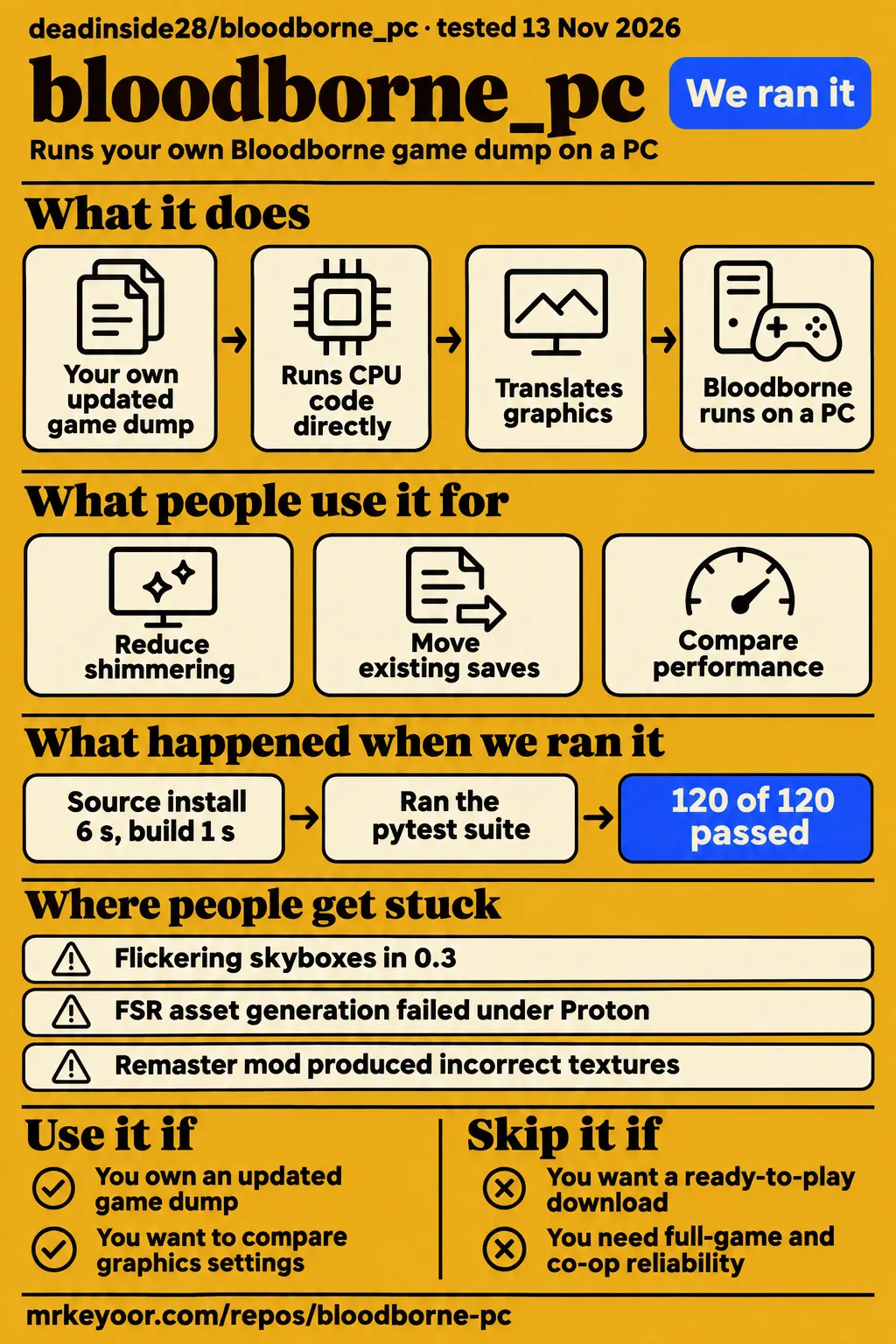
bbport is a candidate for Linux or Windows players who own an updated Bloodborne dump and want to compare graphics settings against an existing setup. Players seeking a ready-to-play download or requiring full-game and co-op reliability should not choose bbport on this review's evidence. Upstream 0.7 adds Windows support, while its current documentation answers the mod-order question left open in older discussions. The useful choice is between specific repositories and releases, each with its own launcher, rendering behavior and support destination.
Upstream Windows support arrived in 0.7
Upstream bbport supports Windows 10/11 from release 0.7, according to its current README. Older descriptions that divide the choices into deadinside28's Linux version and Supermedo's Windows version omit an upstream Windows option. Both repositories offer Windows routes. The upstream 0.7 release notes identify commit 0fc2921 and describe a Windows x86-64 build requiring Vulkan 1.3, with a launcher that opens the selected game folder.
Bloodborne's original x86-64 CPU code runs directly, while a game-specific runtime replaces PS4 system libraries and graphics are translated to Vulkan. The renderer and shader translator began with shadPS4 code and were rewritten, according to upstream. The README's Wine and DXVK analogy explains that division of work. Technical ancestry and support ownership are separate: upstream directs bbport questions to its own community. Upstream architecture and support instructions.
Stars show attention; issue reports show specific outcomes
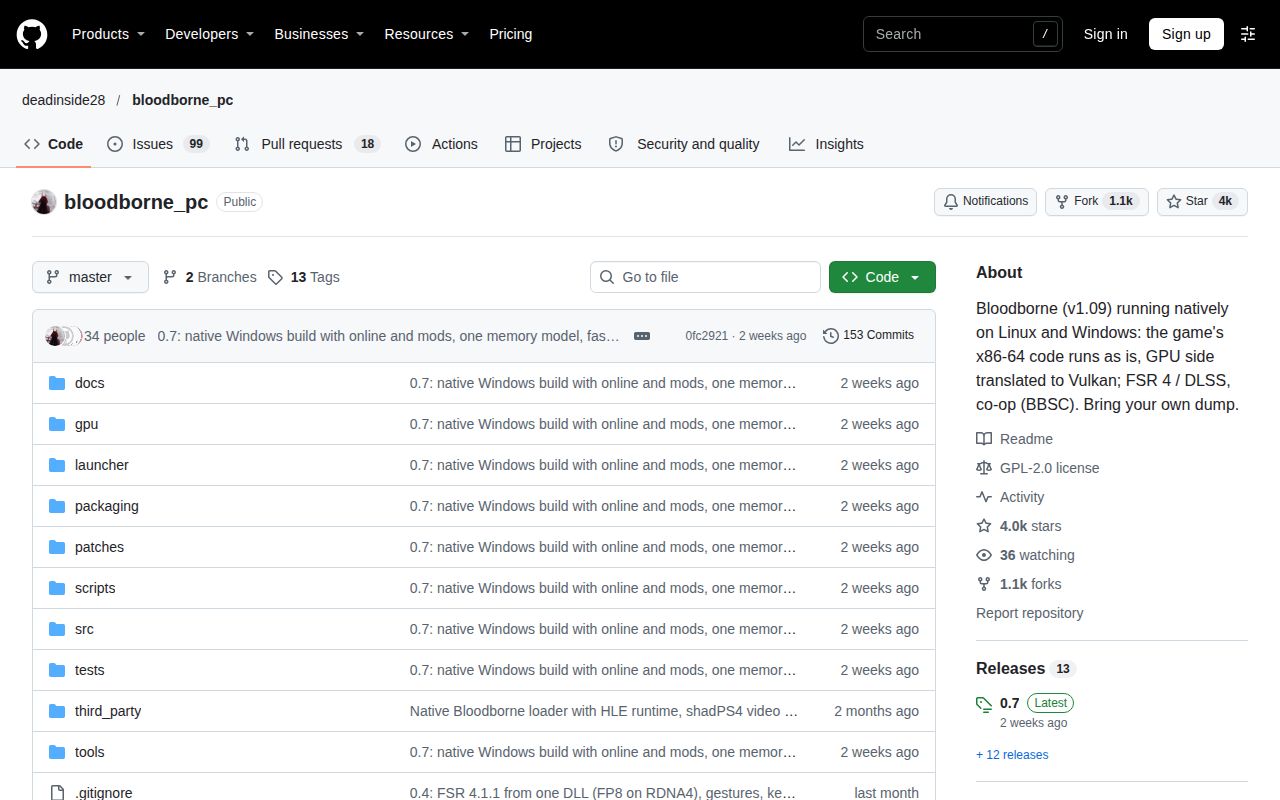
GitHub's supplied public API record returned 4,049 stars and 117 open issues and PRs for upstream on November 13, 2026. Its last push was October 28, 2026, and release 0.7 was published that day. These figures describe repository activity. The player reports below answer practical questions by naming hardware, settings, releases and failures that readers can compare with their own setup. Repository metadata source.
The tracker distinguishes shipped repairs from requests to reproduce an older problem. In the BBSC thread, the maintainer explicitly identifies a repair in 0.7. In the ghosting thread, the maintainer cites rewrites and asks for a fresh reproduction. Those replies carry different meanings even though both reports are closed. A release-specific repair statement gives readers a firmer basis for action than the issue's closed status alone.
What people use bloodborne_pc for
Players report using bbport to reduce shimmering, move existing saves and compare performance with other builds. The use cases below retain each reporter's context. They also show why the same feature attracts different reactions: one player values temporal image stability, while another prefers an image without temporal anti-aliasing. Start with the visual or operational problem you want to solve, then choose a comparison that addresses it.
| Who used it | What they did | Reported outcome |
|---|---|---|
| Heliumrich in issue #9 | Compared native TAA/FSR with the base image | Praised reduced shimmering on thin geometry, including at 4K; another commenter preferred avoiding temporal AA. |
| gibs2193 in issue #251 | Compared upstream Linux with Supermedo/Jgamrot through Wine on an RX 9070 XT | Reported an easy 120 FPS upstream versus barely 60 FPS through Wine, then encountered graphical-mod problems. |
| shaneo88 in issue #26 | Merged game and update folders and brought over a shadPS4 save | Reported mostly 50-60 FPS on an RTX 3060 Mobile after the exit-code-132 crash stopped following the merge. |
| whp199 and another player in issue #282 | Applied three fixes to the 0.6 sources | Reported a working Seamless Hunt summon between a Linux guest and Windows host. |
The RX 9070 XT discussion connects speed with visual correctness. gibs2193 reported better performance upstream, but also missing floors, broken skies and incorrect textures with a graphical remaster mod. Another user with the same GPU reported that the mod worked. A player choosing a build for that remaster mod therefore has a reason to inspect the scene as carefully as the frame counter. Graphical-mod comparison.
What happened when we ran it
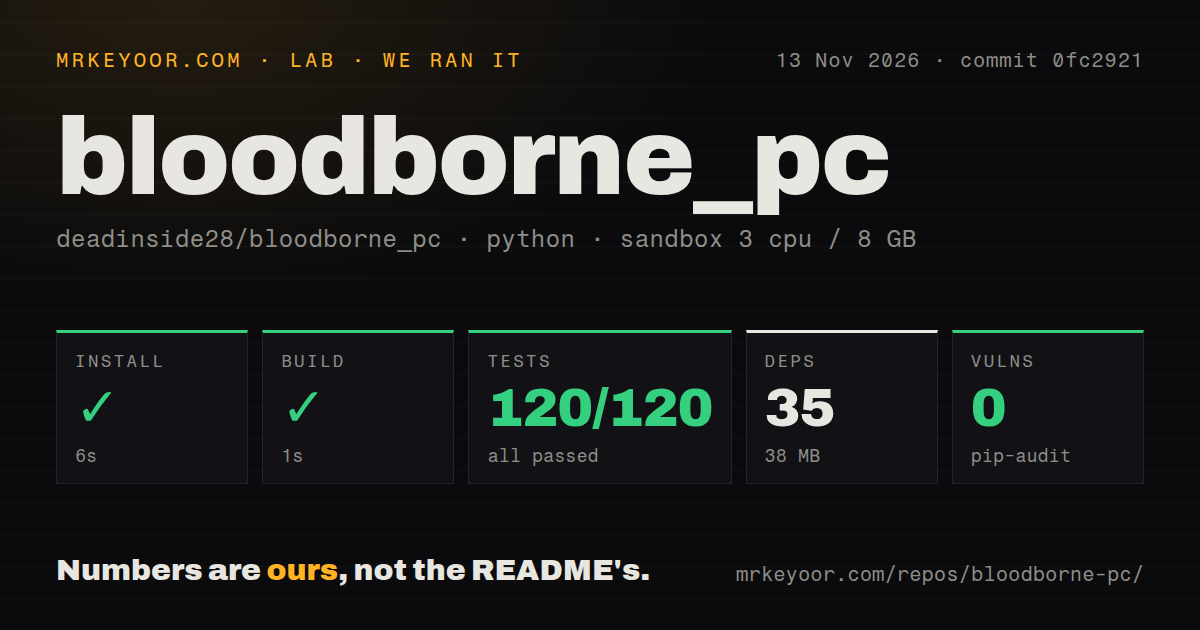
Our November 13, 2026 sandbox run recorded installation in 6 seconds, a build in 1 second and a successful test command in 63 seconds at commit 0fc2921. The harness recorded 35 dependencies and 38 MB on disk. Its repository scan separately recorded 2,232 files, approximately 828,129 source lines and a 61.7 MB checkout. The table separates command outcomes, file-scan findings and the independent hands-on attempt.
| Recorded question | Answer | Verdict | Why |
|---|---|---|---|
| Did installation complete? | Succeeded in 6 seconds; 35 dependencies recorded; 38 MB on disk | Command succeeded | These are the harness's installation and dependency figures. |
| Did the build command complete? | Succeeded in 1 second | Command succeeded | The harness recorded a successful build-command exit. |
| Did the test command complete? | Succeeded in 63 seconds; pytest reported 120 passed, 0 failed and 28 skipped of 120 | Command succeeded; totals conflict | Passed plus skipped exceeds the reported total. |
| What did pip-audit report? | 0 known vulnerabilities | No known advisories reported | This is the recorded audit result. |
| What did the checkout scan find? | 2,232 files, approximately 828,129 source lines and 61.7 MB checked out | Scan recorded | Checkout size is separate from the dependency footprint. |
| What automation files did the scan find? | 0 CI workflow files, no Dockerfile and a tests directory | Scan recorded | These findings describe files at the measured checkout. |
| Did the separate hands-on safety step pass? | None of compose.yaml, compose.yml, docker-compose.yaml or docker-compose.yml existed | Failed | That runner required a Compose file. |
| What did the hands-on summary say? | It claimed deployment with the repository's own Docker Compose and every port bound to 127.0.0.1 | Conflicting record | The explicit safety step reported that no accepted Compose file existed. |
| What did teardown report? | teardown: ok | Recorded as ok | This is the supplied teardown outcome. |
The sandbox configuration records 3 CPUs, 8 GB RAM and image label ghcr.io/astral-sh/uv:python3.12-bookworm. The harness classified the ecosystem as Python, while the supplied GitHub metadata identifies the repository's main language as C++. Those are separate recorded fields. The release page identifies 0fc2921 as the 0.7 commit, matching the revision recorded by the harness. The page retains both fields without replacing the measured checkout with another build.
The hands-on runner's "unsafe repo" result names its own Compose-file requirement. Upstream documents desktop Linux and Windows packages. The explicit failed step is the basis for describing where this attempt stopped; the generic summary separately claims deployment. The supplied hands-on safety record, run summary and teardown record preserve those conflicting outcomes.
Where people get stuck: releases, mods and old workarounds
The tracker documents a BBSC repair in 0.7, player workarounds for older builds and requests for fresh reproductions. A shipped repair points readers toward a release; a workaround describes a user's change; a retest request asks for another observation. The table preserves those distinctions so that a historical settings experiment stays attached to the version and symptom it addressed.
| Symptom and source | What the thread supports | Next action |
|---|---|---|
| Exit code 132, issue #26 | shaneo88 reported that the crash stopped after merging game and update folders. Other reports involved different failures. | Check the matching game/update layout. |
| Flickering skyboxes in 0.3, issue #44 | Users described ConstantRing and two-stage-pipeline workarounds. | Treat these as historical settings experiments. |
| Sewer ghosting, issue #18 | The maintainer cited rewrites and requested a fresh 0.7 reproduction. | Reproduce the reported camera movement and location. |
| FSR asset generation, issue #61 | Finoderi reported success in 0.5-pre-release; later users described Proton-detection and build failures. | Compare the generation output with the selected build's instructions. |
| Missing BBSC kit and ?GoodsName?, issue #282 | The maintainer says 0.7 fixes Linux eboot-image reads and restores the hunter's kit. | Start with the shipped repair before applying a historical module shim. |
| Missing floors and incorrect textures, issue #251 | The synthesis records gibs2193's later report of acceptable behavior with FSR 4.1.1 and Native AA. | Compare that combination with the affected scene. |
| Mouse sensitivity differs across axes, issue #251 | gibs2193 said the mouse issues disappeared after pulling newer code. | Compare source revisions as well as sensitivity settings. |
| FSR 4.1.1 or 4.1.X labels after generation, issue #385 | Users posted differing labels and interpretations of generation output. | Keep the displayed selection alongside the generation log. |
Issue #282 contains more than the missing-kit symptom. A contributor reported that the Kin Bell built a sign locally without posting it, then described a separate failure where the host claimed a sign but the guest never joined. Their patched test achieved a summon between a Linux guest and Windows host. The notes describe matching at the same lamp and a first ring losing a race against the host's 25-second timeout. BBSC diagnosis and patched summon report.
Current upstream documents a mod load order: later mods override conflicting files. Its launcher accepts separate loose-file mod folders with enable switches and ordering, and the README says the original game is preserved. This supplies a documented answer to the historical precedence question in issue #251. It also gives a practical way to arrange replacement files without copying each experiment into the original game folder. Upstream mod-loading documentation.
Local files and online accounts need separate decisions
Upstream includes no game files and requires your own dump with update 1.09. Its requirements describe copying the dumped update over the base game, replacing files. The Windows instructions ask you to choose the folder containing eboot.bin. Optional upscaler assets are a separate input. These preparation steps explain why the harness's 38 MB dependency footprint is separate from preparing the game itself. Upstream requirements.
The upstream README describes two online pools: Seamless Hunt uses an account and BBSC, while The Hunter's Dream uses Discord sign-in without BBSC. It also says the online module is never loaded offline. For Seamless Hunt's seamless co-op, the README says every player needs BBSC and the same server. That configuration belongs in the choice of online pool, alongside the account flow and the repository's own instructions.
The README also describes texture-quality controls and freeing unused textures. Those features matter when comparing a clean installation with a texture pack or moving between areas during a session. A useful comparison records the same character, location, camera route, output resolution, upscaler, mod list and mod order. Keep frame-time output beside FPS, and distinguish generated frames from game frames. This is the comparison checklist for the reports and alternatives on this page.
bloodborne_pc vs shadPS4 and Windows forks
Upstream 0.7 provides Windows support, so operating system alone no longer separates bbport from Supermedo's fork. The supplied comparisons concern reported speed, remaster-mod behavior, launcher features and temporal image quality. The table names the evidence behind each option and the problem it may help address. A working existing setup is also a useful baseline when deciding whether a different build offers something you need.
| Candidate | Evidence behind the choice | When to try it |
|---|---|---|
| Upstream bbport | gibs2193 reported an easy 120 FPS on an RX 9070 XT, compared with barely 60 FPS through Wine, alongside initial mod problems in issue #251. | You want upstream's documented features and can compare the affected scenes. |
| Mainline shadPS4 | GameGPU reported port results of around 120 FPS and 121 FPS against shadPS4's 104 FPS and 95 FPS on an RTX 5070/Ryzen 7 5700X system. GameGPU comparison. | You already have a working emulator setup to retain as a baseline. |
| Supermedo's Windows fork | Its supplied README describes five guided first-start checks. Fork documentation. | Its launcher and fork-specific support address your setup needs. |
| IFreemz/shadPS4-Bloodborne-DLSS-FSR | Heliumrich recommended this repository for less ghosting in issue #5. | Temporal artifacts are the complaint you want to compare. |
Heliumrich recommended IFreemz/shadPS4-Bloodborne-DLSS-FSR for less ghosting in issue #5. That October comment also mentions DLSS, which current upstream now documents too. The enduring reason to inspect the recommendation is therefore the reporter's image-quality comparison. Inspect fences, foliage and moving characters alongside the counter when comparing temporal methods; the RX 9070 XT discussion shows how a higher reported frame rate can accompany broken modded scenery.
What the other reviews get wrong
MakeUseOf's description of PS4 code running without any emulation omits the compatibility runtime and Vulkan graphics translation described by upstream. The useful distinction is which work runs directly and which work the port replaces or translates. Upstream also explicitly describes a build for one game rather than a rewrite of Bloodborne's source code. MakeUseOf research synthesis, upstream architecture.
The supplied synthesis identifies MakeUseOf's treatment of 30 FPS as the frame-rate cap. Current upstream documents unlocked operation and 30/60/90 FPS modes, so the original game's default limit is a poor description of the port's available settings. The author's reported result belongs with that author's build and configuration. A Windows-fork article also concerns a different repository from upstream bbport, even when both run on Windows.
GamingBible describes co-op and PvP as fully functional. Issue #282 supplies a release-specific counterpoint: users reported the missing BBSC kit and broken item names in earlier Linux builds, followed by the maintainer's 0.7 repair statement. Supermedo's supplied README labels online play beta. The fork, release and server therefore matter to interpreting an online-play claim. GamingBible record, BBSC repair, Windows-fork documentation.
The Facebook exchange concerns a different entity. A reply identifies the subject of the PS1-style graphics complaint as the Bloodborne PSX Demake, deliberately made to resemble a PS1 game. That exchange belongs with the demake rather than a judgment about deadinside28/bloodborne_pc. The full repository name distinguishes this mix-up from a graphics comparison between upstream bbport, shadPS4 and a Windows fork. Demake exchange.
Questions people ask
Upstream documents direct x86-64 CPU execution, Windows support from 0.7 and later-mod priority. Those current answers resolve questions raised in older discussions, while the developer's workflow answer and players' settings reports retain their original attribution. The FAQ distinguishes the current documentation from historical plans and individual outcomes, so a reader can use an old question without also inheriting its outdated premise.
How does bloodborne_pc work, and how does it differ from shadPS4?
bbport runs the original x86-64 CPU code directly, replaces the system-library calls Bloodborne uses and translates graphics to Vulkan. Upstream describes shadPS4 as a general PS4 emulator and bbport as a compatibility implementation for Bloodborne v1.09. Its renderer and shader translator started from shadPS4 code. That specialized scope explains the Wine and DXVK analogy. Upstream architecture comparison.
Will the renderer eventually be independent of shadPS4?
In issue #5, the maintainer said they planned to decouple the renderer. Current upstream describes the renderer and shader translator as derived from shadPS4 and rewritten, and credits shadPS4 as their starting point. The October answer states a development intention; the README describes the project's current architecture and ancestry. Maintainer's renderer answer, current upstream description.
How much code does AI generate, and how does the developer verify it?
The maintainer says Claude Code generates code and runs checks, followed by personal testing on a PC and Steam Deck. The answer describes assigned tasks and the developer's desired outcomes, including stability and working anti-aliasing and upscalers. Those goals are separate from the specific repairs and player outcomes elsewhere on this page. Maintainer's development-workflow answer.
Is a Windows version planned for the upstream project?
Upstream Windows support shipped in 0.7, according to the current README and release notes. The release describes a Windows 10/11 x86-64 build requiring Vulkan 1.3, with a launcher that opens the selected game folder. The earlier planned-version answer in issue #5 is historical; Supermedo remains a separate repository with its own launcher. Upstream Windows release.
Which settings make graphical remaster mods work with the Linux port?
The supplied synthesis records gibs2193 reporting acceptable behavior with FSR 4.1.1 and Native AA after earlier texture failures. Another user recommended keeping mod files separate from the originals. Current upstream documents that separate-folder approach and a load order. The report gives readers a specific settings combination to compare with the scene that previously failed. Mod discussion.
How do I enable a 21:9 aspect ratio?
Current upstream documents live 21:9 aspect-ratio support through hooks, alongside 4:3, 16:10, 16:9 and 32:9. Its display instructions describe selecting the output resolution and aspect ratio. The older issue #151 discussion concerned patch selection and later reached a Supermedo-fork crash report. Use the controls documented for the selected repository. Current aspect-ratio documentation, historical discussion.
Which mod takes precedence when two enabled mods replace the same file?
Current upstream documents that later mods override conflicting files. The launcher supports separate loose-file mod folders, enable switches and load order, while preserving the original game. The historical question in issue #251 asks which copy wins when two enabled mods contain the same file; the current README now supplies that ordering rule. Upstream mod-order documentation, historical precedence question.
Can this approach improve frame pacing after shader-cache generation?
Current upstream describes shader recipes compiled before play and cache reuse across updates. Heliumrich's earlier question in issue #5 specifically concerns microstutters after shader-cache generation. Shader preparation and frame pacing are related subjects, but the documented cache behavior answers how preparation works. The comparison checklist above describes what to retain when examining the frame-time result. Frame-pacing question, upstream shader-cache description.
Does an FSR 4.1.X label actually confirm FSR 4.1.2 is running?
Issue #385 records users seeing FSR 4.1.1 or 4.1.X labels after attempting asset generation, alongside logs referring to 4.1.2 models. Participants disagree about what the labels and performance changes mean. The input DLL identities, generation output and displayed model selection are separate pieces of that record, and a faster frame counter alone does not identify the implementation. FSR identification discussion.
What we have not tested yet
Our hands-on attempt stopped before gameplay, so this review contains no measured gameplay performance, image-quality assessment, full play-through, co-op session or GPU-memory test for upstream 0.7. The pack supplies no gameplay screenshots or known-answer task results. The successful harness commands cover their recorded activity. Raw toolchain logs are needed to establish actual runtime versions, identify command coverage and reconcile pytest's inconsistent passed, skipped and total figures.
The supplied reports provide no matched benchmark across Linux, upstream Windows, Windows forks through Wine and shadPS4. We have not exercised documented later-mod priority, independently identified the active FSR 4.1.2 implementation in the disputed reports, or validated AI-generated changes beyond the developer's described checks. The workflow answer supplies no percentage of generated code, and the renderer plan supplies no completion date. Historical graphics and asset-generation reports also leave the full 0.7 regression picture unresolved.
Setup ease, documentation usability, support quality and release maturity remain unscored because the attempt never reached supported desktop operation or a repeatable play session. Launcher-language behavior is outside our observations. Upstream's release notes list hardware and release limits, including untested RDNA4 FP8 operation, unverified Polaris support and an open rare guest fault. The next useful step is a supported desktop setup with a clean updated dump and save backup, followed by the repeatable scene comparison described above.