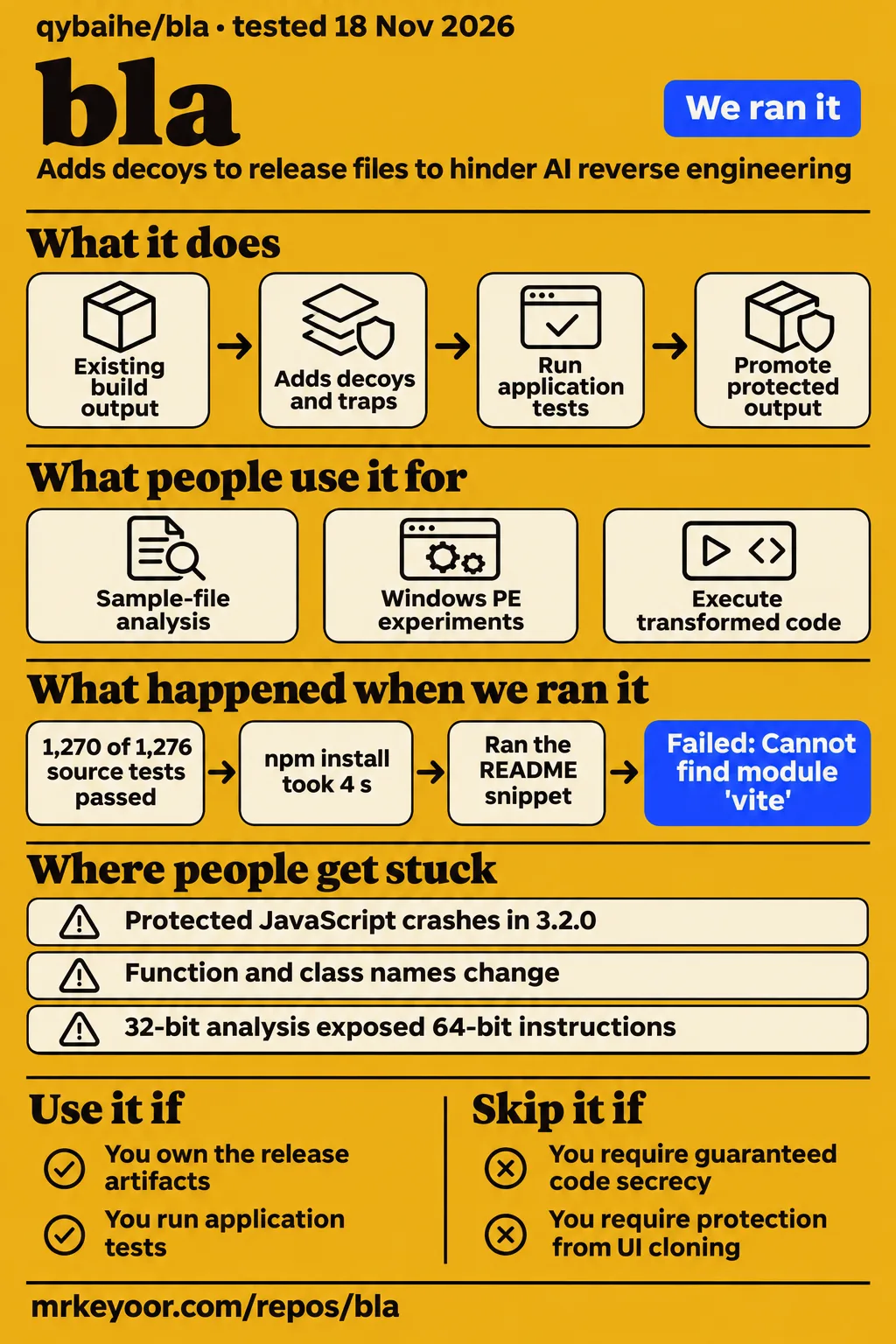
qybaihe/bla adds decoys and analyzer-limit traps to release files to hinder AI reverse engineering. Use it if you own those files and can compare protected output against a specific attacker workflow and your application's behavior checks. Skip it if your release decision requires guaranteed code secrecy or treats a successful structural report as proof that the application works.
Our source run passed installation, build and tests, with 1,270 tests passing. A separate attempt used the README from checkout c20d5dcb10c1 and npm-installed bla-agents 3.5.0. Running its Vite configuration stopped at a missing module. These outcomes answer different questions: whether the source checkout passes repository checks, and whether that copied configuration executes in the recorded environment.
What people use bla for
The supplied examples cover sample-file analysis, Windows PE experiments and JavaScript compatibility reproductions. They give release engineers concrete tasks to repeat with their own artifacts: ask an analyzer to recover known information, execute transformed code and compare the results with the original. The useful outcome is the recovered information or observed behavior, rather than the protection score alone.
| Who used it | What they did | What happened |
|---|---|---|
| BLA maintainers, reported by Botmonster | Hardened samples and called REA analyzers | Nine formats produced hard errors; WASM analysis was partial. |
| GitHub user AyobamiH | Protected synthetic JavaScript and executed the output | Reported crashes and changed observable names in 3.2.0, even when the public defend command reported success. |
| GitHub user jupiternext | Analyzed hardened Windows PE files with DeepSeek 4.1 Flash, then retested | Initially reported little change in token use; later reported higher spending while the agent still identified decoys. |
| AyobamiH, reported by Botmonster | Ran REA 6.8.0 on a fully protected PTX kernel | REA read all 129 entry points in the 26 KB file without hitting a limit. |
The BLA README offers a CLI, an MCP server for coding agents and bundler hooks. A release engineer can harden existing build output; an agent can orchestrate source changes and artifact protection. Choose the intervention that matches your task. An artifact comparison and an agent-directed source rewrite involve different permissions and require different application checks.
What happened when we ran it
Our README-snippet attempt used bla-agents 3.5.0 and stopped with Error: Cannot find module 'vite'. The README came from checkout c20d5dcb10c1; the attempt installed the npm package separately. The installation record identifies the installed package version. That separates the documentation snapshot, the package under execution and the later release metadata.
The November 18 hands-on record identifies a fresh, unprivileged lab-node:22 container with 2 CPUs, 4 GB RAM, no published ports and no secrets. The task was to execute the unedited, six-line TypeScript block under the README's bundler-plugin heading using tsx. The snippet step records failure in 0.4 seconds, exit 1 and the missing Vite module.
| Hands-on question | Answer | Verdict | Why |
|---|---|---|---|
| Did the quickstart-lib clone step complete? | The recorded clone step took 1 second. | Completed | The clone record records that step. |
| Which package did the attempt install? | npm installed bla-agents 3.5.0. | Version identified | The package installation record names the installed version. |
| What occupied the installed directory? | node_modules occupied 9.8 MB. | Recorded size | The installed-size record measures the directory after installation. |
| How many other packages were installed? | 17 packages besides bla-agents. | Recorded count | The dependency-count record supplies this count. |
| Did the unedited Vite snippet execute? | It failed in 0.4 seconds with exit 1: Error: Cannot find module 'vite'. | Failed | tsx stopped during module resolution, as recorded in the snippet log. |
| Did the attempt produce a working bundle or protection result? | Execution stopped at the missing Vite module. | No result | The snippet finding records the failure. |
| Did teardown complete? | teardown: ok | Completed | The teardown record records completion. |
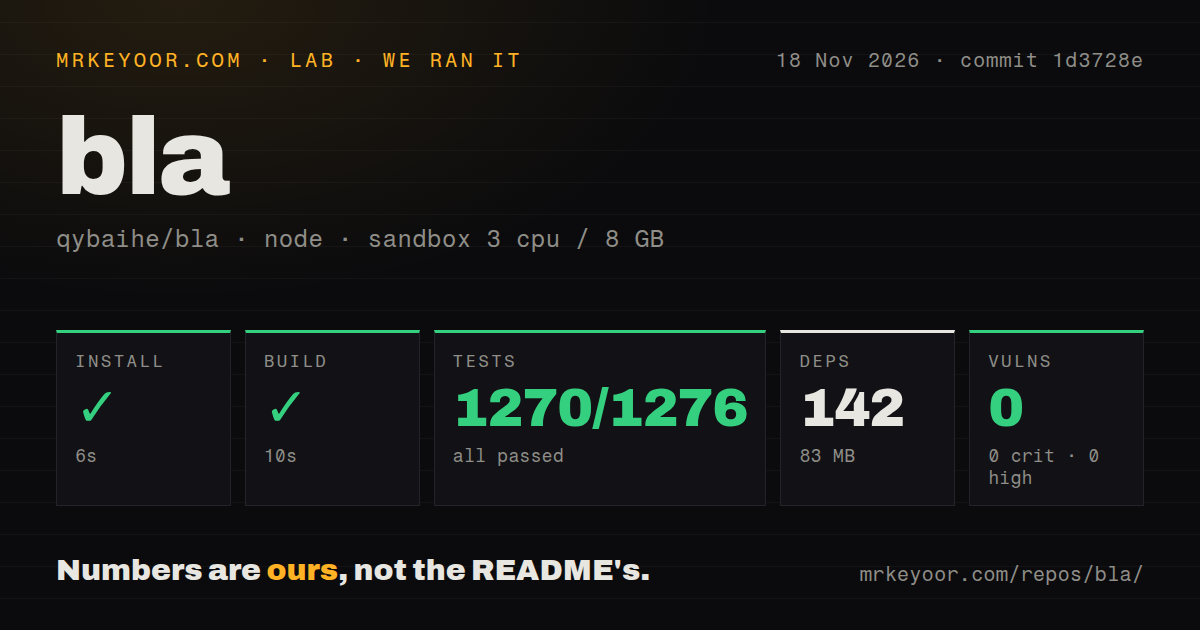
The source harness checked commit 1d3728e on November 18, 2026, using a configured sandbox with 3 CPUs, 8 GB RAM and image label lab-node:22. Our run installed the source checkout, built it and ran its repository suite. These measurements belong to that checkout and environment; the npm-package snippet attempt above has its own version, resources and outcome.
| Source-harness step | Result | What it means for a developer |
|---|---|---|
| npm installation | Succeeded in 6 seconds; 142 dependencies recorded; 83 MB on disk | Source-checkout installation completed in this sandbox. |
| Build | Succeeded in 10 seconds | This commit produced its build output. |
| Tests | Succeeded in 748 seconds; 1,270 passed, 0 failed, 6 skipped of 1,276 | The test suite was the longest recorded step. |
| npm audit | 0 known vulnerabilities across all reported severities | The audit returned no known dependency advisories in this run. |
The checkout contained 511 files, approximately 141,301 source lines and 14.4 MB. The scan found three CI workflow files and a tests directory, and detected no Dockerfile. Contributors should budget for the measured 748-second suite when changing the tool. Release owners have a separate task: exercising the transformed application through its behavior tests, packaging process and promotion procedure.
Where people get stuck: structural success can accompany broken JavaScript
AyobamiH's issue #154 reports that BLA 3.2.0 produced crashing JavaScript while its protection workflow still returned success. The direct-eval reproduction stores 40 in a local variable and evaluates an expression that adds two. The original returns 42; the protected function throws ReferenceError: secretValue is not defined. The report identifies renaming of bindings referenced by direct eval as the failure.
The same JavaScript issue #154 records a shadowed Math binding. One original returns 123457, while protected output throws TypeError: Math.imul is not a function. A module-scope case throws ReferenceError: Cannot access 'Math' before initialization. The report also records changed function and class names, which matter when application registries or serialization use those observable values.
| Reported problem | Recorded resolution | Release decision |
|---|---|---|
| Direct eval and shadowed Math crash in 3.2.0 | Botmonster reports fixes shipped in 3.2.1 | Include these patterns in application regression coverage. |
| Function and class names change | Issue #154 asks for a compatibility contract | Check registries and serialization that depend on observable names. |
| A PTX marker comment passes the protection audit | Botmonster reports 3.2.1 requires actual decoy kernels | Judge the defense by analyzer output as well as its score. |
| CrackMe v6 exposes useful constants and export names | Issue #40 separates v7 challenge mitigations from product changes | Read challenge changes and product fixes separately. |
Botmonster's fix history attributes the eval and Math repairs to AyobamiH's pull request and reports the 3.2.1 release. In CrackMe issue #40, the maintainer labels factory functions as a workaround for a class-renaming failure. That distinction gives a release owner a practical checklist: reproduce the relevant application pattern and inspect its behavior after transformation.
More artifacts require paging and a record of partial work
Issue #75 records discovery paging, progress reporting and cancellation, with cancelled reports identifying written artifacts. Its maintainer updates describe offset and nextOffset paging, followed by progress and cancellation work. A release directory needs those details because stopping a long operation can leave completed outputs behind, and the caller needs a reliable list before deciding what to promote.
Save the discovered artifact list and reconcile it with the written list after hardening. After cancellation, use the reported outputs to decide whether to discard or resume the work. The issue identifies Streamable HTTP and CI-skill polish as optional follow-up work. Its closure covers the documented implementation updates; each proposed feature still has its own status and should be read that way.
Security defaults: preview changes before promoting output
The supplied README says plain hardening writes a partial mirror to .bla-hardened/, while promotion requires --apply. Build the application first, inspect the copied output and run its behavior checks before release. The documented restore operation provides another step in that workflow. Keep the original release available while evaluating the protected copy, particularly when packaging or signing steps change.
For MCP callers, preview issue #71 records read-only discovery, a zero-write dry run and overwrite confirmation with a write receipt in version 2.0. Evidence-ledger issue #72 records stable unsigned run IDs, lookup and correlation between protection metadata and structural-check results. Together, these controls let callers inspect planned work and retain a record of completed operations.
The README describes the shields as TypeScript/Node.js implementations and reserves external tools such as Wabt and tshark for optional live REA exercises. Its CLI quick start contains no model-provider credential step. The coding-agent route adds the host's configuration and permissions and can change source as well as artifacts. A disposable build copy is a practical starting point for evaluating that workflow.
English docs exist; Windows guidance also lives in Chinese threads
The main README is English, while Windows PE issue #157 contains Chinese user reports and maintainer replies. jupiternext initially reported little change when using DeepSeek 4.1 Flash, then reported increased spending after improvements. The thread also describes structural clues that exposed decoys, including 64-bit instructions in a 32-bit program and section permissions. Those reports identify specific properties to examine in PE output.
The PE follow-up record attributes architecture-matched islands and executable section flags to main at 6e5d14f. Separately, the supplied repository metadata records a November 18, 2026 push, and the latest-release record names bla-agents-3.5.1. Keep those versions separate from the npm-installed 3.5.0 snippet attempt and from the earlier 3.2.0 JavaScript reproductions when deciding which report applies to a release.
BLA vs VMProtect, classic obfuscators and raised REA limits
BLA targets analyzer budgets and deceptive artifacts; the maintainer recommends a build sequence that places VMProtect after BLA's compile-time headers. JavaScript Obfuscator provides a separate JavaScript-focused comparison. These choices answer different release requirements, so select the artifact and the information an analyst must recover before comparing outcomes. The supplied sources describe capabilities and workflows rather than a common head-to-head benchmark.
| Choice or workflow | What the evidence supports | When to choose it |
|---|---|---|
| BLA | Botmonster describes decoys and format-specific REA capacity failures | You have a named analyzer path and application behavior checks. |
| VMProtect alongside BLA | The maintainer recommends BLA headers before compilation, then VMProtect | Your native workflow uses virtualization and you control the build sequence. |
| JavaScript Obfuscator | Its README documents identifier renaming, string transformations and control-flow flattening | You want a JavaScript-focused transformation tool to evaluate. |
| REA with raised limits | Botmonster and the BLA README describe caller-adjustable limits | You are comparing default-limit failures with retries under larger budgets. |
| Rebuilding from screenshots and interaction | Botmonster describes a workflow that avoids protected-file inspection | Your evaluation concerns visual or interaction cloning. |
The VMProtect discussion in issue #169 recommends generating BLA defense headers, compiling and then applying VMProtect. The maintainer warns that post-build modifications change file size or checksums and can conflict with whole-file integrity checks. For Authenticode-signed binaries, the reply says BLA skips rewriting the binary and generates sidecar decoys. Resolve that sequence before adding protection to a signed release.
JavaScript Obfuscator's README lists variable renaming, string extraction and encryption, dead code injection and control-flow flattening. The JavaScript Obfuscator README also distinguishes its free package from the hosted Obfuscator.io VM offering. Compare the edition and options you intend to use, then measure recovery of known information and preservation of application behavior on the same input.
What the other reviews get wrong
Botmonster's broad claim that agents cannot read BLA-protected files exceeds the mixed outcomes reported on that page. Its BLA review describes partial WASM analysis and complete PTX entry-point analysis alongside hard errors. The useful conclusion is format-specific: the reported failure of one analyzer path answers a narrower question than whether an agent can recover information from any protected release.
The 2,800x token figure is an internal estimate, not an independently measured result. Botmonster explains that BLA calculated its modeled amplification from REA limits without running REA. The supplied README now explicitly labels the benchmark's token and dollar columns as internal estimates and explains that callers can raise many limits. Keep those modeled figures separate from the listed live analyzer outcomes.
The supplied X extract contains one post by 0xCodila making both claims: that BLA checks every protected file still runs the same, and that REA is no longer dangerous. The 0xCodila post needs to be read against issue #154's runtime failures and Botmonster's successful PTX analysis. The supplied README explicitly describes bla verify as checking structural gates and directs users to run application tests.
qybaihe/bla is unrelated to the other bla npm project
This review covers Blind LLM Agents from qybaihe, installed as bla-agents. The supplied baby-loris/bla repository record describes a different API library installed with npm i bla. Use the owner, full product name and official package together when locating documentation or troubleshooting. That avoids treating an unrelated package's examples as instructions for this software-protection tool.
Questions people ask
The BLA README starts CLI use with existing build output and npx bla-agents harden .. Its separate npx bla-agents setup command registers the coding-agent integration. The questions below come from the supplied synthesis of user questions and issue discussions. Their answers distinguish maintainer-reported support, earlier compatibility failures and the recorded workflow controls so readers can choose the relevant documentation path.
How do I install and use BLA to protect my app from AI reverse engineering?
The official package is bla-agents, and the README recommends Node.js ^22.23.4 or >=24.0.0. Build the application first, then use npx bla-agents harden . to create the partial mirror. The documented --apply step promotes protected files over build output. Run the application's tests against the promoted build before releasing it, as directed by the BLA README.
Does BLA support MSVC, cl.exe, and Visual Studio builds?
The maintainer reports support for MSVC, cl.exe, clang-cl.exe and Visual Studio at 4c1b69b. The MSVC issue #22 covers both compile-time C/C++ headers and post-build Windows EXE/DLL hardening. Its reply describes compiler-specific header behavior, giving native developers a concrete toolchain entry point rather than requiring them to infer support from the presence of GCC or Clang examples.
Should I apply BLA before VMProtect to EXE and DLL files?
The maintainer recommends generating BLA defense headers before compilation, compiling them with the program and applying VMProtect afterward. The sequencing reply in issue #169 also explains how post-build changes interact with whole-file integrity checks and Authenticode signatures. Use that documented sequence when planning a native release and retain the application's signing and packaging checks in the release procedure.
Does BLA meaningfully increase token usage when analyzing Windows PE files?
jupiternext reported little initial change, then increased spending after improvements in issue #157. The analyzing agent still identified structural signs of decoys. The Windows PE report therefore supplies a specific user observation and a follow-up sequence. For an application decision, compare the same recovery task on original and protected PE artifacts and record the analyzer configuration used for each.
Can BLA generate architecture-specific decoy instructions for 32-bit PE files?
The maintainer reports genuine 32-bit x86 islands for PE32 and separate architecture patterns at 6e5d14f. That update followed a report that 64-bit instructions exposed the decoys in a 32-bit program. The architecture follow-up in issue #157 also describes executable section flags. Those are concrete implementation changes to examine when selecting a build for a PE comparison.
Does bla verify actually prove that protected JavaScript behaves like the original?
No. The supplied README calls its checks structural, and Botmonster reports that 3.2.1 changed the wording after crashing-output reproductions. Issue #154 records the earlier passing reports for failing JavaScript; Botmonster's fix account describes the correction. Application behavior requires execution of the relevant tests, including any use of direct eval, shadowed globals or observable function and class names.
Can I preview hardening without writing files or overwriting my build?
Yes. The maintainer records read-only discovery and a zero-write MCP dry run in version 2.0. The preview and confirmation issue #71 also records refusal to overwrite without confirmation and a write receipt. These controls provide an inspection step before an MCP write operation; the CLI's default partial mirror is a separate documented part of the release workflow.
How can I process more than 64 artifacts and cancel a hardening run safely?
Use discovery paging and the returned next offset, then retain the written-artifact list after cancellation. The maintainer's paging and cancellation updates in issue #75 identify paging in #90 and progress and cancellation in #92. Reconcile discovered inputs with written outputs before promotion so that a cancelled task's completed artifacts remain accounted for in the release process.
Can I retrieve a hardening run's evidence after restarting the MCP server?
Issue #72 records stable unsigned run IDs and bla_run_lookup as the shipped ledger mechanism. Retrieval after process restart was part of the issue's requested scope, and the closing reply identifies the implementation and metadata correlation. The evidence-ledger discussion gives callers a concrete lookup name to consult when preserving run evidence outside the coding agent's conversation memory.
Is the BLA plugin available through the Claude marketplace?
The supplied issue's closing update tracks manifest bundling and external portal submission on a release checklist. The marketplace issue #177 distinguishes shipping a skill playbook from wiring up the MCP server during marketplace installation. Use the README's documented setup route for the workflow described here, and read the checklist status separately from the issue's closed label.
What we have not tested yet
Our evidence covers a source harness run and a README-snippet failure, rather than a completed protected production application. The snippet stopped before a working bundle or protection result. We have not tested a representative JavaScript application, measured REA token consumption or independently rerun the reported compatibility repairs. The source harness and snippet records use different commits, package contexts and resource allocations.
The lab-node:22 image label does not identify the actual Node.js or operating-system version; those require raw toolchain logs. The passed source suite and zero-advisory audit cover the recorded repository checks. They do not prove application compatibility, release security or runtime equivalence across the advertised formats. The 3.5.1 release metadata likewise does not change the snippet attempt's recorded npm version of 3.5.0.
The supplied evidence leaves final PE effectiveness at 6e5d14f, Authenticode sidecars, the recommended VMProtect sequence, observable-name compatibility, sustained production use, debugger resistance and actual marketplace availability unresolved by our own testing. Signed-manifest trust is separate from the unsigned run ledger. The modeled token multiplier needs an independent cost experiment with analyzer settings recorded. Screenshot-based cloning also sits outside file-inspection defenses, as Botmonster explains.
For the next trial, choose one release artifact, specify the information REA must recover and retain the application's behavior checks. Compare original and protected files under default and raised analyzer limits. Record recovery outcomes, token use and distribution size separately. Promote protected output only after it passes the application's release checks and the measured resistance justifies the resulting distribution and maintenance cost.