Six metadata sources make Bindery a credible Readarr replacement
Bindery exists because Readarr's central metadata backend disappeared. Its answer is architectural: OpenLibrary is the default source, while Google Books, Hardcover, DNB, Audnex, and Audible can enrich or fill gaps. The app monitors authors, searches indexers, sends a chosen release to a download client, and imports the result into an ebook or audiobook root. A Readarr database importer carries authors, indexers, clients, and the blocklist into the new system.
That scope is narrower than the long feature list first suggests. Bindery acquires and organizes books. It does not try to become the best reader or audiobook player. The README describes Calibre-Web-Automated and Audiobookshelf as downstream tools, and the project can hand files or catalogue data to them. This division makes sense: one service decides what to fetch and where it belongs, while another handles the reading experience.
The 124-test run backs up the single-binary pitch
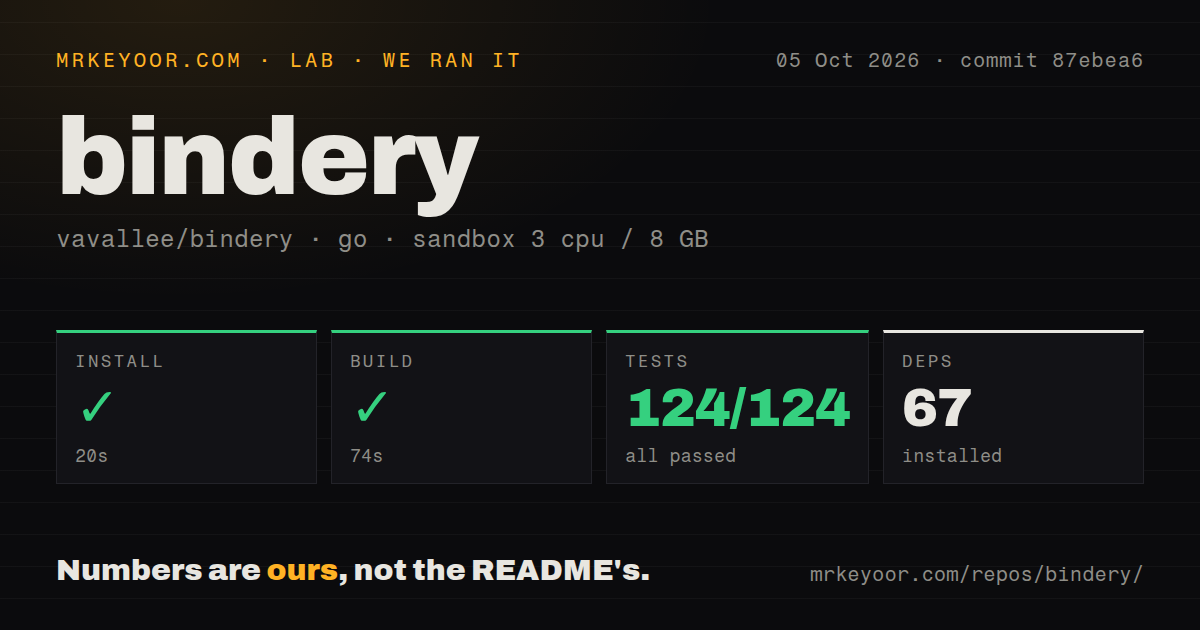
Our sandbox installed commit 87ebea6 in 20 seconds and added 67 packages. The build succeeded in 74 seconds. Go test then completed in 264 seconds with 124 passed and 0 failed of 124. The container was unprivileged, had 3 CPUs and 8 GB of RAM, and held no secrets. We tested repository mechanics, not metadata quality or real download throughput.
The checkout was substantial at 1,697 files, roughly 419,692 lines of source, and 24.1 MB. It included a Dockerfile, a tests directory, and 18 CI workflow files. That is a reassuring amount of visible verification for a project that writes files, stores API keys, and talks to services on a home network. It also tells contributors this is no tiny Go utility despite the single-binary deployment.
What happened when we ran it
Our run produced a clean install, build, and test result at commit 87ebea6. Installation took 20 seconds for 67 packages, the build took 74 seconds, and all 124 Go tests passed in 264 seconds. No supplied result measures search relevance, metadata accuracy, download speed, or the success rate of matching an existing library. Those need your own catalogue and storage layout.
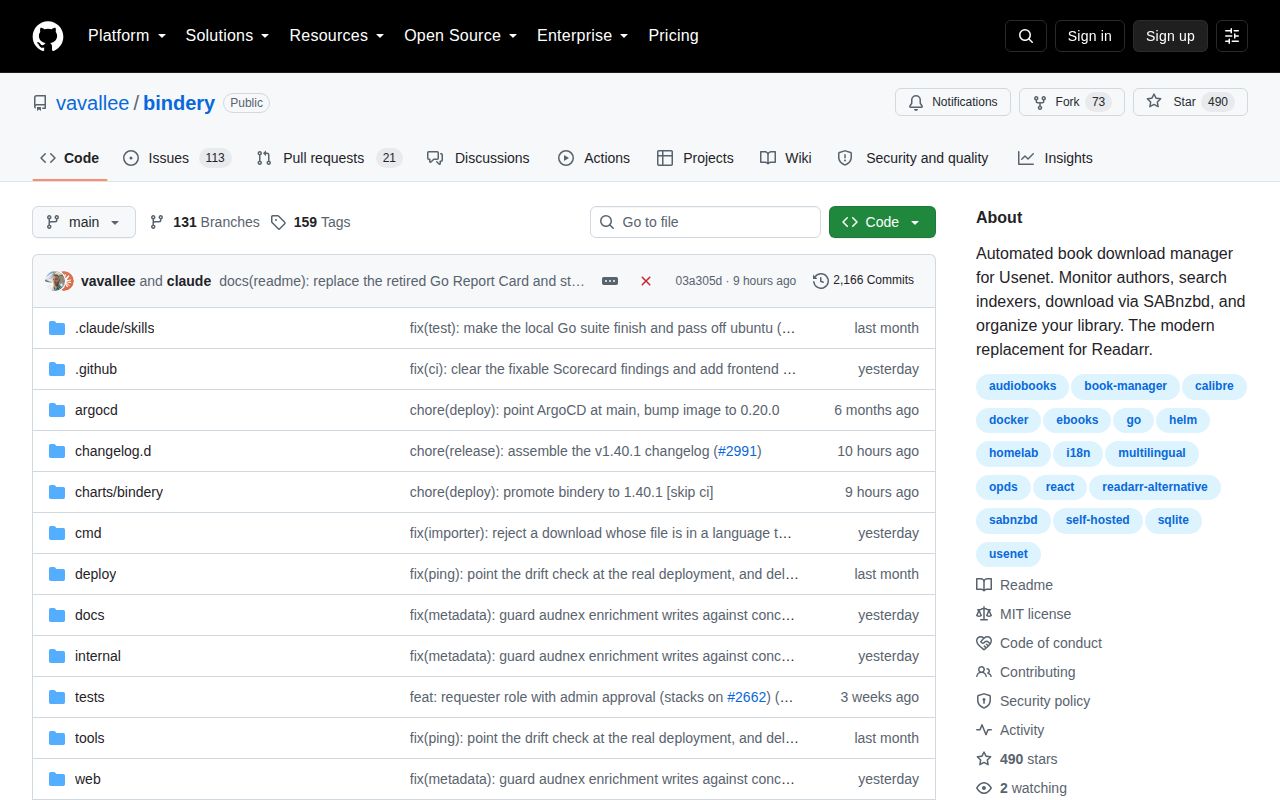
The repository signals were equally concrete. We found 18 CI workflows, a Dockerfile, and a tests directory. The size was 24.1 MB before installed packages. This combination matters more than the binary being easy to launch: an ebook manager can rename, move, copy, or hardlink files, so a regression can damage a carefully arranged library even when the landing page loads. Keep backups and test imports against a sample root.
Port 8787 is easy; the three mounted paths are the work
The quick start maps port 8787 and mounts /config, /books, and /downloads. First load creates the administrator. From there you still need an indexer and a download client whose protocol matches it. Bindery must understand the path reported by that client, see the completed file, and write to the correct library root. Separate containers or machines often require a path remap.
Permissions add one sharp edge. The official image is distroless and cannot change users after it starts, so the Compose user value must match the owner of the mounted files. Hardlinks only work on the same filesystem. Copy mode is safer across mounts but uses more storage. The built-in Diagnose action checks client connectivity, category, path mapping, readability, and hardlink ability, which turns a vague failed import into a specific configuration problem.
One open bug can repeat a failed Usenet grab
Issue 3024, opened October 5, 2026, describes failed NZBGet or SABnzbd content being selected again after the cooldown instead of entering the blocklist. The reporter documented repeated grabs of the same unusable releases. We did not reproduce that network workflow in our sandbox, so this is an upstream report rather than our test result. It is still a concrete reason to watch the queue after enabling unattended search.
The current tracker also shows work around concurrent scans, duplicate review, metadata matching, and import behavior. GitHub listed 134 open issues and pull requests combined on October 6. That total includes active pull requests, not 134 confirmed bugs. Release v1.40.1 arrived on October 5, and the repository was pushed later that day. The maintenance pace is high, with user reports and fixes moving together.
SQLite and daily telemetry are deliberate choices
Bindery uses SQLite in WAL mode and explicitly declines MySQL or PostgreSQL support. For one homelab instance, that removes another service and keeps backup recovery understandable. It also closes the door for teams whose platform rules require a managed database. The docs say every credential stored by Bindery is present in database backups, so those backup files need the same protection as indexer and download-client secrets.
One daily telemetry ping is enabled by default. The documented payload includes a random install ID, version, OS, architecture, deployment method, feature counts, and fixed error-message strings. The project says it excludes library contents, URLs, hostnames, and log attributes. You can disable the ping in settings or set BINDERY_TELEMETRY_DISABLED=true before the first start. That clear opt-out is good; privacy-sensitive deployments should use it deliberately.
Magazines and external databases will stay outside the plan
The roadmap says magazines and periodicals do not fit Bindery's author, book, and edition model. It also rejects an external database and direct shadow-library integrations. These are standing design limits, not missing checkboxes waiting for the next sprint. LazyLibrarian is the closer fit for magazines and comics. Calibre-Web-Automated or Audiobookshelf is better when serving files is the whole requirement.
For the intended Readarr migration, Bindery is easy to recommend for a trial. Our 124 passing tests support confidence in commit 87ebea6, while the Readarr importer and multiple metadata providers address the exact failure that displaced users faced. Start with copied data and one monitored author. If paths, permissions, and failed-download handling behave on your storage, this is the replacement I would keep.