RustDesk can use public or self-hosted connection servers
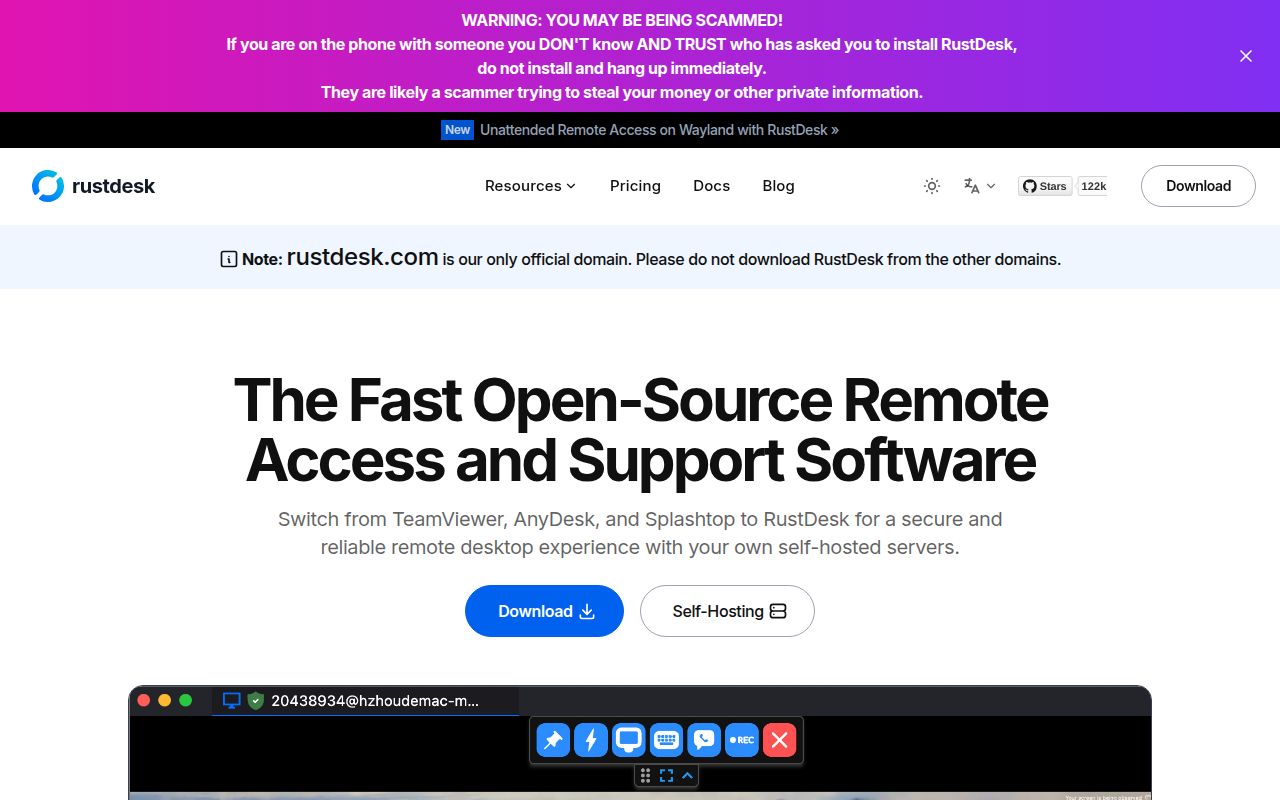
RustDesk handles remote screen viewing, input, file transfer, clipboard work, and TCP tunneling through native clients. The client first uses rendezvous infrastructure to find its peer, then connects directly when possible or falls back to a relay. You can use RustDesk's public service, deploy the separate server, or write a compatible rendezvous and relay implementation. That choice is the main reason to consider it over a closed remote-support service.
Release 1.4.9 provides downloads for Windows, Ubuntu, macOS, Android, Flatpak, iOS, and web access, with architecture coverage varying by platform. The codebase combines Rust services with a Flutter interface and older Sciter code marked deprecated. Rust handles capture, codecs, networking, input, and clipboard operations. That breadth explains both the platform reach and why compiling it is unlike building a normal Rust command-line program.
The Linux source build needs native multimedia packages
The README tells Linux builders to install compilers, GTK development files, audio libraries, X11 components, Clang, CMake, and GStreamer development packages. It also uses vcpkg for libvpx, libyuv, Opus, and AOM. A Sciter dynamic library is downloaded separately for the older GUI path, while the README points contributors to CI for the Flutter build.
Our checkout had 959 files, about 181,855 source lines, and 11 CI workflow files. A Dockerfile supplies another build route, but its documented command mounts the repository and Cargo caches rather than producing a simple runtime container. The guide warns that Cargo subcommands such as install and run are unsupported through that container method. Developers need to choose a target platform and follow its exact toolchain.
What happened when we ran it
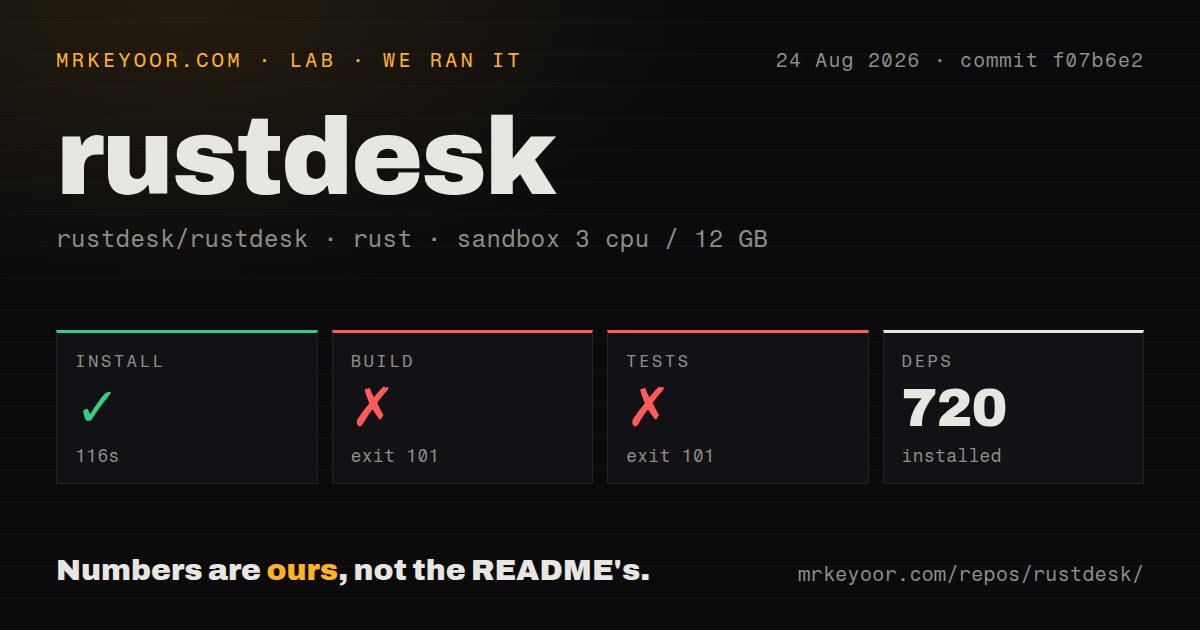
Our sandbox installed 720 Rust packages in 116 seconds. The build ran for another 165 seconds, then exited with code 101. pkg-config could not find gstreamer-1.0, the .pc file was unavailable through its search path, and PKG_CONFIG_PATH was unset. The log does not establish anything beyond that missing system-library discovery, so it would be wrong to blame RustDesk's Rust code for the failure.
Tests failed with the same exit code 101 after 5 seconds. Their log again stopped in gstreamer-sys before test execution because pkg-config could not locate gstreamer-1.0. The repository has a Dockerfile and 11 CI workflows but no tests directory. Our result shows that resolving 720 Cargo packages is only the first layer; system multimedia dependencies must be present before compilation or test execution can begin.
Version 1.4.9 ships binaries for most users
People installing RustDesk for daily use should start with published binaries rather than reproducing the development build. The July 6, 2026 release includes desktop packages, Android artifacts, Flatpak, and an iOS App Store link. Its change notes cover connection auditing, monitor restoration, terminal cleanup, clipboard behavior, file-transfer conflicts, Windows updating, and Wayland clipboard work. Those are practical remote-support details, not decorative additions.
Source builders have a different burden. The 16.5 MB checkout expands through hundreds of Rust dependencies before native SDKs and generated assets are considered. Running from the repository root matters because the executable expects resources at known paths. Teams producing internal binaries should reproduce the project's CI matrix, sign artifacts, and test updates on each supported operating system instead of generalizing from one successful target.
Wayland remains an active compatibility front
Two open reports from August 2026 are relevant to Linux buyers. Issue 15973 says a pending screencast portal request can stall later Wayland connections for minutes. Issue 15952 reports high CPU use with the preview DRM mode on Hyprland. Open pull requests also address rotated output, headless displays, session detection, cursor position, and lid behavior. This is active engineering around a difficult display stack, not evidence that every compositor path is settled.
Windows has platform-specific risk too. Issue 15945 reports paged-pool growth on one controlled Windows 11 host after display-resolution changes, with memory released when RustDesk exited. That is a reporter's reproducible environment, not a universal measurement. Fleet testing should include long sessions, resolution switching, reconnects, sleep, multiple monitors, clipboard transfer, and unattended service behavior on the hardware and drivers actually deployed.
Self-hosting moves trust into your own operations
Running the rendezvous and relay service gives an organization control over connection infrastructure and data paths. It also creates a sensitive internet-facing system that needs access policy, patching, monitoring, backups, and a defined response when credentials or endpoints are compromised. RustDesk's claim that users have full control of their data should be read as an architectural option, not a substitute for a threat model.
Licensing and product scope need a procurement pass. GitHub identifies the client as AGPL-3.0, while the README advertises RustDesk Server Pro for advanced features. Decide which server edition and management functions your rollout needs, then confirm their terms. With 121,873 stars, a push on August 26, 2026, and 147 combined issues and pull requests, the project is plainly active. That activity does not remove the work of operating remote access safely.