Hindsight stores conclusions as well as raw memories
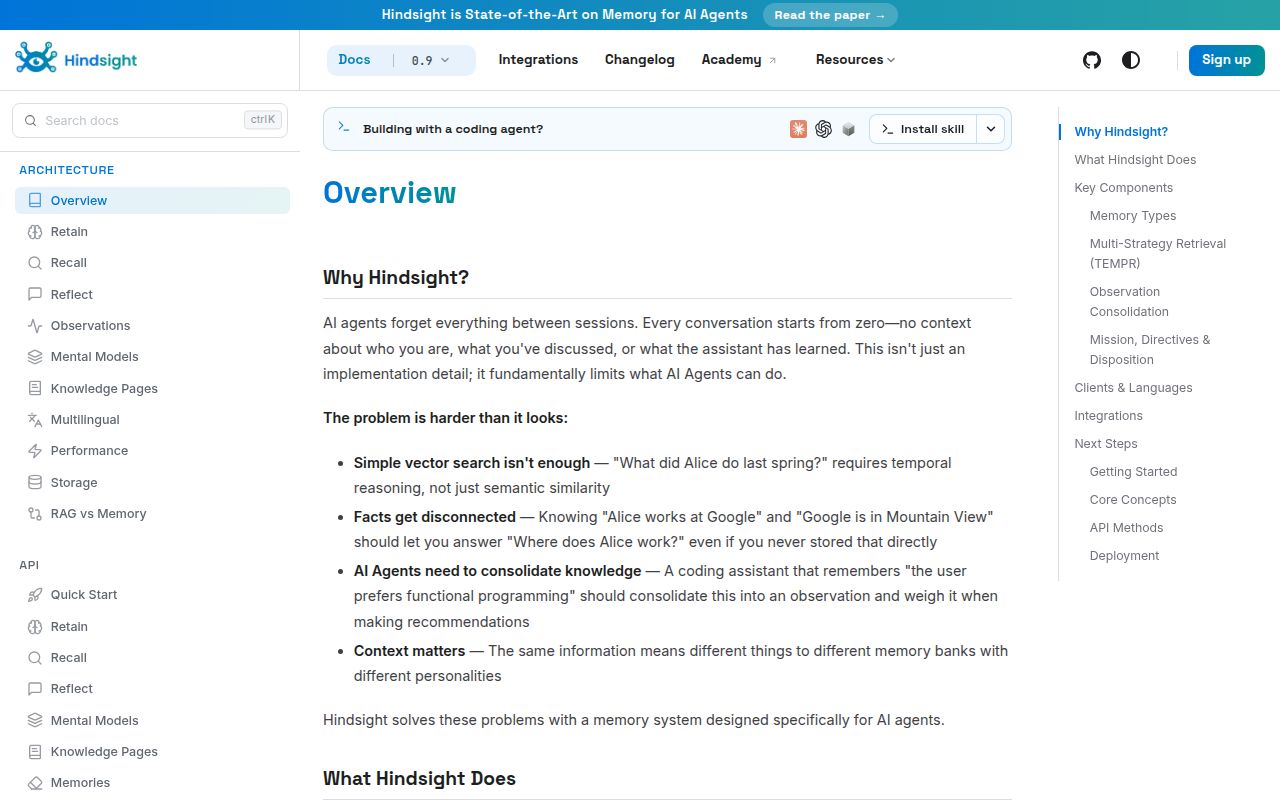
Hindsight gives an agent three main operations. Retain extracts facts, entities, relationships, and time information from new content. Recall searches semantic, keyword, graph, and temporal representations before merging and reranking results. Reflect asks a model to reason over the bank rather than returning a lookup result. The service also consolidates repeated evidence into observations and maintains standing answers called mental models. This is a richer design than saving chat turns in a vector database and retrieving the nearest chunks.
A bank isolates memory for one user, agent, or project. It can carry background information and disposition settings, while metadata can restrict retrieval within a user's material. Knowledge pages turn mental models into maintained documents that can be projected to ordinary Markdown. These parts are useful when an agent must learn preferences or project conventions over months. They are unnecessary when a workflow only needs the last few messages or a durable status field.
The coding-agent package remembers repositories and sessions
One npm package installs Hindsight support for Claude Code, Codex CLI, Cursor CLI, GitHub Copilot CLI, and several other coding agents. It creates a bank per repository, ingests git history and past sessions, and can maintain knowledge pages about architecture or ongoing work. The built-in MCP endpoint exposes retain, recall, reflect, and knowledge tools at a bank-specific URL. A separate documentation skill is available for coding assistants.
That convenience changes the sensitivity of the stored material. Session text and repository history may contain customer names, internal paths, debugging output, or credentials pasted by mistake. Hindsight documents Memory Defense with 45 patterns, but the feature is opt-in per bank. A production coding setup should decide what sessions are retained, where the database lives, which model receives extracted content, and who can call each bank's MCP endpoint before automatic ingestion starts.
What happened when we ran it
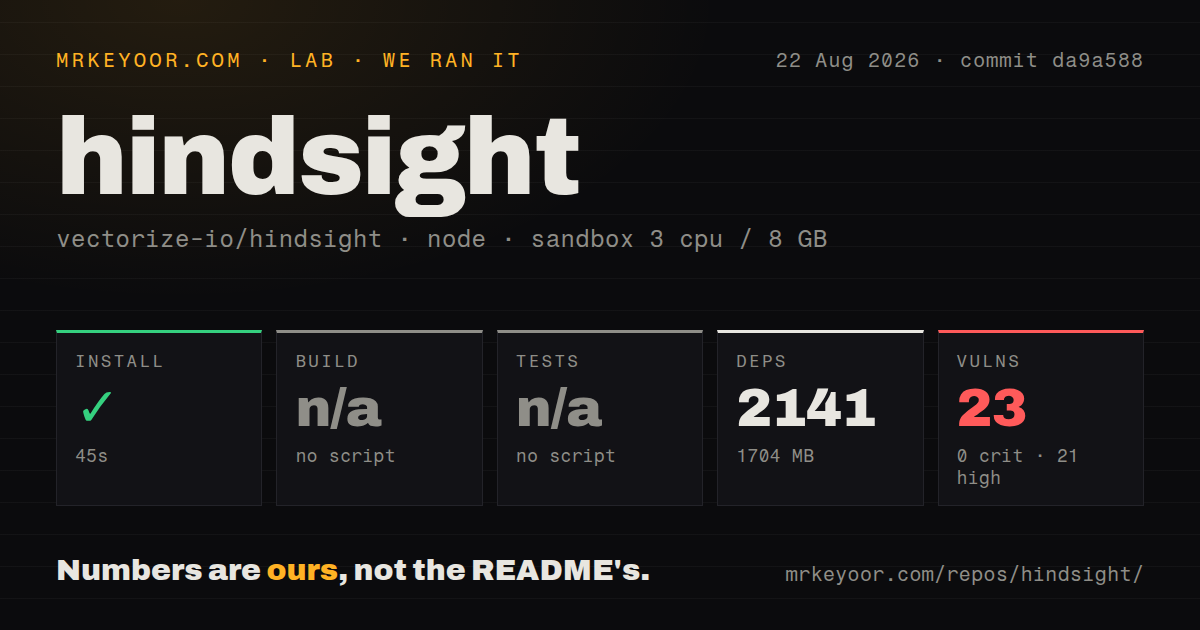
Our sandbox installed the npm workspace at commit da9a588 in 45 seconds. It pulled 2,141 packages and occupied 1,704 MB on disk. Npm audit reported 23 known vulnerabilities: 21 high, 0 moderate, 2 low, and 0 critical. That is a large client-side and tooling footprint for a memory product whose primary repository language is Python, and the high-severity findings deserve dependency tracing before deployment.
The measured workspace had no build script or target, so the build step was skipped. It also had no test script or target, so no tests ran. This does not mean Hindsight has no testing elsewhere: the checkout had 9 CI workflow files and the v0.9.2 release notes mention many fixes and test changes. It means our defined npm path produced no build or test result that a buyer can count as independent evidence.
The repository itself was substantial at 4,136 files, about 643,904 source lines, and 217.4 MB checked out. There was no Dockerfile and no top-level tests directory in our scan, although the README recommends a published container and documents several deployment routes. Our run did not start that image, connect a model, populate a bank, or measure recall accuracy. The published benchmark claims therefore remain separate from our installation findings.
Production means a model service plus a database
The shortest documented start uses a container, one LLM credential, ports 8888 and 9999, and a named volume for the embedded database. Bare-metal pip and an embedded Python package are also available. Hindsight lists more than 25 provider routes, including hosted APIs, local Ollama or llama.cpp, OpenAI-compatible services, and subscription-backed coding tools. Client libraries cover Python, Node.js, and Go, with REST and CLI access for other stacks.
For production, the README points to PostgreSQL with pgvector or Oracle AI Database 23ai. It also documents Prometheus metrics, dashboards, migrations, repair commands, stuck-operation handling, lifecycle webhooks, and tenant or authentication extension points. Helm can install the service in Kubernetes. Hindsight Cloud removes that operating work, but it changes the data boundary and billing model. Self-hosting keeps control with the team only if the selected LLM and embedding routes are local too.
Retrieval quality must be tested on your failures
The README says Hindsight leads LongMemEval and links continuously updated accuracy, latency, and cost results. It also says researchers at Virginia Tech's Sanghani Center and The Washington Post reproduced its benchmark performance, while competitor scores come from vendors. Those statements support taking the system seriously. They do not tell a support team whether a bank will preserve corrected account details, forget a revoked preference, or retrieve the right event from months of similar conversations.
A useful evaluation feeds the service contradictions, repeated names, late corrections, and information that should never cross bank boundaries. Compare recall with the exact transcript method and with a simpler database query. Record model cost and the delay added by retain, recall, consolidation, and reflect. The product's value comes from better decisions by the agent, so a benchmark win matters only when the application's own wrong-answer rate falls.
Version 0.9.2 is moving quickly
GitHub showed 21,216 stars, 122 open issues and pull requests, and a last push on August 26, 2026. Release v0.9.2 arrived one day earlier with fixes across retention, recall, databases, coding agents, knowledge pages, configuration, and memory defense. That pace shows active engineering, but the size of the change list also signals an API and operating model still being refined below version 1.0.
Hindsight is a credible choice when agent memory has become its own subsystem. Its bank model, evidence-backed observations, standing knowledge pages, and MCP access solve problems that a transcript table does not. The trial cost is higher than the Docker command suggests: our npm path used 1,704 MB, exposed no test target, and reported 23 audit findings before any model or database ran. Put it behind a real evaluation set, enable privacy controls intentionally, and adopt it only when learned memory beats simpler state.