mrkeyoor.com_
Fri 02 Oct 15:00 UTC
Self-Hostedevaluationupdated 02 Oct 2026

bank-sampah review

Bank Sampah Digital is an Indonesian-language web app for running a community waste bank, where residents exchange sorted waste for account credit. Its README and interface are in Indonesian, with no English documentation offered, and it covers deposits, pickups, withdrawals, grocery redemptions, staff work, and public price information.

Verdict

Our install pulled 81 npm packages and used 147 MB, but the build failed after 12 seconds, so Bank Sampah Digital is a source base to inspect rather than a deployment we can vouch for. Its Indonesian waste-bank workflow is unusually specific and useful for a local Laravel team willing to debug the frontend and validate the PHP side. Skip it if you need English documentation, container packaging, or an unambiguous project license.

We ran it

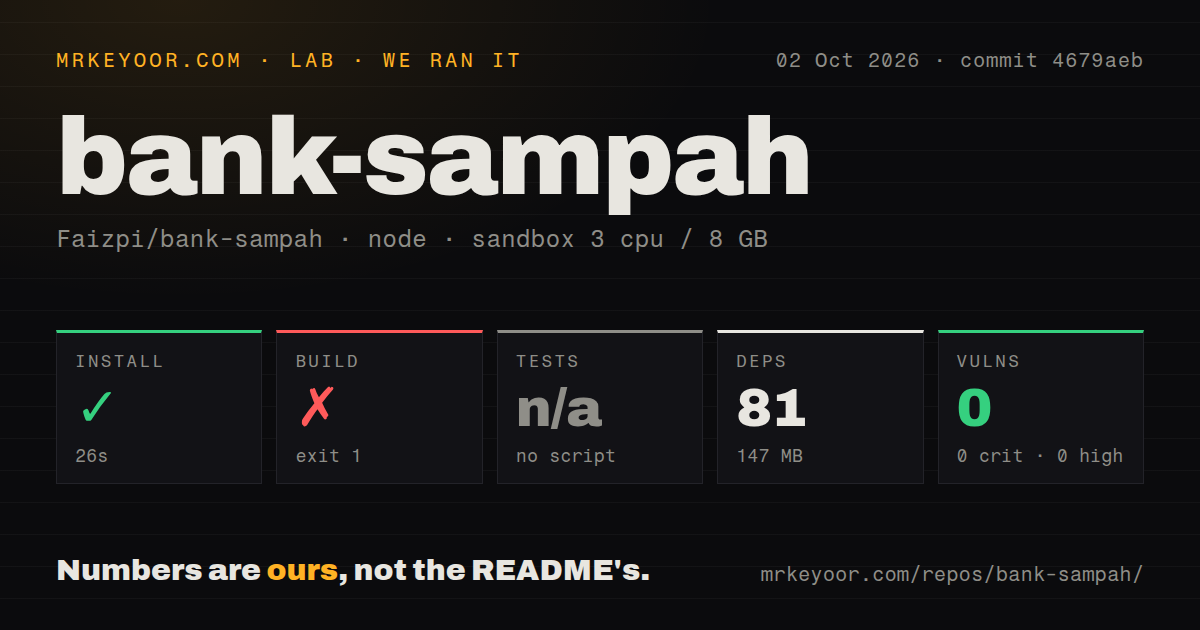
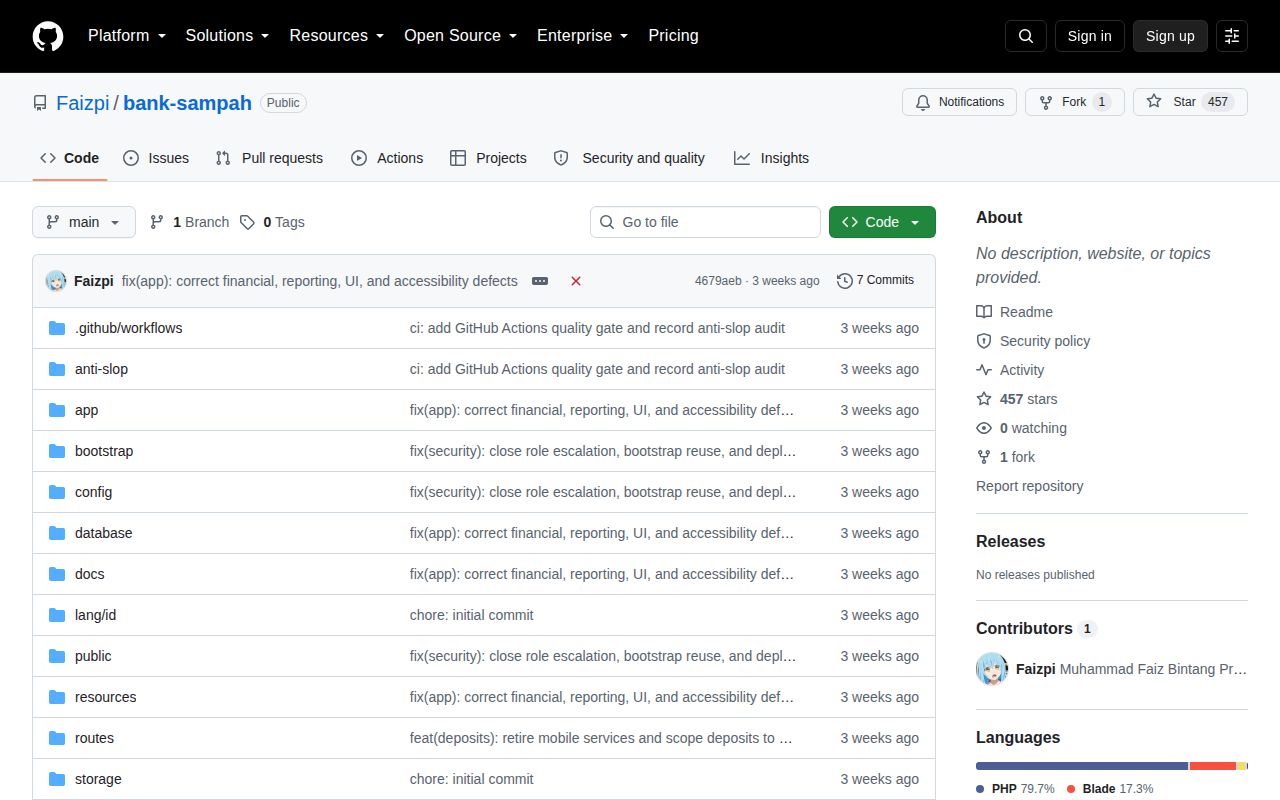
Lab card: what happened when we ran bank-sampahScreenshot of bank-sampah (github.com/Faizpi/bank-sampah)
Install✓ · 26s81 packages · 147 MB
Build✗ · 12s
Testsn/ano test script
Known vulns00 critical · 0 high · 0 moderate · 0 low (npm audit)
Repo728 files~69,984 lines of source · 16.1 MB · 1 CI workflows · tests dir

Answers from our run

Does bank-sampah build from source?

Dependencies installed in 26 seconds (81 packages), and the build failed. We cloned commit 4679aeb into a clean Debian container with 3 CPUs and no project-specific setup.

Does bank-sampah have tests you can run?

Not through a standard command: the project exposes no test script or target that our harness could run.

Does bank-sampah have known vulnerabilities in its dependencies?

npm audit found none in the dependency tree at the time of our run.

Who should not use bank-sampah?

Organizations outside Indonesia that cannot translate the product and remodel its local administrative hierarchy: the README, locale, and roles are Indonesian, and no English guide is provided.

What are the alternatives to bank-sampah?

Aplikasi Bank Sampah PHP, ERPNext, OpenLitterMap. Our install pulled 81 npm packages and used 147 MB, but the build failed after 12 seconds, so Bank Sampah Digital is a source base to inspect rather than a deployment we can vouch for.

Setup2/581 packages installed, but our 12-second Vite build failed
Docs4/5Clear Indonesian setup plus detailed architecture and operations docs
Community2/5457 stars, but no issue history or releases yet
Maturity2/5Broad workflow, young repository, and no tagged release

Who it’s for

Indonesian community waste banks that need resident balances, QR member cards, pickups, and cash withdrawals in one system.
Laravel teams prepared to adapt local roles such as petugas, bendahara, dusun, RW, and RT.
Field staff who need a phone-first interface while weighing or collecting sorted waste.
Operators who want transaction history, reconciliation, and audit records rather than a simple recycling directory.

Who it’s NOT for

Organizations outside Indonesia that cannot translate the product and remodel its local administrative hierarchy: the README, locale, and roles are Indonesian, and no English guide is provided.
Teams requiring a verified one-command setup: the README needs Composer, MySQL or MariaDB, environment configuration, migrations, and npm, while our frontend build failed.
Buyers whose policy requires a clearly granted project license: GitHub detects no license and the repository root has no license file.
Container-first operators expecting an included deployment image: our scan found no Dockerfile, and the README recommends Laragon plus a virtual host.
Teams that need an established release and support record: the repository has no releases and had no open or closed issues when checked.

Setup reality

Our npm run at commit 4679aeb installed 81 packages in 26 seconds and used 147 MB. The Vite build failed after 12 seconds. Its log tail ended inside enhanced-resolve and Rolldown error handling without naming the file or dependency that triggered the error. No npm test target existed, so tests were skipped.

The README's complete setup also requires PHP 8.3, Composer, Laravel, MySQL or MariaDB, an application key, migrations, seed data, and a configured environment file. Production seeding needs a private admin password of at least 12 characters.

The documented local route favors Laragon and a virtual host pointing at public. Our sandbox found no Dockerfile. The project defaults to the Indonesian locale and Asia/Jakarta timezone, so an overseas deployment needs product adaptation as well as server configuration.

This is software for a waste bank, not a recycling brochure

Bank Sampah Digital starts with a specific exchange: a resident brings sorted waste, a staff member records its type, condition, and weight, and the resident's balance rises at the price captured for that transaction. The same account can request collection, withdraw money, or exchange credit for grocery packages. That makes the project relevant to an operating waste bank, not merely to a municipality publishing recycling advice.

Five user groups are named in the README. Residents see balances and history, field staff enter deposits and work pickups, treasurers verify withdrawals, administrators manage prices and territories, and visitors can browse public prices and statistics. The product is phone-first because staff may use it beside a scale or during collection. That division of work is the strongest reason to study this repository.

Indonesian roles and geography are built into the product

The default locale is id, the timezone is Asia/Jakarta, and the data model names dusun, RW, and RT. The README and supporting documents are in Indonesian, with no English edition offered. An Indonesian operator gets familiar terms. A team deploying elsewhere must translate the interface and decide what replaces those administrative levels. This is product work, not a language-file swap alone.

The application also distinguishes petugas, bendahara, admin, residents, and unauthenticated visitors. Public QR member cards, waste catalogs, announcements, and prices sit beside financial records. Those choices make sense in the setting described by the author. They also mean a generic recycling nonprofit should map its real permissions and cash-handling rules before copying the schema.

What happened when we ran it

Our sandbox cloned commit 4679aeb and identified the npm side of the project. Installation succeeded in 26 seconds, adding 81 packages and occupying 147 MB. The checkout itself held 728 files, roughly 69,984 lines of source, and used 16.1 MB. Npm audit reported 0 known vulnerabilities in the installed dependency set.

The Vite build failed with exit code 1 after 12 seconds. The supplied tail shows calls through enhanced-resolve, then Rolldown's binding-error aggregation and Vite's build path. It does not identify the original file, missing module, or system package. We will not invent a cause from that stack. The concrete result is that commit 4679aeb did not produce a frontend build in our fresh Debian container.

No npm test script or target was available, so our harness skipped tests. The repository does contain a tests directory and one CI workflow, but those signals are not a passing run. The README's full path also calls composer install, application-key generation, database migration and seeding before npm run build; our measured npm run does not prove that the Laravel application or its database workflow starts correctly.

The README is short, while deployment has several moving parts

Local setup is presented as a Laragon workflow: clone, install Composer dependencies, copy .env, generate a key, migrate with seed data, install npm packages, and build. The virtual host must point at public. The PHP manifest requires PHP 8.3 and Laravel 13.8, while the environment example uses MariaDB on port 3306. None of that is exotic for a Laravel developer, but it is more than a static PHP upload.

Production has separate safeguards worth preserving. The initial admin password must stay in a private environment, contain at least 12 characters, and is used only when an account does not already exist. Demo mode has its own sample accounts and must be disabled after testing. Session, cache, and queue defaults use the database, while scheduled work expects cron. A production owner needs backups, a scheduler, file-retention policy, mail delivery, and a review of every default limit.

No license file or release tag makes adoption a source review

GitHub reported 457 stars and one fork on October 2, 2026. The repository was created on September 11 and last pushed on September 13. There were no open issues or pull requests, no closed issue history, and no latest release. That is too little time and public activity to infer dependable support, even though the first audience response is visible in the star count.

The project root also lacks a license file, and GitHub reports no detected license. The Composer manifest's MIT value belongs to the Laravel project metadata and does not by itself grant a clear license for this repository's application code. Any organization planning reuse should get that question answered before investing in changes.

Bank Sampah Digital is most convincing as a detailed model of how a local waste bank actually works. It is least convincing as a ready deployment: our 12-second build failed, the PHP and database path remains unmeasured, and the public maintenance record is only weeks old. A capable Indonesian Laravel team may still save months of domain modeling here, provided it treats the code as the start of its own validation process.

Alternatives

ProjectWhat it isPick it when
Aplikasi Bank Sampah PHPA smaller native-PHP waste-bank app with transactions, reports, and spreadsheet export.pick this instead when you want a simpler PHP codebase and do not need Bank Sampah Digital's broader Laravel workflow.
ERPNext gh↗A general open-source ERP with accounting, inventory, permissions, and configurable workflows.pick this instead when finance controls and organizational support matter more than a ready-made Indonesian waste-bank interface.
OpenLitterMapA mapping platform for recording and analyzing litter observations.pick this instead when the job is public litter mapping rather than deposits, balances, pickups, and withdrawals.

What people are saying

  1. [velocity-scout] Faizpi/bank-sampah

Sources

  1. Bank Sampah Digital README
  2. Environment configuration example
  3. Deployment documentation
  4. Repository activity and metadata

More self-hosted reviews

FluxDown · life-recorder · 3x-ui_runonflux · printfilm · odysseus · Spun · the whole board →