Twenty-four chapters make this a syllabus rather than an application
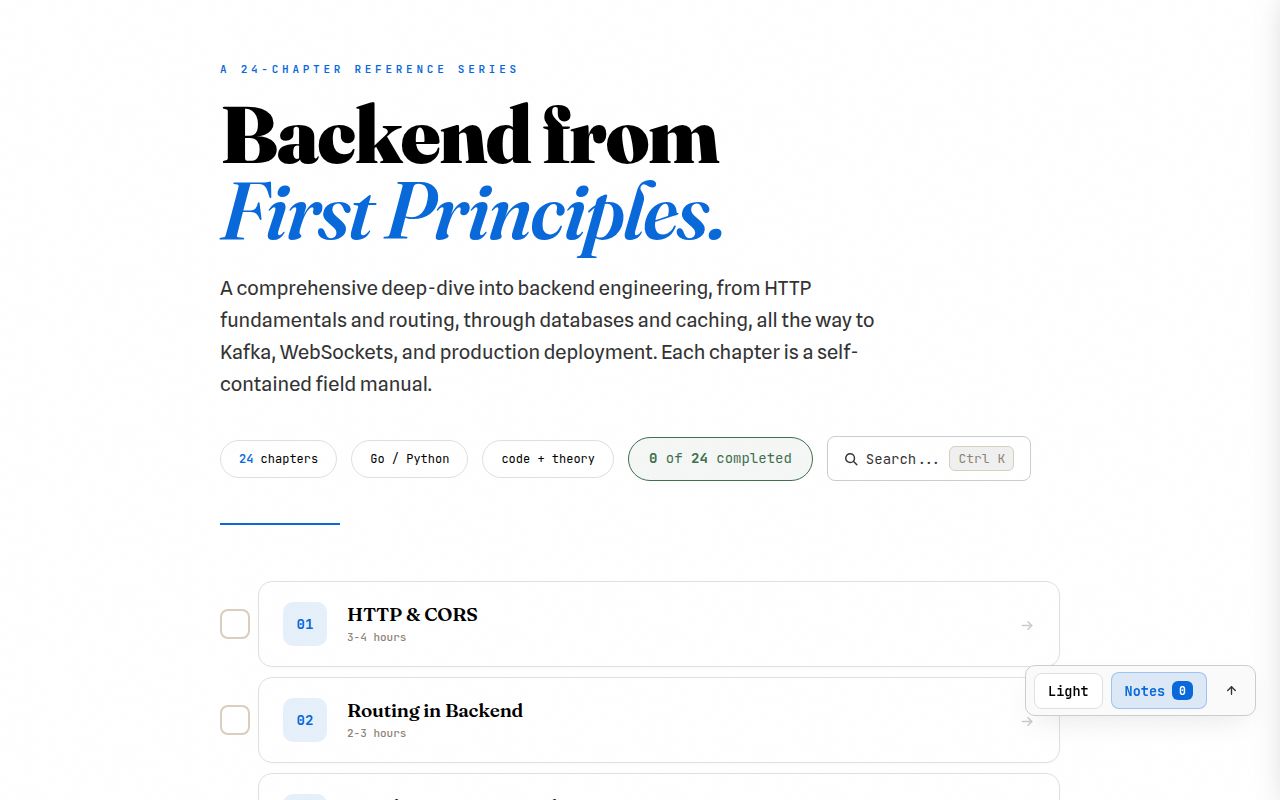
Backend from First Principles starts with HTTP and CORS, then moves through routing, serialization, authentication, validation, layered application structure, REST APIs, databases, and caching. Later chapters cover task queues, search, failure handling, gRPC, configuration, observability, shutdown, security, scaling, concurrency, containers, testing, Kafka, and WebSockets. The order is useful because a new backend developer can see how request handling grows into operations and distributed systems.
The measured commit contains 24 static chapter pages plus a home page. Each chapter is a substantial HTML document with diagrams, explanations, code blocks, and a local table of contents. Chapter 22, for example, moves through the testing pyramid, test doubles, database integration, contract tests, end-to-end work, flaky tests, load testing, and CI. This is closer to a long set of course notes than a conventional source repository.
Go and Python carry most of the executable examples
The source tree at commit 6e2d007 contains 128 Go files and 112 Python files, alongside 23 SQL files, 11 JavaScript files, 6 shell files, and several YAML examples. That mix gives readers different views of common backend patterns. HTTP handlers, queues, logging, security controls, database calls, and graceful shutdown are easier to compare when the idea is separated from one web framework.
Many files are short teaching fragments, while a few folders contain small runnable arrangements. There is no root dependency manifest or command that prepares every language and service. A Redis queue example, an Elasticsearch search handler, a Kubernetes manifest, and a Python API naturally need different environments. Treat the snippets as starting points to inspect and adapt, then consult the named technology's own documentation before using them in an application.
What happened when we ran it
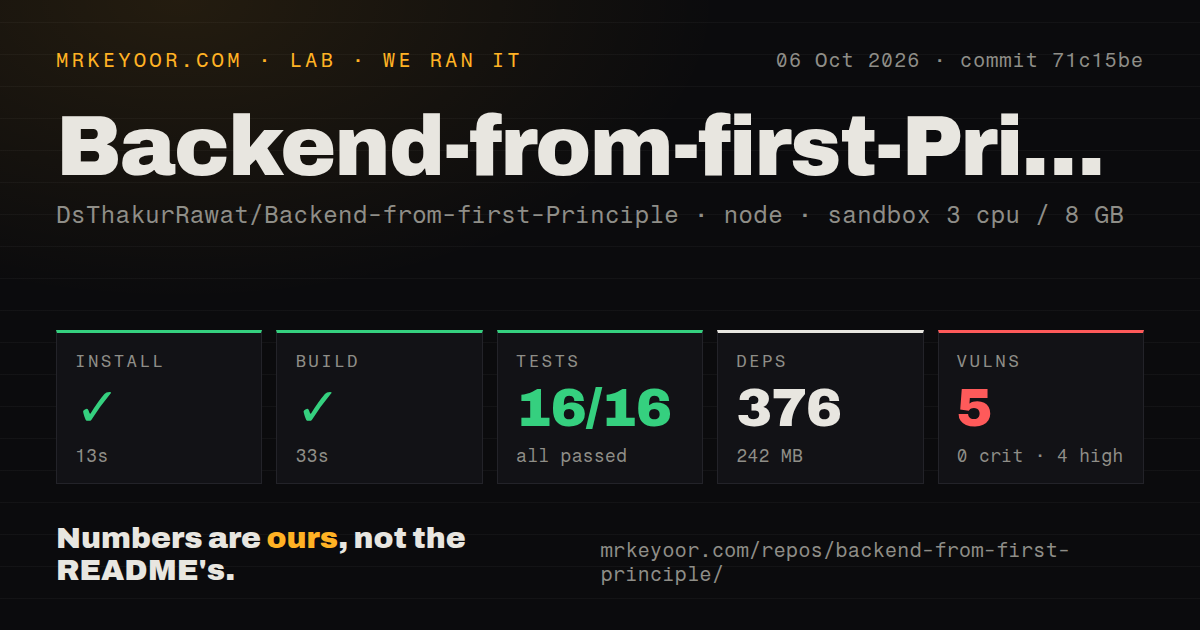
We did not run Backend-from-first-Principle in our sandbox. The lab classified the repository's JavaScript ecosystem as unsupported and found no Dockerfile at commit 6e2d007, so it recorded no install, build, test, dependency, or vulnerability result. That is a limitation of what we measured, and it also reflects the repository's structure: there is no single backend program here for a generic harness to execute.
Two Node assertion files exist under tests, but they check the documentation interface rather than the chapter examples. One reads HTML and CSS to verify contributor links and a hover rule. The other checks theme assets across all 24 pages. Their presence is useful for site maintenance, yet it does not establish that the Go, Python, SQL, security, queue, or deployment examples behave correctly in their respective runtimes.
The reading interface has more features than the README explains
The static site includes search, themes, chapter navigation, copy buttons, a study-notes drawer, highlights, and bookmarks for diagrams or code. Those tools suit a course that readers may revisit. The home page links all 24 chapters, and the hosted Vercel site removes the need to clone anything when the goal is simply reading.
Interface work has also generated visible friction. Issue 15 says the persistent sidebar, footer, selection notes, and copy controls distract from reading, then proposes simpler previous and next navigation. Earlier reports about invisible code text and contribution-button contrast were fixed through pull requests. That history shows responsive maintenance, while also showing that the course shell is changing quickly.
The absent license blocks reuse even though contributions are invited
The README welcomes contributions and specifically suggests adding Rust, Java, C++, and TypeScript implementations. The repository tree has no LICENSE file, and GitHub returns no detected license. Those facts leave the default copyright position in place. Reading a public repository is different from receiving permission to republish its prose or code.
Issue 13 makes the consequence concrete. A reader wants to publish a French translation with extra TypeScript and security material, but asks the maintainer for explicit approval because there is no license. The issue had no reply when fetched. Educators, newsletter authors, and training companies should link to the original instead of copying chapters until the permission terms are written down.
August activity is high, while release history is empty
The repository was last pushed on August 31, 2026 and had 319 stars. GitHub showed 3 open issues and 4 open pull requests, so the combined count of 7 is not a bug total. Recent merged work fixed code-block colors, improved themes, added study tools, and repaired a contribution button. That pace is encouraging for a project created in June 2026, though it provides only a short maintenance history.
There is no GitHub release. Readers follow the moving main branch or the hosted site, and references can change without a named version. Open issue 16 asks Chapter 21 to mention Kubernetes Gateway API as the recommended successor to Ingress. Open pull request 18 begins a seven-part effort to add JavaScript and TypeScript examples, starting with Chapter 1. Both show that coverage is still being revised.
Use the course to find gaps, then verify with primary sources
As a map of backend subjects, this repository is unusually broad and sensibly ordered. A learner can discover why idempotency, graceful shutdown, message delivery, observability, and backpressure belong in the same mental model. The examples then give enough shape to start a small experiment. That is a good use of the project, especially for someone comfortable translating Go or Python patterns into their own stack.
A 24-chapter course cannot be the final authority for every database, security control, Kubernetes API, or queue guarantee it mentions. The missing license also prevents a clean recommendation for course reuse. Read it to identify what you do not understand, follow its examples in disposable environments, and confirm operational details against current vendor or standards documentation. Choose Build Your Own X when finished projects teach you more effectively than reference notes.