A directory, not a new agent
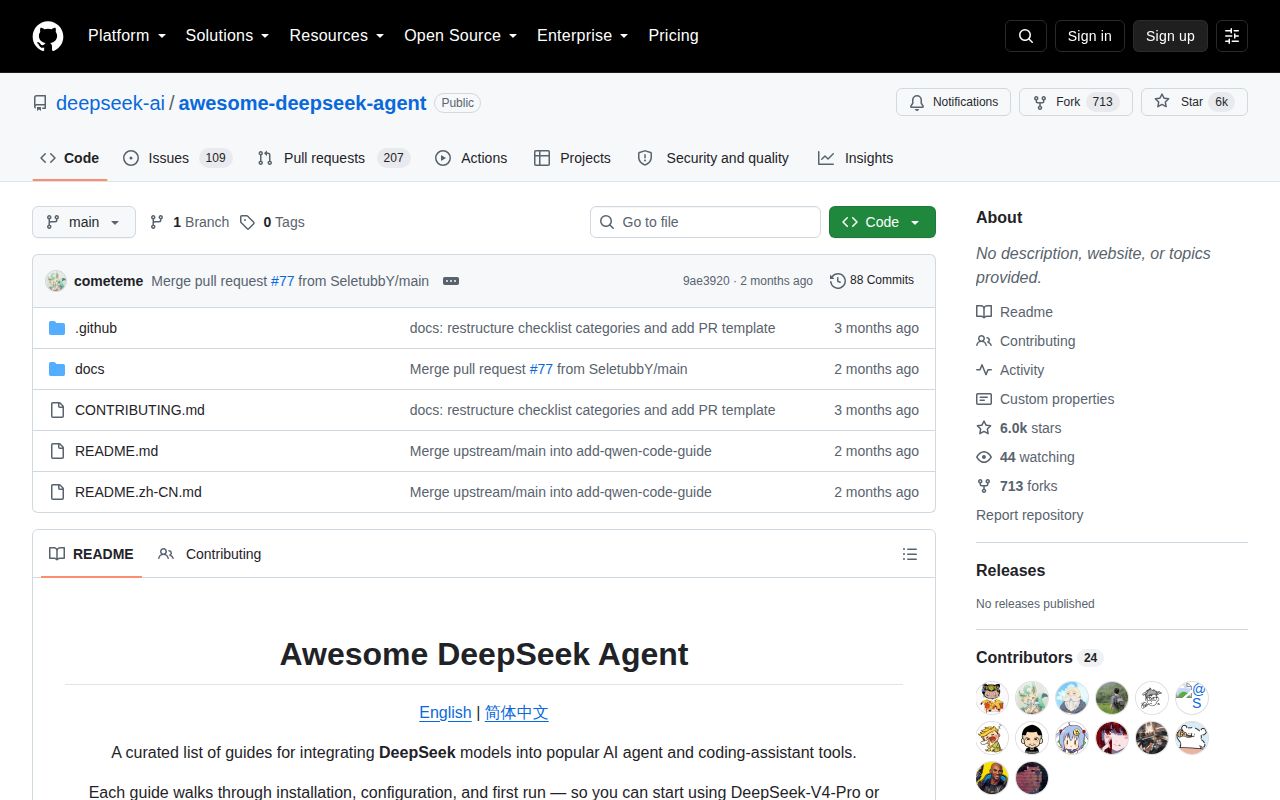
Awesome DeepSeek Agent is easy to misunderstand from its name. It does not ship an autonomous agent, an SDK, or a server. It is a curated set of Markdown instructions for connecting DeepSeek V4 models to existing tools. The current table covers 22 clients, ranging from Claude Code, Codex, Cline, and OpenCode to desktop chat applications and chat-platform assistants. Each entry points to a focused guide, usually mirrored in English and Simplified Chinese.
That narrow job is valuable. Model clients expose provider settings in different places, use different names for reasoning controls, and do not all speak the same API shape. A developer can waste an afternoon discovering which base URL, environment variable, or compatibility layer a tool expects. This collection turns those details into short installation, configuration, and first-run recipes.
It also makes choosing an agent easier. Reading several guides side by side shows which clients connect directly, which need an OpenAI-compatible or Anthropic-compatible endpoint, and which introduce another local service. Just remember that this is documentation about third-party tools. Installing or trusting any listed tool remains a separate decision.
The quality varies with the integration
The OpenCode guide is almost the ideal case. Install a recent OpenCode version, run it, choose DeepSeek through the connection menu, enter an API key, and select the model. The Claude Code guide is longer but still direct: install the CLI or extension, set the Anthropic-compatible base URL and model variables, then launch the tool. Screenshots help with graphical clients such as Cherry Studio and Cline.
Codex shows the other extreme. Because Codex uses the Responses API, the guide introduces Moon Bridge as a forwarding layer. Users install Node.js and Go, clone another repository, create a YAML file containing model and provider settings, start the bridge, generate Codex configuration, and keep the proxy running while they work. The guide includes verification requests and practical troubleshooting, which is good documentation, but the process is no longer a quick provider toggle.
Depth is uneven. The Codex guide exceeds 7,000 bytes and explains failure modes. The OpenCode guide is under 800 bytes because the client has native provider support. Other guides sit between those points. This is reasonable when integrations genuinely differ, but readers should not assume that every entry has been tested to the same depth merely because every tool gets one row.
Compatibility is the part to distrust carefully
The contribution rules are unusually specific. New guides must be bilingual, use current V4 model names, account for the one-million-token context option, support high reasoning effort, and avoid stale workarounds. Contributors are also told to verify that configuration fields actually affect the client. Those requirements show that the maintainers understand how quickly model integration advice decays.
The open queue shows that written standards do not guarantee current published pages. Pull request #370 says the contributor guide recommends an unsupported [1m] suffix for the Flash model in Claude Code examples, even though the current Claude Code page uses the plain Flash identifier. It remained open on August 14. This kind of small naming mismatch can turn a copy-and-paste recipe into an authentication-looking failure.
More serious gaps live at the boundary between client and provider. Issue #349 documents Codex subagent tasks arriving in message fields that DeepSeek's adapter does not read. The reporter verified a local proxy rewrite, but that is not the clean experience suggested by merely pointing Codex at a compatible endpoint. Issue #284 describes Claude Code auto-mode classifier requests timing out with DeepSeek Pro V4 and discusses adjusting reasoning effort through a proxy. These reports concern specific advanced workflows, not proof that the basic guides fail. They are still strong reasons to test the exact features your team relies on.
No installation does not mean no operational cost
Browsing the repository costs almost nothing. Running the resulting setup may involve a paid DeepSeek account, local configuration changes, third-party packages, and long-lived proxy processes. Several snippets place an API key in environment variables or a local configuration file. That is normal, but teams should use their existing secret-handling policy and avoid pasting production credentials into an unreviewed desktop client.
Back up configurations before following recipes that generate files. The Codex page explicitly advises backing up its main configuration, and that warning deserves to be generalized. A provider experiment should not silently replace tuned defaults, organization policies, or another model setup. Pin client and proxy versions where possible, because a guide tied to today's configuration surface can become wrong after an automatic upgrade.
The repository also has no detected license. For ordinary reading and linking, that may not change much. Anyone copying substantial guide text into commercial documentation or redistributing modified material should get clarity rather than assuming an open GitHub repository grants reuse rights.
Active interest, slow integration
The repository had 5,518 stars and 684 forks on August 14, 2026. Activity around it is intense: issues and pull requests were updated that day, and contributors continually proposed new tools and fixes. GitHub's combined open count was 309, which breaks down into 108 issues and 201 pull requests.
The uncomfortable counterpoint is that the default branch's last push was June 17. The project has no published releases, and only 55 pull requests had been closed against 201 still open. That does not make it abandoned. It means community demand is moving faster than maintainers are merging it, so a promising guide may sit outside the published table for weeks.
Use Awesome DeepSeek Agent when it has a guide for the client you already chose. Read the whole page, check its linked dependencies, and then compare the critical model names and API behavior with current official docs. It is a convenient map of a fragmented ecosystem, but it cannot make compatibility claims stay true on its own.