The 38 MB environment supports a research collection
Installing this repository used 38 MB on disk in our sandbox, but it did not give us a video-making application. Awesome Claude 5.5 Videos organizes examples, source records, and research figures. The old awesome-opus-5-5-videos address now redirects to the broader Claude collection. Open it when you need to choose how to make something: code-drawn animation, a rendered scene, an edit of existing footage, or a workflow that directs another video model.
The English overview links original posts and related production projects instead of presenting every example as the same kind of result. A browser animation written by Claude and a film rendered by an external video model have different production dependencies. Keeping those roles visible is the collection's most useful editorial choice. You can learn from the process without mistaking the named assistant for the software that produced every pixel.
What happened when we ran it
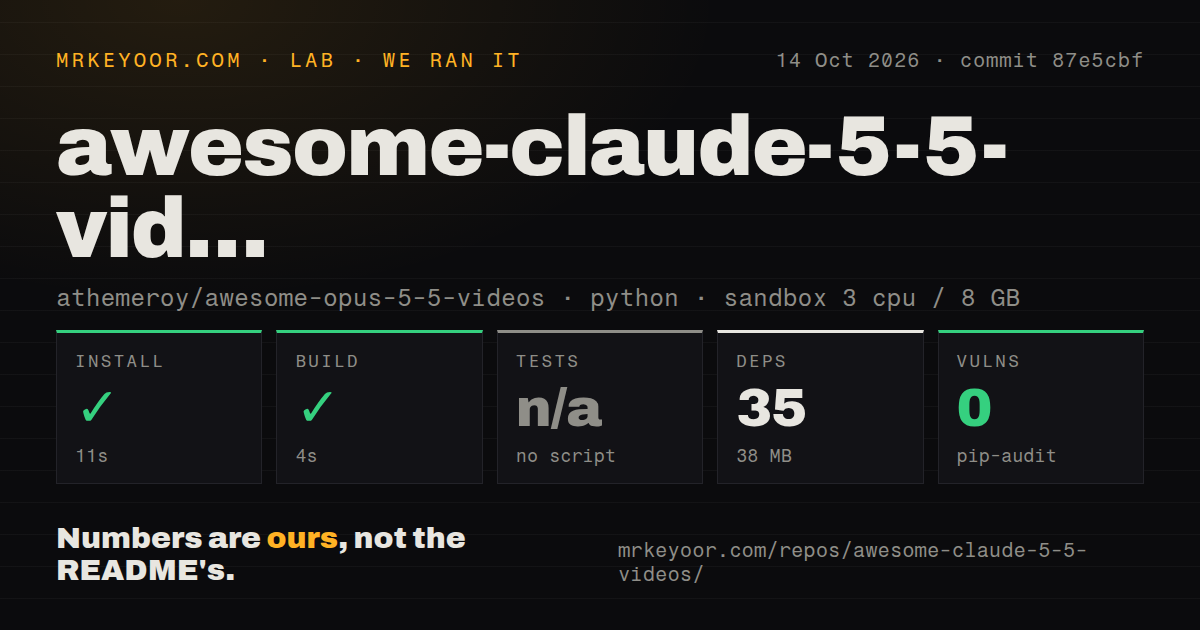
Our October 14, 2026 run installed commit 87e5cbf in 11 seconds, adding 35 packages and occupying 38 MB on disk. The build succeeded in 4 seconds. The unprivileged Debian sandbox used the uv Python 3.12 Bookworm image, 3 CPUs, and 8 GB of RAM, with no secrets. The checkout contained 322 files, roughly 4,075 source lines, and 8.7 MB before installation. That makes the measured repository path modest in local resource demands.
Tests were skipped because the lab found no test script or target. Pip-audit reported 0 known vulnerabilities, and the scan found one CI workflow, no Dockerfile, and no tests directory. A successful build and a clean known-advisory result are useful findings, but neither establishes the truth of the catalog's creator claims. We did not measure rendering speed, repeat a creator's production workflow, or compare video quality between models in this sandbox.
Source posts and classified files have different denominators
The README's October 11 collection contains 424 distinct source posts, with preview sampling recorded for part of that collection. Its earlier content and color study counts files from a frozen snapshot. A post can hold multiple attachments, and a multi-model comparison can appear in several model groups. Adding the model-group rows together therefore does not produce a total number of distinct films. The documentation explains that limitation rather than hiding it in a chart footnote.
That distinction helps when you use the research in a brief. The maintenance guide keeps the frozen study separate from later source additions, so a newly discovered post does not silently change the older analysis. Our 322-file checkout is a different unit again: it counts repository files, not films or source posts. Read a dataset's unit before quoting its total, especially if your decision depends on how common a particular visual treatment seems to be.
Sampled frames cannot validate full motion or model identity
The collection uses nine-frame preview sampling, which the README says cannot verify full motion or model calls. Fable labels retain creator-reported attribution. A still can reveal composition or color, but it cannot demonstrate smooth transitions, coherent action across the whole clip, or what backend actually ran. The repository is useful precisely where it preserves those distinctions. Treat a model label as the stated provenance of that example rather than an independently repeated experiment.
The 35 packages installed in our run do not bridge that evidence gap. Reproducing the public charts redraws published summaries, while the original MP4s and complete sampling sheets remain outside the checkout. The figure guide states that public color vectors support redrawing summaries rather than repeating the original extraction and clustering. This is inspectable research output with a limited reproduction boundary, which matters if you need to audit the media analysis itself.
Python maintains the records, linked projects make the films
The maintenance guide documents generation and checking of source indexes and summaries. Collection work uses Python's standard library, while snapshot figure work adds pinned rendering packages. Contributors edit the source ledger or responsible generator instead of hand-editing generated pages. That is a sensible arrangement for preserving provenance across later additions, and it gives a developer an explicit place to make corrections when an attribution or link is wrong.
Our scan found one CI workflow, but the lab skipped tests because there was no target. Do not turn that into a claim that every documented maintenance check passed in our run. Some operations also reach beyond the public files: engagement refreshes need a Chrome CDP session and Playwright, and thumbnail extraction requires local media. Browsing the directory avoids that work. Maintaining its evidence collection is a separate task with separate inputs.
English summaries do not replace every Chinese research page
The documentation index says some original research pages exist only in Chinese. English guides summarize findings and link the same source data, so an English reader can understand the collection's purpose and major limitations. The prompt playbook and detailed prompt matrix still create friction if you need those practical materials without translation. Language coverage should influence how you use the repository, rather than becoming a reason to assume every linked page has an English counterpart.
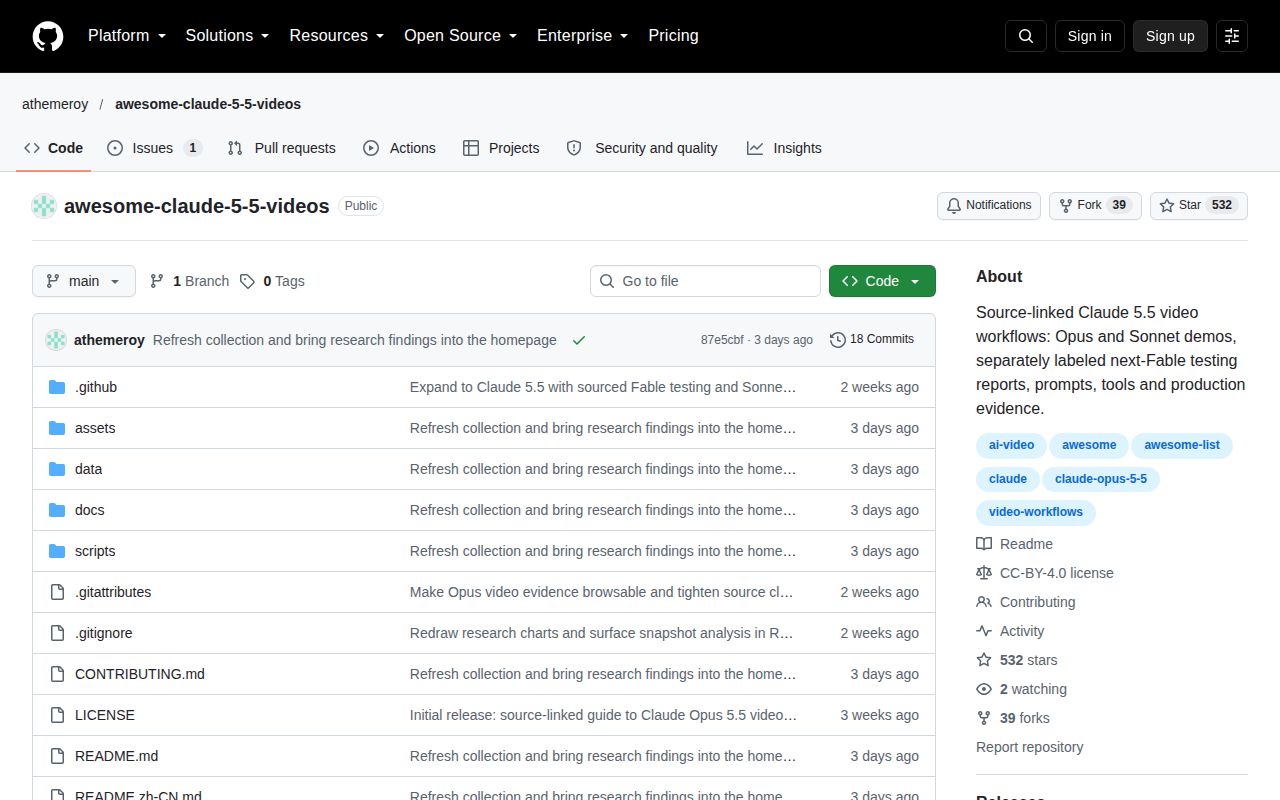
The last push was October 11, 2026, with 532 stars and one open issue or PR reported by GitHub. That open item submits another video case and explicitly distinguishes creator reporting from public execution evidence. The latest-release endpoint returned no release, which is unsurprising for a maintained collection and does not show abandonment. For actual production, compare Lemo-Opuscar, Papermotion, or ClaudeAnimationBase. The collection's CC BY license covers its own writing and charts, while creator footage and stills retain separate rights.