
A style prompt comes with a film you can inspect
Lemo-Opuscar pairs reusable animation directions with example films and their source. The practical attraction is being able to inspect how an effect was made before asking an agent to adapt it. Its English README links a separate Chinese edition, and the style names work in either language. A watercolor story or a terminal-shaped science-fiction scene gives you a specific starting point instead of a blank request to make something cinematic.
Our checkout contained 1,754 files and about 101,675 source lines, occupying 95.8 MB. That is substantial material to explore, even though the npm step itself was small. Spend your first session choosing an example close to the intended film. Copying its visual vocabulary is a more bounded task than asking the agent to invent a new style while also solving pacing, narration, and rendering problems.
What happened when we ran it
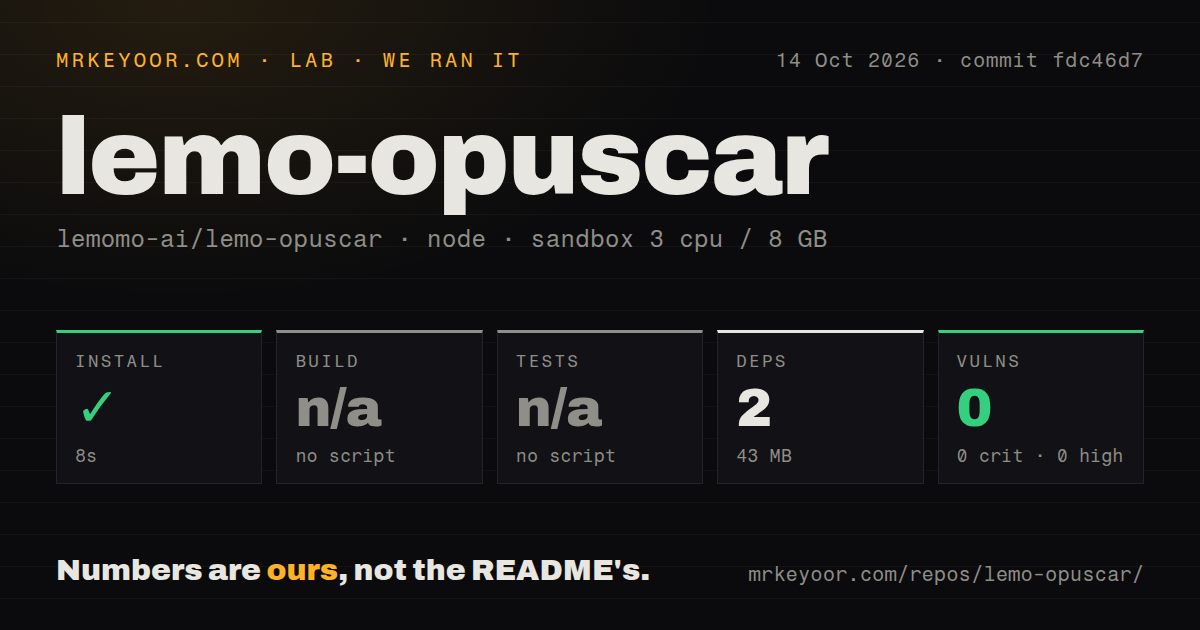
Our sandbox installed commit fdc46d7 in 8 seconds, adding 2 npm packages and using 43 MB on disk. We ran the Node path in the lab-node:22 image on October 14, 2026, with 3 CPUs and 8 GB of RAM. The Debian container was unprivileged and had no secrets. Installation succeeded, and npm audit reported 0 known vulnerabilities across its severity categories.
The harness found no build script or target and no test script or target, so it skipped both steps. It also recorded a single CI workflow file, no Dockerfile, and no tests directory. Those findings describe the harness's selected path. They do not establish that every helper lacks checks, and they do not show a completed film, a working narration pipeline, or an export from a graphics-heavy example.
The 43 MB npm result leaves most of the workflow unmeasured
The 43 MB we measured belongs to the package setup our harness performed. The technical guide describes a broader environment: a headless browser captures frames, Python handles audio work, and ffmpeg assembles the output. You need an authorized coding-agent session as well. Treat that npm result as an entry check, not a storage budget or an end-to-end readiness certificate for a finished narrated film.
The documented prerequisites are Node 20 or newer, ffmpeg, and Python 3.11 or newer, with uv offered as another route to Python tooling. Development happened on Apple Silicon. The guide says Linux should work, directs Windows users to WSL, and recommends a GPU for shader-heavy and three-dimensional styles. Those qualifications matter more than the successful npm install if your intended host is a CPU-only server or a locked-down Windows laptop.
Narration can stay local, but the default Chinese route uses a network
The guide separates English and Chinese narration paths. English defaults to local Kokoro speech generation, while the Chinese helper uses edge-tts and requires network access. You can supply your own recording instead. That is useful flexibility for a team with an approved narrator, but it means you should decide how voice assets may leave the machine before accepting the agent's default choice for a confidential script.
Our 8-second install did not validate any of those voice paths. The guide also asks the agent to transcribe generated speech and compare it with the script, then listen where the automatic check disagrees. That is a sound reason to keep a human in the review loop. A technically valid audio file can still mispronounce a company name or say the wrong number. Listen to the mixed export, where music can expose a different problem from the isolated voice track.
Storyboard approval is optional, so ask for it when direction matters
The plugin asks about your story, supplied assets, and whether you want a storyboard. If you decline the storyboard, the documented workflow continues toward the finished film. For a client commission, I would accept that checkpoint. Approving a few representative shots is easier than explaining after rendering that the whole piece uses the wrong emotional register. The repository's sample films are useful references for that conversation, rather than guarantees about a new prompt.
A 95.8 MB checkout also deserves a quick asset review before you reuse a demo wholesale. The code is MIT licensed, but the README says third-party demo assets retain their own licenses and points to each demo's credits. Check the music, fonts, and other borrowed materials for the film you actually ship. The project's permission to distribute source does not answer every question about your customer's use of its example assets.
An October 13 fix shows attention to reading-time checks
The last push was October 13, 2026, and GitHub reported 2,380 stars with no open issues or PRs on October 15. The recent activity includes merged PR 4, which corrected the text-reading checker when a sampled interval extended beyond a film's endpoint. That is a relevant maintenance signal because it concerns whether on-screen words receive their intended reading time. The latest release, tagged thanks, distributes example films rather than a conventional numbered software update.
Remotion is a better fit when your own React scene system matters more than borrowing a film style. Motion Canvas suits developers who want to author animation directly. Lemo-Opuscar is worth a trial when an inspectable example can narrow the creative brief and you can supervise the rest of production. Pick a restrained style first, request storyboard approval, and judge the actual exported film before expanding the assignment.