A character kit gives the coding agent somewhere to start
ClaudeAnimationBase supplies a painted character, motion helpers, and a guide for making short cartoons in p5.js and p5.brush. You can ask a coding agent for a scene, have it storyboard the action, then inspect rendered contact sheets as it works. The useful part is the shared vocabulary: emotions, turns, camera movement, and brush transitions already have names and code. A prompt does not have to invent the entire animation system before a character can react.
Our checkout contained 18 files and roughly 1,430 source lines, occupying 7.9 MB. That is a manageable starting point for a developer who wants to change the character or learn how the shots work. It is also a narrow foundation. The supplied Clawd artwork and handmade cartoon direction suit expressive scenes better than product interfaces, corporate typography, or a general video editor. Choosing the kit means choosing a visual starting point you may have to redraw.
What happened when we ran it
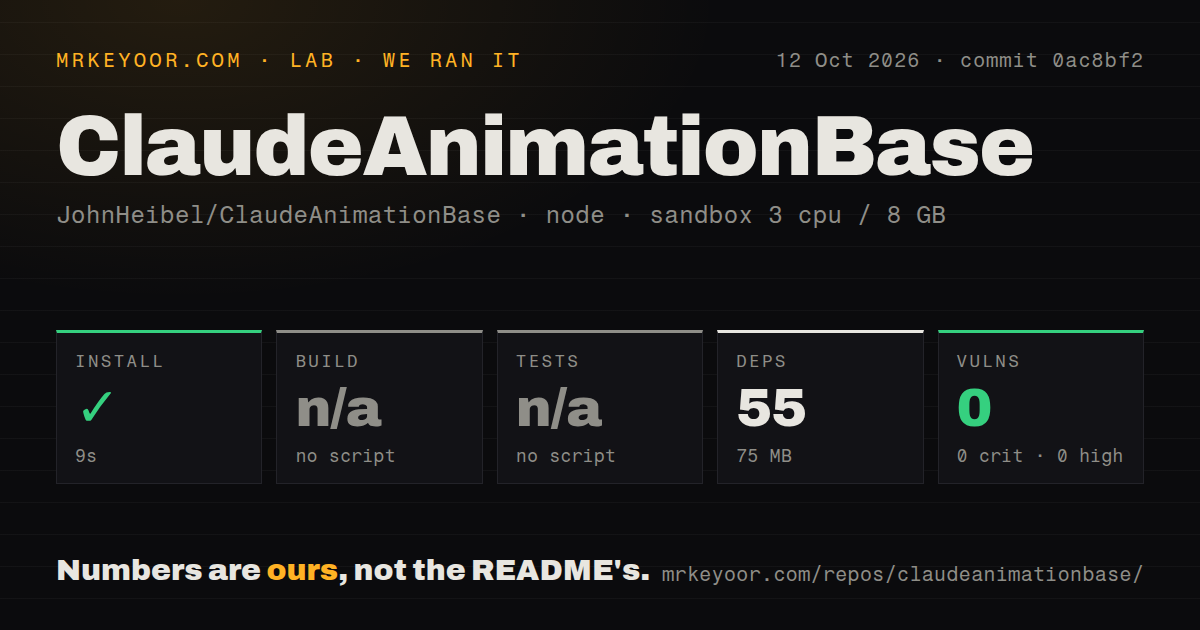
Our run installed ClaudeAnimationBase commit 0ac8bf2 in 9 seconds on October 12, 2026, adding 55 packages and using 75 MB on disk. The fresh Debian sandbox had 3 CPUs and 8 GB of RAM, used lab-node:22, and had no secrets or elevated privileges. Installation completed successfully. That confirms the dependency step for this checkout, without establishing that Chrome, WebGL, or ffmpeg produced a usable animation.
Build and test steps were skipped because the project had no build or test script or target. The lab found 0 CI workflow files, no Dockerfile, and no tests directory. Npm audit reported 0 known vulnerabilities. Those are useful boundaries for the evidence: there was no failed compile or suite, but there was also no automated result checking the renderer, character poses, or encoded movie. Treat the kit as source material requiring inspection.
Chrome and ffmpeg remain separate requirements
The README requires Node.js, Google Chrome, and ffmpeg. Its rendering command drives a browser and encodes output, while studio.html provides a way to scrub through the scene in Chrome. If Chrome is outside the usual locations, an argument or CHROME_PATH points to it. Existing Playwright Chromium installations can also be discovered. These are local tools, separate from the coding agent you choose to write or revise the scene.
The 75 MB installed footprint does not settle rendering cost on your machine. The author warns that watercolour fills can render slowly without a dedicated GPU and suggests avoiding them on integrated graphics. We have no measured rendering speed for this kit. On a machine without a GPU, the documented --soft-gl option uses software WebGL. Headless NVIDIA systems have separate GPU-angle flags and a probe script to inspect the renderer selected.
The Linux renderer launches Chrome with --no-sandbox, a behavior stated in the README and visible in render.mjs. That matters if you expected browser process isolation to remain enabled. Keep the rendering environment appropriate for the local scene code you run. A successful dependency install says nothing about that isolation choice, nor does it verify that a cloud GPU configuration actually uses the intended hardware.
The guide makes visual inspection part of the workflow
The animation guide asks for a written storyboard before scene code and for checking key poses before adding motion. It provides contact sheets, frame strips, and crops for inspecting faces, hands, and moving details. These controls are more useful than trusting a completed MP4 just because a command exited successfully. A character can be technically rendered while its pose is unreadable or its reaction arrives before the audience notices the cause.
The 55 packages installed in our run do not include a quality judgment about those frames. The guide's default style calls for flat painted shapes, moving linework, and little text, while allowing the person's prompt to override its rules. That makes it opinionated rather than rigid. If you need captions and precise charts throughout a lesson, however, you will be working against the provided examples and should compare a motion-graphics framework before extending this kit.
The encoder has a reported music mismatch
Pull request 4 reports that encoding saved frames ignores PROJECT.audio even though the guide says that setting applies. It also reports premature endings when the audio is shorter than the video. The current --encode branch reads the command's audio argument, while the direct clip path also reads the project setting. Both audio paths include ffmpeg's -shortest option. That source inspection supports taking the report seriously, without claiming we reproduced it.
Our 9-second install did not exercise either encoding path. Before a music-backed deliverable, verify that the exported file contains audio and lasts through the intended ending. Another open proposal, pull request 6, corrects guidance that applies stepped drawing time to camera movement as well. It argues that characters can use onTwos(t) while the camera keeps continuous time. That correction is proposed work, not a fix already included in the guide we read.
September maintenance is visible despite no published release
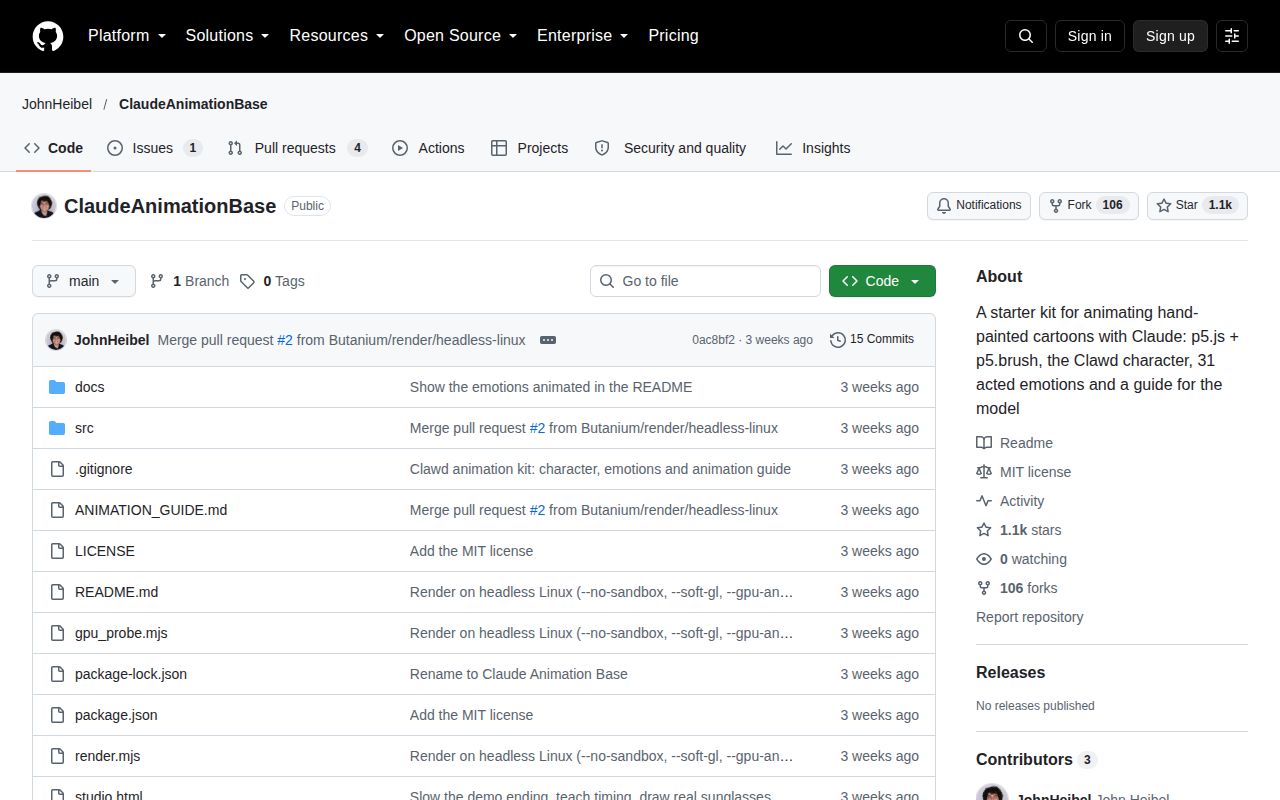
The last push was September 24, 2026, and GitHub listed 1,073 stars with 5 open issues and PRs. The latest-release endpoint returned no published release. Public discussion and proposed fixes continued on September 28, including the audio and camera changes. The activity points to people using and extending the kit, though it gives no guarantee of maintainer response or a release schedule. A missing tag alone does not mean the project is abandoned.
The 18-file checkout is appealing when you want to own the scene code and can inspect every export. Motion Canvas is a better candidate for informative vector animation synchronized with narration, while p5.js gives you a general creative-coding foundation without this character kit. I would choose ClaudeAnimationBase for a short painted character scene whose style already fits the brief. Before delivering it, play the encoded movie through its final frame with sound enabled.