Forty-nine entries make a useful first shortlist
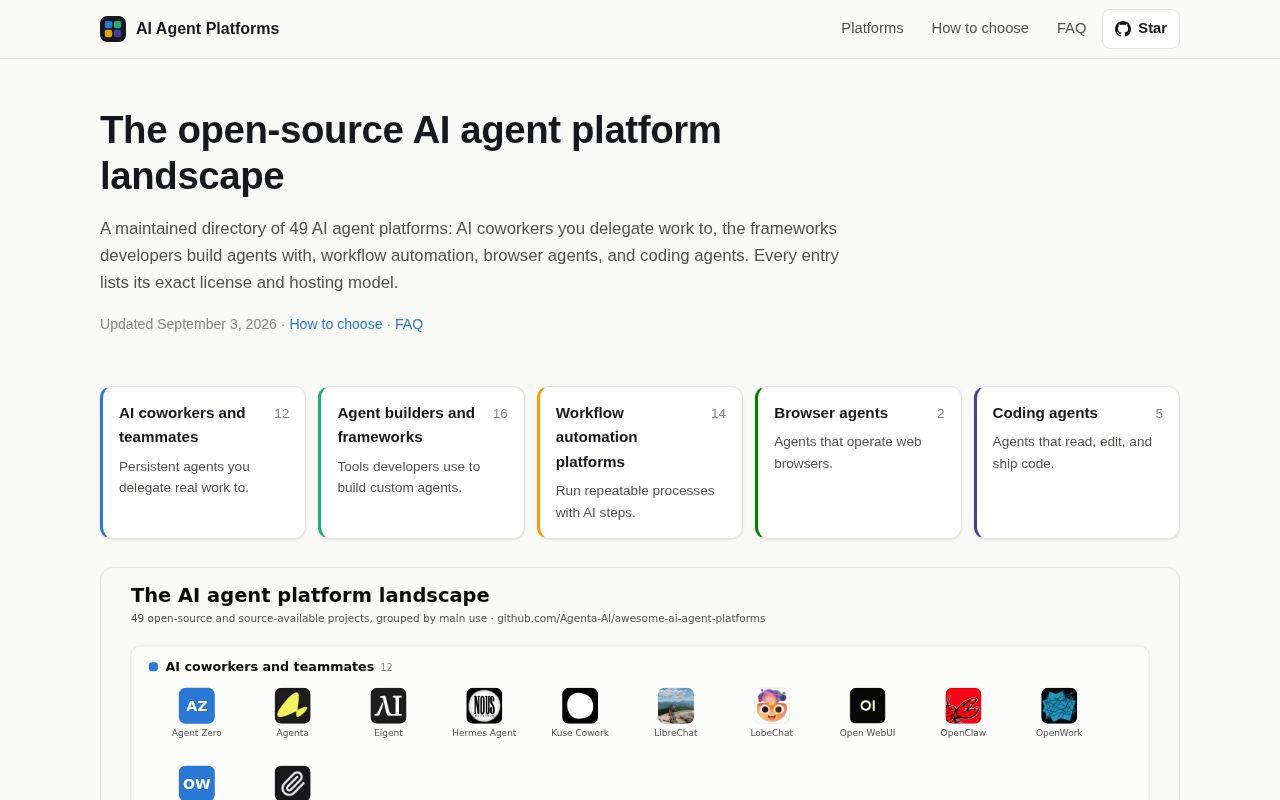
Awesome AI Agent Platforms reduces a messy category into 49 named projects. The README groups them into 12 AI coworkers, 16 builders and frameworks, 14 workflow platforms, 2 browser agents, and 5 coding agents. Each bullet carries a factual description, a license label, and a hosting note. The companion site turns the same material into cards, category pages, detail pages, a market map, and one comparison table.
That is enough structure to answer an early question: which projects deserve a first visit? A team can separate a ready coworker from a programming framework, then filter for self-hosting or a familiar license. The 1.8 MB checkout is mostly text, static site code, data, and image assets. It does not run the listed agents or normalize them behind one API.
License and hosting labels are the list's strongest filter
Many agent roundups stop at a project name and slogan. This one records whether a tool is self-hosted, local, vendor-hosted, or available in more than one form. It also distinguishes MIT and Apache-2.0 projects from entries with source-available terms or separately licensed enterprise features. That saves time before a deeper technical and legal review.
The title still needs careful reading. The directory calls itself open source while including LobeChat, Open WebUI, n8n, and Pipedream with source-available or fair-code labels. The README does disclose those labels, so the useful information is present. Buyers should treat the directory as a mixed catalog with explicit terms, not assume every one of its 49 projects meets the Open Source Definition.
What happened when we ran it
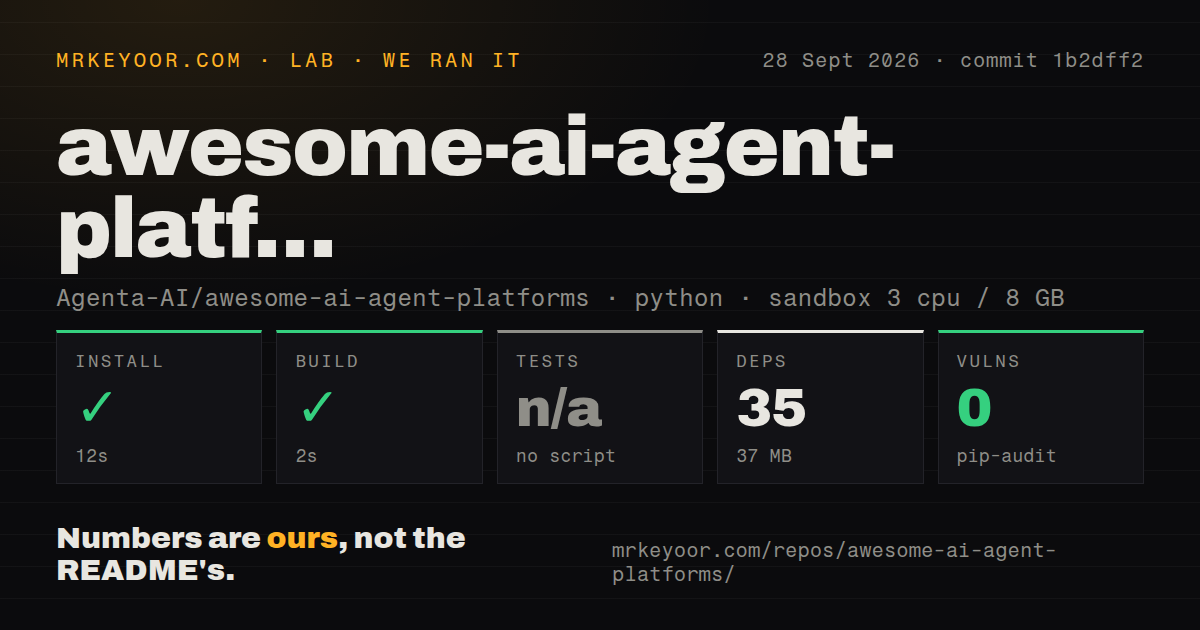
Our sandbox cloned commit 1b2dff2 into a fresh, unprivileged container with 3 CPUs and 8 GB of RAM. The Python install completed in 12 seconds, adding 35 packages and leaving 37 MB on disk. The build then passed in 2 seconds. Pip-audit reported 0 known vulnerabilities in the installed environment.
There was no test script or target, so the lab skipped tests. The 34-file repository had about 749 lines of source, 2 CI workflow files, no Dockerfile, and no tests directory. A successful static build establishes that the checked-out content and site generator could produce output. It does not check whether 49 repository links resolve, license notes remain current, or every hosting claim still matches its vendor.
The source has two toolchains with different jobs. Python scripts generate the market map and social artwork. An Astro package parses the README before each build, writes structured project data, copies the artwork, and emits static routes plus a sitemap. The content stays centralized in the README, which reduces duplication. Rich platform details live in a separate JSON file, so those descriptions still require their own maintenance discipline.
Two browser agents leave that category thin
The category balance tells you where this guide is most helpful. Builders and frameworks account for 16 entries, workflow automation has 14, and coworkers have 12. Browser agents contains only Browser Use and Skyvern. Coding agents has 5 entries. A buyer comparing agent frameworks gets a meaningful reading queue, while someone surveying browser automation should widen the search immediately.
The selection policy also limits what the list claims. A project needs an active official repository or product page, a usable product or runtime, public license and hosting information, and ongoing maintenance. Demo repositories and discontinued tools are excluded. Inclusion is explicitly not an endorsement, and the maintainers say star count, funding, and company size are not selection criteria. There is no score for security, reliability, setup effort, or model quality.
Ten open addition pull requests expose the freshness problem
GitHub showed 337 stars, 10 open issues and pull requests, and a last repository push on September 3, 2026. The API returned all 10 open items as pull requests. They propose additions such as coding agents, browser agents, coworkers, and another builder. The newest had activity on September 24, three weeks after the last push. No GitHub release was available.
That queue does not prove abandonment, because contributor activity continued after the maintainer's last push. It does show that the published 49-entry snapshot trails submitted candidates. The website itself hard-codes “Updated September 3, 2026.” A list about fast-moving agent tools needs routine link, license, and maintenance checks, yet this repository exposes no automated test target for any of those jobs.
Use the directory to choose what to investigate next
A good first pass is job, hosting, then license. Decide whether you need a coworker, framework, repeatable workflow system, browser operator, or coding agent. Remove entries that cannot run where your data must stay. Then open the primary repository and verify the current license, release activity, installation path, security model, and unresolved issues yourself.
The 12-second install and 2-second build make this directory easy to mirror or contribute to, and CC0 licensing removes friction around reuse. Its value ends at shortlist creation. Once a project reaches your final few, this list has done its job; the purchase decision belongs to current source, a sandbox run of that project, and evidence from your own workload.