
Start with one example you can inspect
Open the tarot app's helper file and the deployment question becomes concrete: it calls phi4 through Ollama on localhost. Awesome LLM Apps collects agent and document-chat examples you can borrow for your own projects. Our checkout contained 1,976 files and about 153,171 source lines, so choosing a folder is the first useful decision.
The English README organizes examples by task, including retrieval, voice, memory, and MCP connections. It also offers skills for Claude Code and other coding agents. That breadth makes it useful when you know what interaction you want to study. Our selected example installed 95 packages, a reminder that even a small-looking app brings its own environment.
What happened when we ran it
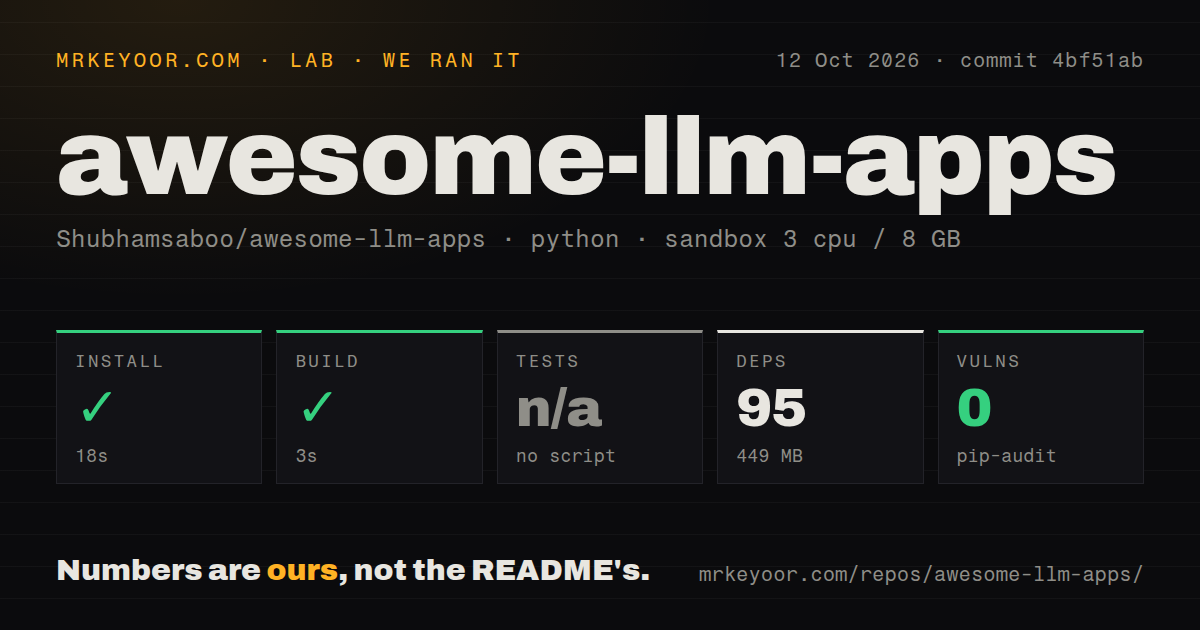
Our run installed the tarot example in 18 seconds, adding 95 packages and occupying 449 MB, then completed its build in 3 seconds. We cloned commit 4bf51ab on October 12, 2026, into an unprivileged Debian container with 3 CPUs and 8 GB of RAM. The image was ghcr.io/astral-sh/uv:python3.12-bookworm, and the container held no secrets. Installation and build both succeeded on that path.
Tests were skipped because our run found no test script or target. Pip-audit reported 0 known vulnerabilities. The repository scan found 2 CI workflow files, no Dockerfile, and no tests directory. These findings cover the supplied sandbox run, including its selected project under advanced_llm_apps/chat-with-tarots/. They establish neither successful execution of every example nor the quality of a generated tarot reading. A clean dependency audit cannot settle those questions.
The tarot app needs Ollama after Python setup
Python 3.12 handled our measured installation, but the example README separately requires a running Ollama service and a downloaded phi4 model. It tells you to run ollama pull phi4, start the service, and launch streamlit run app.py. The helper sets the service URL directly to localhost. If Streamlit and Ollama live in separate containers, that address needs attention because each container has its own localhost.
The 449 MB we measured covers the installed Python environment, not a measured model-serving deployment. This example uses a local model without a hosted API credential. Other folders have different requirements: the collection's starter section describes agents using API keys, while its local retrieval examples name local model and database services. Budget for the folder you choose. There is no single credential recipe or model runtime that applies across this catalog.
Relative files make the working directory matter
The tarot source reads data/tarots.csv relative to the process directory and loads card images from images/. It checks that the CSV contains card meanings and symbolism, then puts that information into the prompt. Run the app from its own folder so those paths resolve. The example README's clone command points to maurizioorani/TheMagician-IA-Reader, which can send a reader into a different checkout than the collection being reviewed.
Our 90.1 MB repository checkout includes much more than the measured app. Copying the tarot folder without its data and images would leave its code expecting assets you haven't carried over. The source shows useful teaching material: random card selection, prompt preparation, and a Streamlit interface. Change the model address, preserve the assets, and decide what generated advice your own application should display.
Open reports concern specific demos, not the tarot result
Issue 1194 reports unexpected model replies breaking several named demos. Its examples include a retrieval diagnostic saving an empty reply as a report and a governance agent truncating tool arguments containing commas. These reports concern those components, not the tarot app we measured. Inspect those failure paths before unattended use.
The successful 3-second build and the absence of a runnable test target leave application behavior largely unmeasured on our selected path. The tarot source catches exceptions around its reading action and displays the error in Streamlit. That is helpful for a person experimenting at a browser. It does not give an operator evidence that malformed model replies, missing assets, or service interruptions produce acceptable behavior in a deployed application.
September's push and October's issue work show activity
GitHub reports the last push as September 30, 2026, with 141,471 stars and 29 open issues and PRs. The latest-release endpoint returned no published release. October issue activity matters alongside that push date: the report above was updated on October 11, and open pull requests address its named failures. That supports a judgment of ongoing contributor activity. It doesn't establish that the proposed fixes have landed.
Our scan's 2 CI workflow files are an encouraging sign of automation, though their presence cannot prove every example works. The README's broad testing claims should be kept separate from our narrower result. Apache-2.0 licensing makes adapting the collection's code practical, and the task-based index helps you locate relevant material. Documentation quality varies at the folder level, as the tarot README's separate clone target demonstrates. Read that local documentation before following the main quick start.
Choose a course or framework when the catalog is the wrong shape
Microsoft's Generative AI for Beginners suits someone who wants an ordered course rather than a menu of applications. NirDiamant's GenAI Agents is another collection of agent tutorials worth comparing for the particular pattern you're learning. LangGraph fits a developer who needs a framework for persistent workflows and human approval. Those choices solve different jobs, so pick by what you need to build rather than which repository has the longest index.
Awesome LLM Apps earns a place in a developer's reference pile. Our 18-second installation makes the selected example approachable, while the missing test target keeps the result modest. Borrow one interaction, keep its data files, and inspect the calls it makes before adding credentials. For the tarot example, the next consequential check is whether your actual Ollama service can answer the app's prompt on the machine where you intend to run it.