The English edition is complete, but zh-TW leads
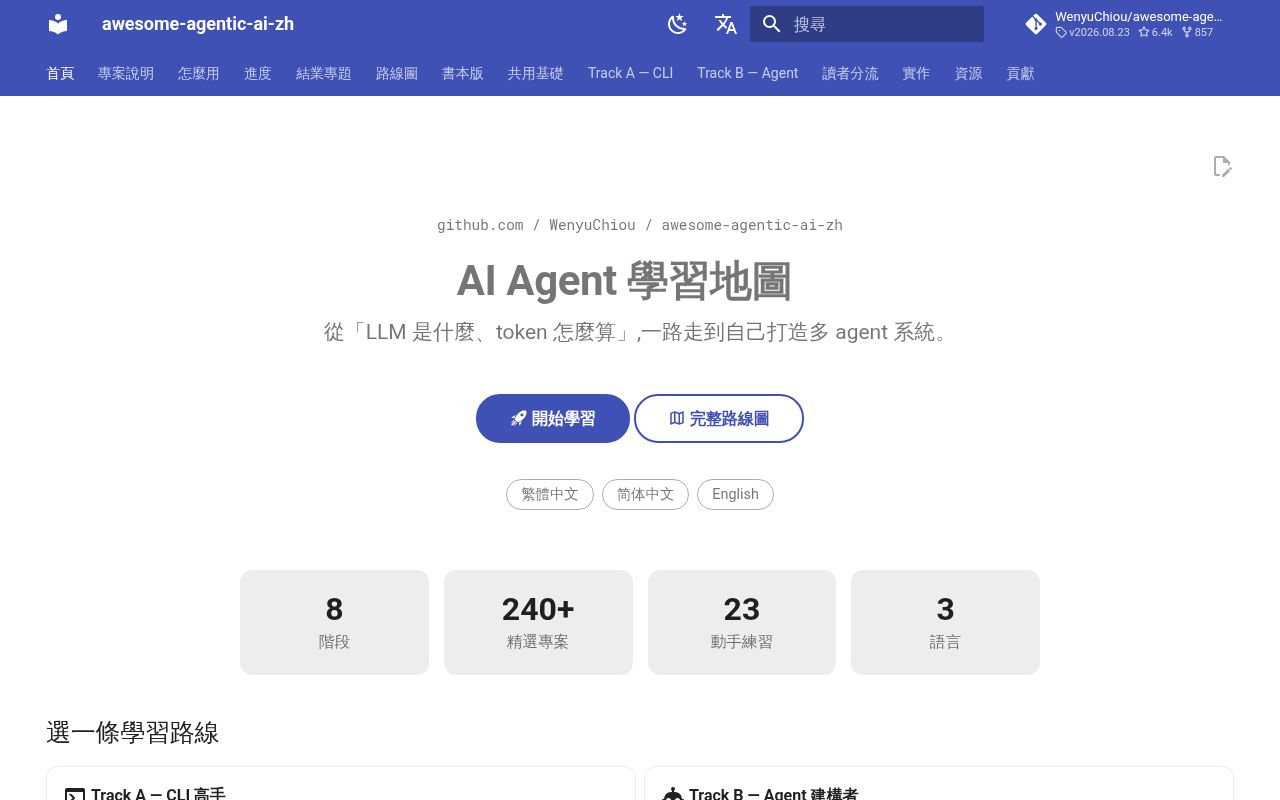
This is a Traditional Chinese-first curriculum rather than a translated link dump. The canonical material starts in zh-TW, with full Simplified Chinese and English companions that follow the same structure. The English README says new content lands in Traditional Chinese first and CI checks localization plus anchor integrity. English readers get a genuine edition, although a recent edit may appear in the canonical files before its translation catches up.
The repository maps more than 240 projects and 81 MCP or skill entries across 8 stages, 2 main tracks, and 5 audience branches. Each entry aims to explain who a resource suits, what it teaches, and how to run it. The result feels closer to a syllabus than an awesome list. The route starts with Python, git, APIs, and tokens, then covers tools, frameworks, Claude Code, memory, RAG, multi-agent operation, browser use, computer use, and sandboxes.
Two tracks prevent beginners from learning the wrong job
Track A is for people who want to use CLI agents such as Claude Code, Codex, OpenCode, or Gemini CLI. It covers selection, reusable command-line workflows, MCP connections, CI automation, and operational concerns. Track B is for builders who want to write tool-using loops, compare frameworks, manage context, and design multi-agent systems. Both share the early foundations plus Stage 5 on the Claude Code ecosystem and Stage 8 on agent interfaces.
The time estimates make the commitment explicit. Track A is budgeted at 8 to 10 weeks. Track B needs at least 16 to 22 weeks, with 5 to 7 months described as realistic at 5 to 8 hours per week. The repository spans several professions under the word agent. A learner wanting one afternoon on function calling should choose a focused tutorial, while someone changing their working habits can justify the longer path.
What happened when we ran it
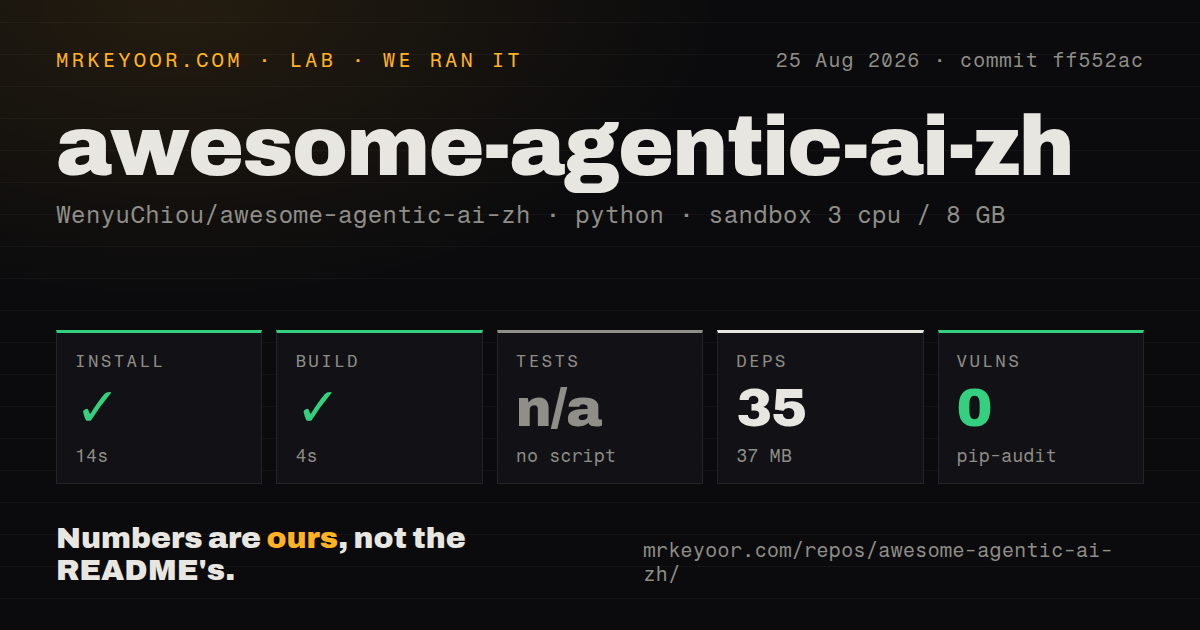
Our fresh Python 3.12 sandbox installed 35 packages in 14 seconds and used 37 MB. The checkout held 485 files, about 16,565 source lines, and occupied 86.2 MB. The documentation build completed successfully in 4 seconds. pip-audit reported 0 known vulnerabilities in the installed environment. There was no Dockerfile, which fits a project built around reading material and small local examples.
The repository had no test script or project-wide test target, so our harness skipped tests. It did have 8 CI workflow files and the latest release describes several content gates. Those checks cover duplicate repositories, language consistency, links, and structure. They do not mean every external project or exercise was executed under one command. Learners should still run the exercise they are studying and verify any third-party tool against its current documentation.
The local build result says the book can be rendered, not that a learner's agent environment is ready. Individual exercises may ask for an Anthropic or another provider API key, while dual paths can use Ollama for local inference. The beginner setup guide budgets 30 to 45 minutes for Python, a first key, and a hello-world call. Costs and hardware therefore depend on which branch and model path the reader selects.
Complete starter files can encourage passive learning
The exercises are deliberately small, generally 70 to 150 lines, and use mocks where practical. There are 23 exercise folders spread across the stages. The cross-stage walkthrough grows one paper-summary bot through 7 steps and roughly 300 lines. This scale is good for seeing a pattern without inheriting a full application, and the local versus hosted provider comparison makes model dependencies visible.
There is a catch the maintainer calls out directly: starter.py is a complete solution, not an unfinished scaffold. Running it and watching its tests pass proves almost nothing about the learner's understanding. The prescribed method is to rename it as a reference, inspect the signature, write a replacement, and look only after being stuck for 20 minutes. That extra discipline is easy to ignore. People who learn best through enforced assignments may prefer a course platform that withholds solutions and grades submissions.
Curation is opinionated and has a popularity floor
The latest release, dated August 23, 2026, says project submissions still face a 1,000-star inclusion threshold. That keeps the catalog from becoming an unfiltered directory and gives the maintainer a defensible rejection rule. It also biases the material toward already visible projects. A technically excellent new library or a narrow research tool may be missing until it crosses the popularity line, so the list should guide exploration rather than define the full field.
That release documents a readability audit across 10 chapters that found 17 issues, plus a duplicate-repository checker added after a repeated entry escaped 6 existing gates. The write-up describes two noisy versions of the checker before the shipped rule narrowed its comparison. It shows what the editorial process missed and how the check changed.
Repository health is current. The last push was August 24, one day after the release, and all 3 open GitHub items were recent resource suggestions. The low combined count does not prove an absence of content errors, but issue activity and release notes show an attentive maintainer. Since agent specifications and product names change quickly, dated updates are more meaningful here than a large back catalog left untouched.
Use it as a syllabus, not an authority list
awesome-agentic-ai-zh works best when a learner picks one track, follows the time budget, and writes the exercises instead of merely running them. The trilingual maintenance is real, the structure separates agent users from agent builders, and the Claude Code plus MCP material goes beyond generic framework comparisons. Keep primary vendor documentation open for fast-changing APIs, and search outside the 1,000-star catalog when the task is specialized. Used that way, the roadmap supplies order without pretending that one repository can freeze the agent ecosystem.