
Start with the agent loop before choosing a framework
Hello-Agents asks you to build ReAct, planning, and reflection examples before settling into a framework. That's a useful order if you've called a language model but still can't explain how an agent decides to use a tool. The Chinese-first course has an English README and English chapters. Its teaching goal is understanding the moving parts well enough to change them, with travel planning and a simulated town among the larger exercises.
Our checkout contained 2,434 files and about 207,680 lines of source. That size reflects a course with contributed projects as well as teaching material, so treating the repository as one application will send you in the wrong direction. Choose an exercise, read its own instructions, and keep its environment separate. A successful command in a contributed notebook project doesn't establish that every chapter's code works.
What happened when we ran it
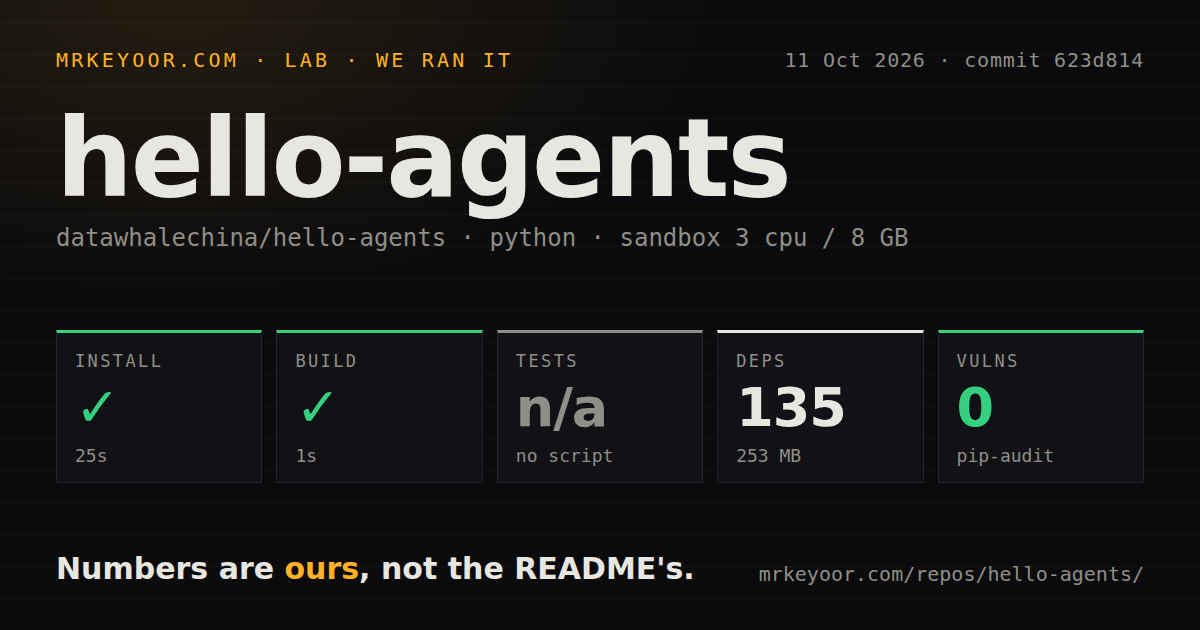
Our run installed the DataAnalysisAgent project at commit 623d814 in 25 seconds, adding 135 packages and occupying 253 MB. The build succeeded in 1 second. We used a fresh, unprivileged Debian container on October 11, 2026, with 3 CPUs, 8 GB of RAM, Python 3.12, and no secrets. The selected project lives under Co-creation-projects/1zrj-DataAnalysisAgent/, rather than at the repository root.
The lab found no test script or target, so it skipped tests. Pip-audit reported 0 known vulnerabilities. Those results establish a working install and build path for this selection, with no automated test result to support a stronger claim. The run doesn't establish that its generated charts are correct or that its written analysis matches the input data. A report file alone wouldn't answer either question.
The repository occupied 192.7 MB before installation. Our scan recorded 0 CI workflow files, no Dockerfile, and no tests directory. Those are useful limits on what the measured checkout supplied, especially for a reader hoping to lift an exercise into a service. They don't mean the lessons lack value. They mean your own validation has to accompany any code you reuse beyond a learning session.
The notebook needs a model endpoint after dependencies arrive
DataAnalysisAgent's README tells you to configure LLM_MODEL_ID, LLM_API_KEY, and LLM_BASE_URL, then open main.ipynb through Jupyter Lab. Its example points at ModelScope through an OpenAI-style API. You put tables in data and look for an ECharts HTML file plus a Markdown report in outputs. That is a concrete learning workflow, but the model endpoint and account remain your responsibility.
The 25-second install didn't exercise authenticated model calls because our sandbox had no secrets. Read the notebook's configuration before running its cells, even though the README describes a preconfigured endpoint. Choose the account and model deliberately. A developer adapting this exercise should also check whether the chosen provider may receive the data in those tables. The course's online reading option requires none of that model configuration.
English chapters help, but contributed instructions still vary
The English course contents cover agent fundamentals, memory and retrieval, communication protocols, and evaluation. Basic Python and familiarity with calling a model API are the stated starting point. Readers who need a first programming course should start elsewhere. Readers comfortable with Python can use the progression to connect an ordinary API call to a program that keeps state and chooses actions.
The measured 135-package project shows why you should inspect each contribution separately. Its README is Chinese, its directory diagram names a different code-review project, and its final implementation description also refers to code review. These are small but concrete editing problems in a data-analysis example. English coverage of the main chapters doesn't promise equally polished English instructions across the contributed projects. Expect some translation and source reading there.
Recent fixes matter more than the PDF release date
The last repository push was October 13, 2026, and GitHub recorded 83,423 stars with 121 open issues and PRs on October 17. Recent pull requests address calculator validation and ReAct step-limit reporting. Those are signs of ongoing work on teaching examples. They don't establish that the proposed fixes have landed, so pin the example you study and read any relevant discussion before relying on its behavior.
The latest release, V1.0.3 from July 17, distributes English and Chinese PDFs. Its notes say the PDFs include the main tutorial and omit the extra chapters. That release is a reading snapshot, while the October activity shows the repository continues changing. Choose the PDF when you want a stable reading copy. Use the repository when following current examples or contributing corrections, and record which revision your notes describe.
Choose this course when you want to inspect the mechanics
The 1-second build makes this selected exercise approachable, but the absent test target leaves the learning work with you. Change a tool input, inspect the result, and compare the report with the original table. Hello-Agents suits a Python developer willing to do that checking. The repository's stated CC BY-NC-SA license also deserves attention before you reuse course material in a commercial training product.
For an English teaching route with Microsoft's examples, consider AI Agents for Beginners. Hugging Face's Agents Course is another option if you want a final assignment with automated evaluation. Choose Hello-Agents for its build-the-mechanics progression and the larger exercises you actually want to study. Start with one notebook and data whose correct answer you already know.