One command starts a multi-agent coding process
Autoprompt installs a skill into a supported coding assistant and waits for an explicit invocation. In Claude Code that is /autoprompt; Codex uses $autoprompt. The user supplies a goal, constraints, and success criteria. The skill then divides work among planning, management, execution, review, testing, and sign-off roles instead of asking one agent to approve its own changes.
Version 1.0.4 lists nine supported hosts: Claude Code, Codex, OpenCode, Kilo Code, VS Code, Prime Agent, Oh My Pi, DeepSeek Harness, and Reasonix. The 652-file repository contains provider-specific packages, installers, role instructions, translations, release assets, and compatibility tests. It is much more than one markdown prompt.
The explicit trigger is a good design choice. Multi-agent work changes token cost, elapsed time, and the number of concurrent actions. Ordinary coding requests stay outside the workflow until the user deliberately opts in.
The workflow earns its cost only on substantial tasks
Separate planning and review can catch mistakes that a single context misses. A migration across many models, a race-condition fix with a regression test, or a feature spanning API and UI gives agents work that can proceed independently. The mode control caps concurrency, opens every ready lane, or accepts a custom subagent ceiling.
Our checkout occupied 16.3 MB and about 40,085 source lines, a sizeable instruction and adapter surface for a tool that installs as a skill. On a one-file edit, the coordination overhead can exceed the implementation. The README estimates roughly 3 times the elapsed time and 2 times the tokens, although it plainly says timing and token logs were not retained. Treat those figures as planning guidance, not measurements.
Custom model routing is another dividing line. The support table enables it for Claude Code and Codex. The other seven providers inherit the active or parent model. Every host supports concurrency mode, but installing the same skill does not make their delegation and model-selection capabilities identical.
What happened when we ran it
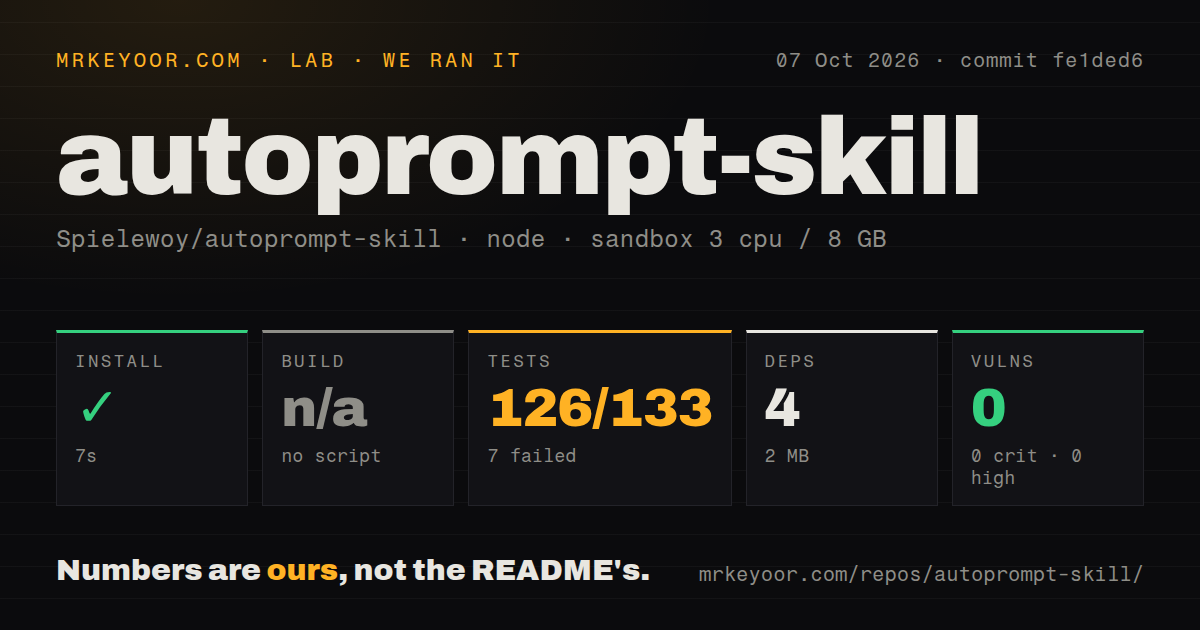
Our npm install completed in 4 seconds, added 0 packages, and used 21 MB on disk. Commit 91dc6ed contained 652 files and roughly 40,085 source lines in a 16.3 MB checkout. Npm audit reported 0 known vulnerabilities: 0 critical, 0 high, 0 moderate, and 0 low.
There was no build script or target, so the lab skipped build. The test command ran for 12 seconds and exited 1. Node's summary counted 80 tests, with 78 passing and 2 failing. The supplied log tail shows later packaging, documentation, provider-list, Windows CI, and release assertions passing; it does not show the names or error messages for the two failures. We cannot assign a cause from that tail.
The repository does have a tests directory and five CI workflow files, but no Dockerfile. A test suite that mostly passes still fails as a release signal when two cases fail. Buyers should run autoprompt doctor --strict after installation and exercise their specific provider rather than relying on the aggregate count.
The benchmark supports a trial, not a universal claim
The project's Terminal-Bench 2.1 comparison used OpenCode 1.18.7. Its published table says the baseline solved 60 of 89 tasks and the AutoPrompt run solved 73, changing failures from 29 to 16. That is the source of the advertised 45% reduction. DeepSeek's separate score is presented as a reference and explicitly described as non-comparable.
Those are project measurements, separate from our 80-test repository run. One benchmark configuration cannot tell a team how the skill behaves with Claude Code, Codex, a different model, or a private codebase. The missing timing and token logs also prevent checking the full quality-cost tradeoff. A useful evaluation would repeat a team's own backlog sample, track spend and elapsed time, then inspect whether independent review found defects that mattered.
The claim is specific enough to test, which is better than a vague promise. It should still be phrased as a result from one published run, not a property of every provider and task.
Provider adapters are the main maintenance risk
Coding assistants change their skill paths, subagent interfaces, model controls, and installer behavior. AutoPrompt documents minimum and audited versions for each provider, supplies doctor and repair commands, and tests package allowlists plus lifecycle entry points. This is the right maintenance shape for nine integrations. It also means one provider can break while the others remain fine.
Open issue #20 is a concrete example. On the reported DeepSeek Harness setup, the AutoPrompt preset registers ap_* tools but denies old subagent names that are not registered, causing every delegated role call to fail. The issue was opened on August 25, 2026 against 1.0.4. DeepSeek users should wait for a confirmed fix or patch and retest the preset themselves.
A new project with unusually detailed release discipline
The repository was created on August 17, 2026, pushed on August 25, and release 1.0.4 shipped on August 21. GitHub listed eight open issues and pull requests combined. Recent work covered provider additions, installer behavior, Windows paths, packaging, and a breaking DeepSeek report. That is active maintenance across a very short public history.
AutoPrompt is worth testing when a coding task can support several independent lanes and the user can measure the added cost. Its process design is sensible, its benchmark disclosure names important limits, and provider support is documented precisely. Keep it off tiny edits, pin the host version, run the strict doctor, and require a clean repository test result before making it a default team workflow.