ARIS coordinates research through files and agent skills
ARIS packages research procedures as Markdown skills that an agent can read and follow. The main route uses Claude Code to execute work and Codex as an independent reviewer, but the repository also documents Codex-native, Cursor, Copilot CLI, OpenClaw, and other combinations. The goal is broader than literature search. Workflows cover idea discovery, experiment execution, result analysis, paper drafting, rebuttals, presentations, and persistent research notes.
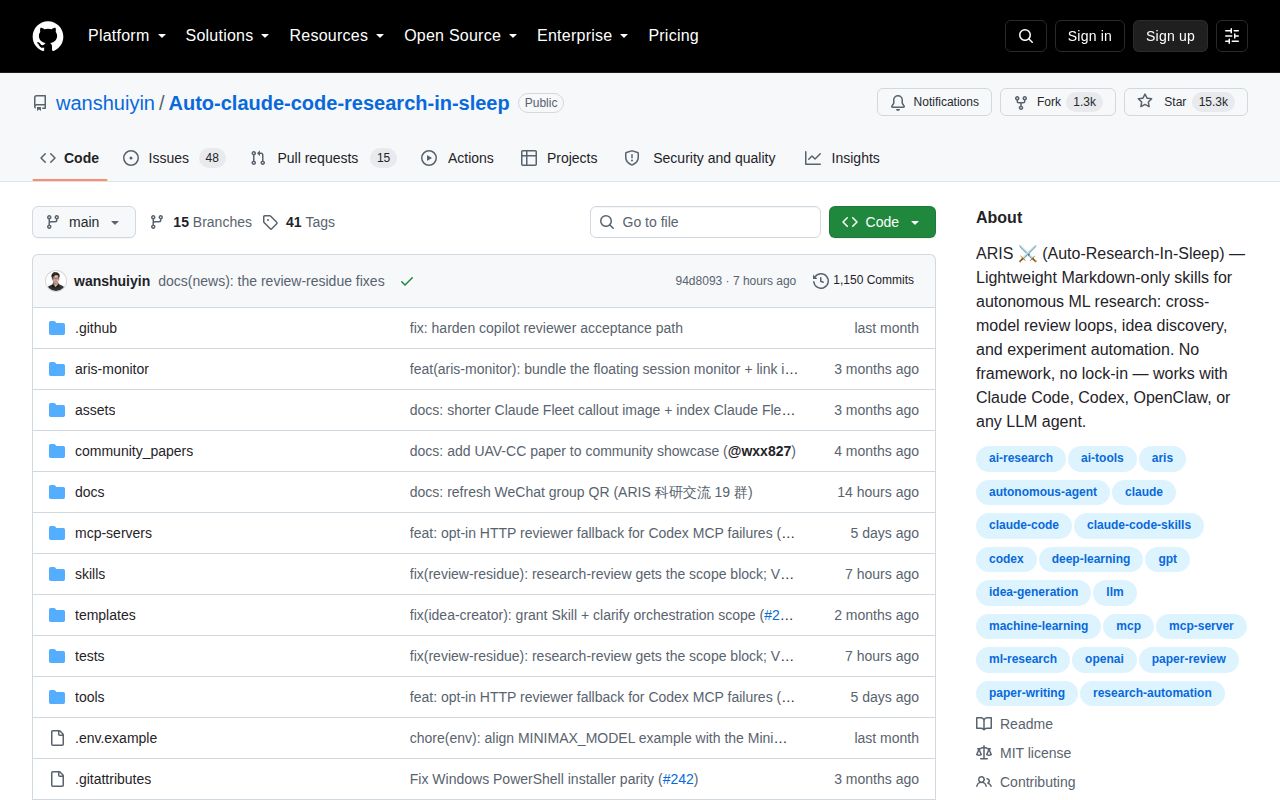
The checkout at commit 9cbb6aa contained 700 files, about 48,988 lines of source, and occupied 37.9 MB. GitHub identifies Python as the primary language, while the standalone ARIS-Code CLI and the skill collection widen the implementation footprint. The main README is English-first with several Chinese passages and links to a separate Chinese README. English setup and adaptation guides exist, so English readers can use the project without translating the core instructions.
The default pipeline can continue past selection checkpoints
The full research command links idea discovery, review loops, experiments, and paper writing. AUTO_PROCEED defaults to true according to the README's parameter table, which means the agent reports its selected idea and continues in the same turn. Setting it to false requests approval before committing GPU time. That switch deserves an explicit project decision because an attractive overnight workflow can otherwise move from analysis into code and compute while its owner is away.
Effort settings range from lite at roughly 0.4 times the default token budget to beast at 5 to 8 times. Those are README controls, not results from our sandbox. More effort can mean wider searches, more iterations, and deeper audits, which also means more model use and a longer trail to inspect. A serious trial should start with a bounded question, a fixed compute ceiling, and a repository branch created for the run.
What happened when we ran it
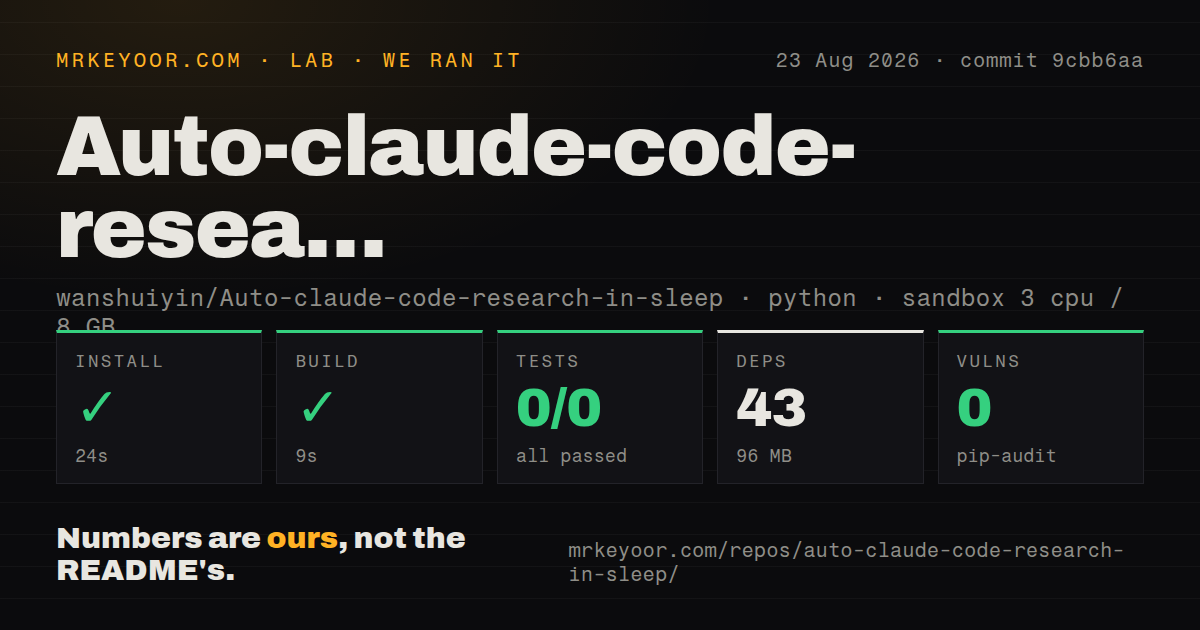
Our sandbox measured the Python project under mcp-servers/feishu-bridge/ at commit 9cbb6aa. Installation succeeded in 24 seconds, adding 43 packages and occupying 96 MB. Its build succeeded in 9 seconds. Pip-audit reported 0 known vulnerabilities in the installed dependency set. These results describe the bridge subproject, not a claim that every one of ARIS's research workflows executed successfully.
The test command failed with exit code 5 after 10 seconds because pytest collected no tests. Its final line was no tests ran in 0.00s, so the measured totals were 0 passed and 0 failed out of 0. The repository did have a tests directory and 4 CI workflow files, but the command available in the measured subproject did not exercise tests in our environment. A successful build does not fill that evidence gap.
Paper output requires 2 local document tools
Basic skill installation starts with an agent host. Cross-model review adds Codex CLI or another configured reviewer route. Workflow 3 also needs a LaTeX environment with latexmk and pdfinfo; the README provides commands for macOS and Ubuntu or Debian, plus a separate Windows path. Idea discovery and auto review can run without LaTeX, which lets a team install only the pieces connected to its immediate job.
The recommended project-local installer creates one symlink per skill in .claude/skills/ and records managed entries in .aris/installed-skills.txt. A later git pull updates existing linked content, but new or removed skills appear only after the installer runs again. Selective flags can install named groups or exclude an unwanted pipeline. That is a sensible control for a repository whose README lists 10 install groups and many optional integrations.
Overnight permission is the main operational risk
The optional auto-allow example permits Codex MCP calls, Write, Edit, and the auto-review-loop skill without prompts. A GPU configuration can also let the agent create scripts and run them locally, over SSH, or on rented compute. These capabilities are the reason ARIS can make progress while nobody watches. They are also why the first run should happen in an isolated branch with bounded credentials and no production secrets.
No GPU is required for review and rewriting, according to the README; experiment fixes can be left for manual follow-up. Feishu can add mobile approval, while Zotero and Obsidian supply research material. Each integration adds its own identity, storage, or network boundary. A team should decide which one agent may read and write before copying the broad overnight permission block into a live research project.
August activity is strong, but release notes move quickly
GitHub showed 15,287 stars, 63 combined open issues and pull requests, and a last push on August 26, 2026. The recent activity list included updated pull requests and user questions in both English and Chinese. Release v0.4.24 was published August 9, while the README already described changes dated August 26. That combination shows active work beyond the latest tagged release, so users should distinguish the chosen commit from the latest downloadable CLI package.
ARIS offers more concrete workflow machinery than a folder of generic prompts. The cross-model review idea is useful, the installation can be narrowed by skill group, and the documentation admits when LaTeX, a GPU, or an external service is optional. The trade is control: 43 measured bridge dependencies are the easy part. Trusting generated experiments and rewritten claims after an unattended run requires code review, result verification, and a recovery path that the project owner defines.