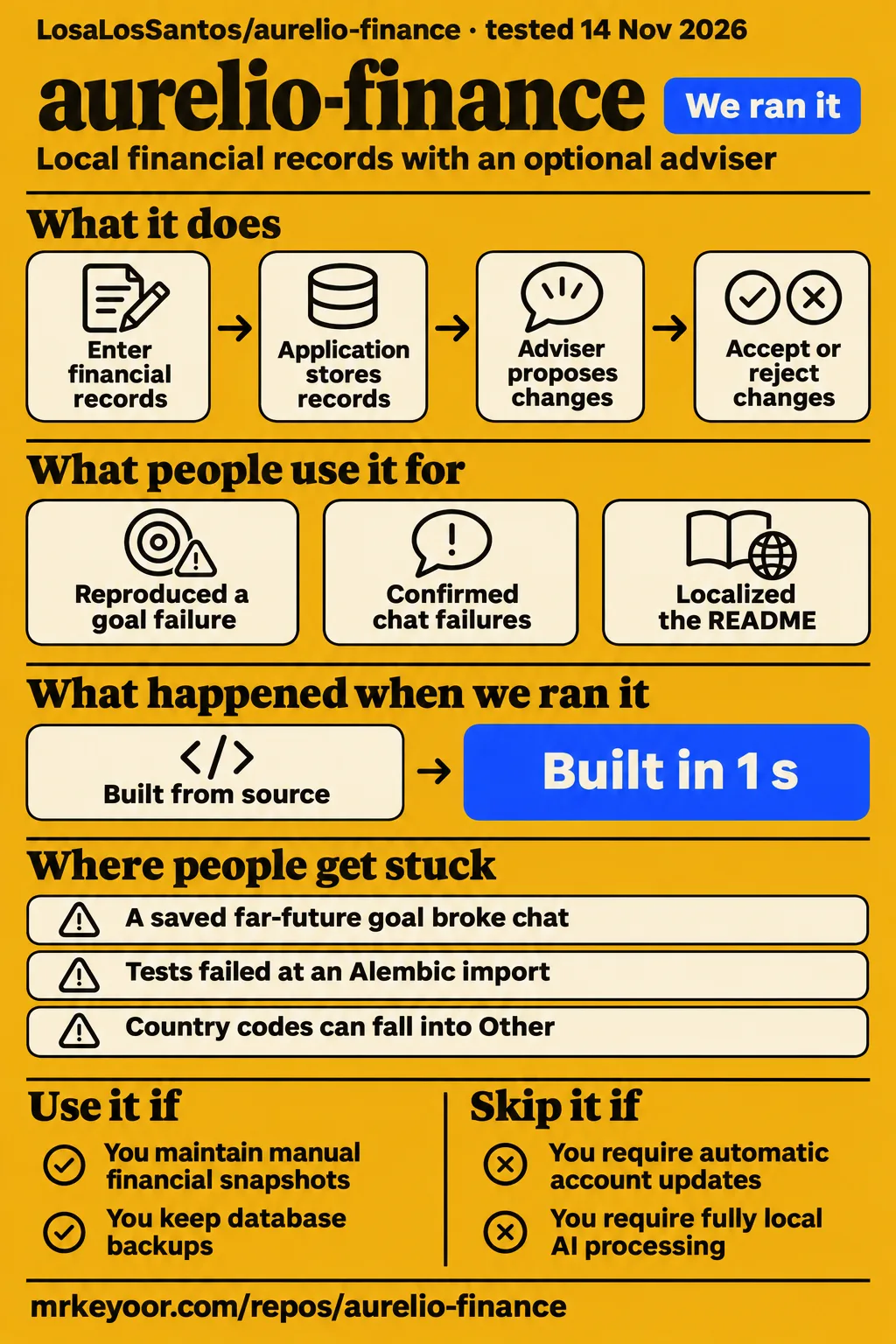
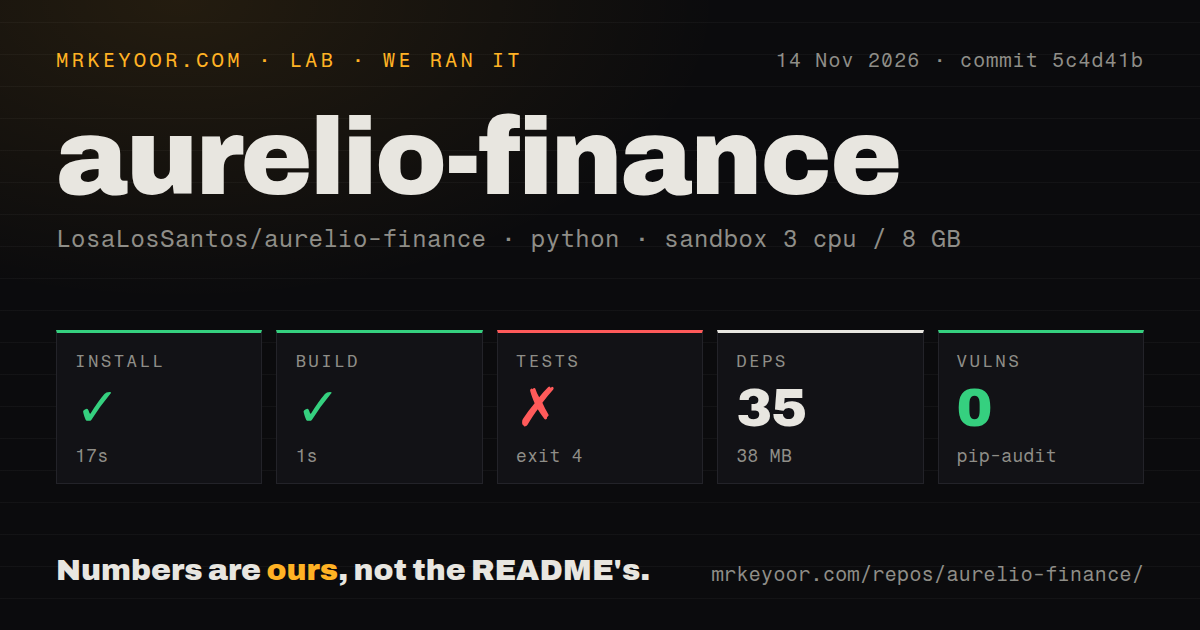
Aurelio's backend installed in 17 seconds and built in 1 second in our sandbox, but its test command stopped at an Alembic import error. The application combines locally stored financial records with an optional OpenRouter adviser. Its documented holdings, debts, goals and fund exposure make it worth investigating for technical households prepared to maintain snapshots and backups. Start with the invented-household demo described in the README.
What you can do with Aurelio Finance
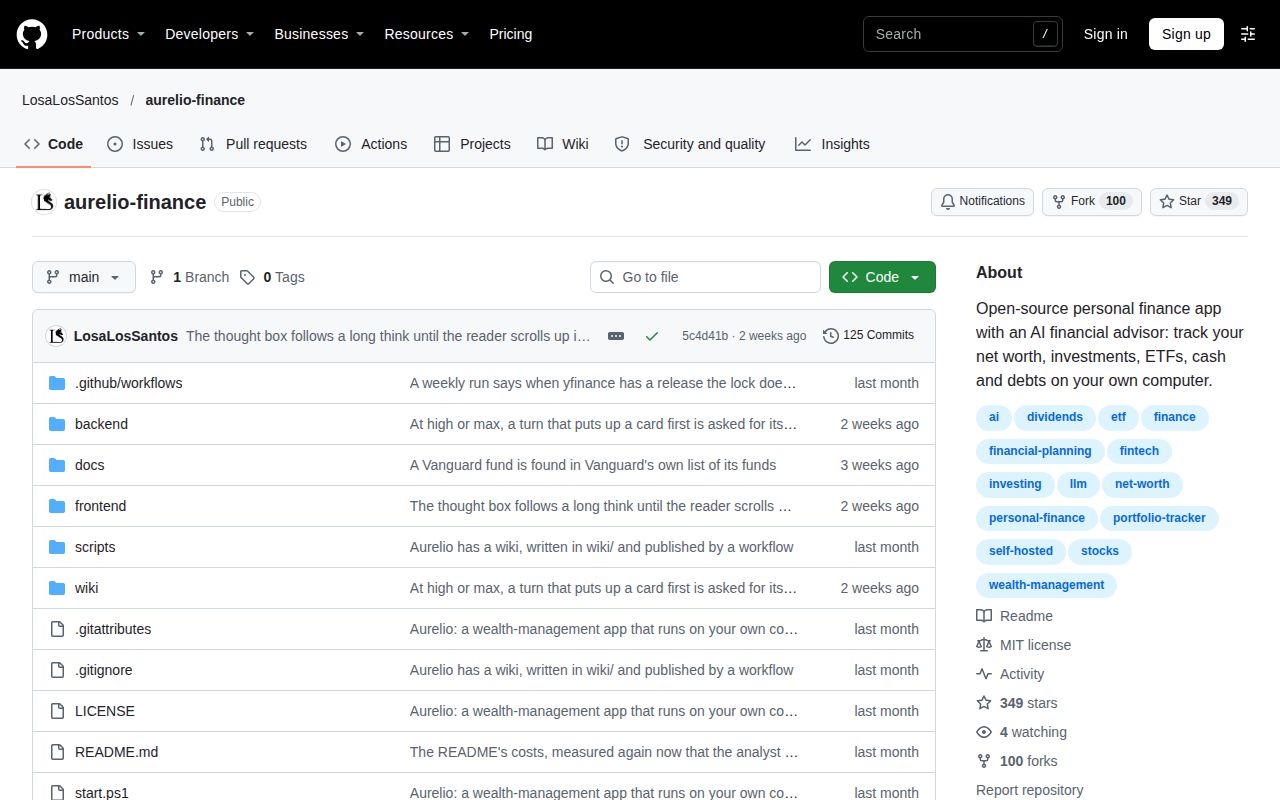
Aurelio's README documents holdings, cash, debts and savings goals in one locally stored financial picture. Its wealth view covers banks, brokers and dated holdings, while its portfolio view includes market prices, cost, gain and dividends. The Aurelio upstream README describes those capabilities. That combination addresses a household's assets and liabilities, with investment records sitting alongside the cash and borrowing that affect financial decisions.
Fund look-through breaks exposure down by country, sector, company and currency, according to the README. For someone holding several funds, the practical question is which underlying exposures overlap. The documented planning features add recurring investments, homes, loans, income, expenses, savings rates and required goal returns. These views give a reader specific tasks to examine in the demo: compare holdings, inspect exposure and see how a goal relates to existing cash commitments.
The MTD Technologies overview describes manual, dated snapshots that users enter and update themselves. Choosing that workflow means taking responsibility for keeping the financial picture current. A useful starting exercise would be to enter one dated account balance and one holding, then follow those records through the wealth and exposure views. This is a proposed evaluation task, separate from the backend command results reported below.
What people use aurelio-finance for
The supplied activity records describe a maintainer reproducing a goal failure and a contributor publishing Chinese onboarding material. The maintainer's response connects a reported planning problem to failed chat requests. The localization contribution provides another route into the project's documentation. Together, they show specific troubleshooting and documentation work around Aurelio, rather than supplying a household bookkeeping success story.
| Who | What they did | Recorded outcome |
|---|---|---|
| Maintainer LosaLosSantos, responding to an issue reporter | Reproduced a long-horizon goal failure | Confirmed saved chat questions followed by HTTP 500 and reported a fix through PR #5. Goal overflow issue #4 |
| DEV author linking aurelio-finance-cn | Localized the README into Chinese and added a quick-start section | Reported publishing the translated onboarding material. Chinese localization article |
The localization article discusses the README's confirmation-card approach: the adviser proposes a change for the user to accept or reject. That is relevant to readers deciding how much control they want over edits to financial records. The maintainer's issue response answers a different practical question, showing how an existing goal could affect a later chat request and identifying the reported fix for that failure.
What happened when we ran it
Our November 14, 2026 sandbox run at commit 5c4d41b installed the backend in 17 seconds, built it in 1 second and failed the test command after 1 second with exit 4. The Python project was under backend/. Our run reached test configuration loading, where tests/conftest.py imported Alembic. Dependency installation and the build completed before that test-loading failure.
| Sandbox check | Recorded result | What to take from it |
|---|---|---|
| Install | Succeeded in 17 seconds | The recorded backend dependency step completed. |
| Build | Succeeded in 1 second | The recorded build step completed. |
| Tests | Failed, exit 4, in 1 second | Loading conftest failed at an Alembic import. |
| Dependencies | 35 recorded, 38 MB on disk | The dependency footprint measured in this run. |
| pip-audit | 0 known vulnerabilities | The dependency-advisory result for this run. |
| Repository scan | 3 CI workflow files, tests directory, no Dockerfile | These files and signals were present in the checkout. |
The failing log names tests/conftest.py:34 and from alembic import command. Its error is ImportError: cannot import name 'command' from 'alembic' (unknown location). Those details identify where loading stopped and provide a concrete starting point for investigation. The recorded checkout contained 451 files, approximately 112,580 source lines and 6.9 MB of source. The sandbox configuration specified 3 CPUs, 8 GB RAM and image label ghcr.io/astral-sh/uv:python3.12-bookworm.
The separate browser runner failed its safety check because it required a Compose file. It found none of compose.yaml, compose.yml, docker-compose.yaml or docker-compose.yml. The browser-run safety record names the failed step, and the browser-run teardown record records successful teardown. Aurelio's README supplies shell and PowerShell startup scripts, which are a different startup route from the runner's Compose requirement.
Where people get stuck: a saved goal broke chat
Issue #4 describes a saved far-future goal that caused required-return overflow and downstream failures. The supplied synthesis places the threshold beyond roughly 85 years and identifies effects on planning, chat context, MCP context and purchase sizing. The goal overflow report and maintainer response describe a calculation problem whose consequences extended beyond the goal view itself.
The maintainer confirmed that chat stored each question before building its financial context. Questions submitted while the affected goal existed therefore remained in history and received HTTP 500 responses. That sequence explains how a planning-data problem appeared as a chat failure. The maintainer reported a fix in commit a008d7f through contributor juliasadler's PR #5, applying the suggested overflow handling.
| Symptom or finding | Evidence-led next step | Resolution recorded |
|---|---|---|
| Chat returns HTTP 500 after a far-future goal is saved | Inspect the goal and compare the installed revision with the reported fix | Maintainer reports a008d7f through PR #5. |
Our test command cannot import alembic.command |
Preserve the log and investigate the import in the recorded environment | The supplied log ends at the import failure. |
| Country-code reproduction places eurozone entries in Other | Compare the normalization input with the issuer path supplying the holding | The synthesis distinguishes the reproduction from the supported-feed boundary. |
The goal report gives a useful troubleshooting sequence: retain the input associated with the failure, identify the calculation that reads it and follow the resulting error into the affected feature. Here, the saved goal, context construction and HTTP response form that chain. The Alembic import error belongs to a separate investigation because it occurred while loading test configuration, before the recorded test command could proceed.
Country normalization can distort the exposure view
Issue #3 reports eight eurozone country codes reaching Other currency and region buckets in its reproduction. The affected codes were CY, EE, HR, LV, LT, MT, SI and SK. The country normalization report explains that the normalization map omitted those codes, while the currency and region mappings expected long country names. A country supplied as a code could therefore take a different path from the same country spelled out.
The report says unknown codes remain visible as supplied. Its consequence is concrete: a code that survives normalization can miss the long-name mappings and fall into Other. For a reader examining fund exposure, the useful comparison is between the issuer's country label, the normalized label and the resulting currency and region. Checking only an overall portfolio total would answer a different question from checking how exposure is classified.
The supplied synthesis also records a narrower supported-feed boundary: the maintainer found the eight codes absent from the supported Vanguard feed they checked and identified disagreement between long country names. That distinction matters when interpreting the report. A reproducible mapping defect and the holdings reaching that mapping are separate facts, so the issue should guide inspection of the actual issuer data feeding a portfolio rather than a blanket conclusion about every Vanguard holding.
Security: local records and the optional adviser
Aurelio stores records in backend/data.db, and its optional adviser connects through OpenRouter using the user's key. The upstream README describes chat answers based on those records, web search and proposed changes presented as confirmation cards. Enabling that integration requires an OpenRouter account, credit and OPENROUTER_API_KEY in backend/.env. Local database storage and the external AI connection are distinct parts of the documented design.
Confirmation cards provide the documented decision point for accepting proposed changes. The user can examine the suggestion before accepting it, while the invented-household demo provides sample records in a separate file for an initial look at the application. Readers can therefore begin with the documented demo and make a separate decision about configuring the adviser, rather than treating AI setup as part of the basic tracker installation.
The README says the application saves a copy beside the database before an update changes its format. That is a specific backup behavior and location. For someone maintaining financial records locally, it belongs alongside decisions about where independent copies will live and how the database will be restored. The original database, the neighboring copy and the user's wider backup arrangement each have a practical role in that maintenance plan.
Aurelio Finance vs YNAB, Mint and Actual Budget
Actual Budget documents synchronization between devices, while YNAB describes adding accounts and planning money before spending. Aurelio's README centers a local wealth picture with portfolio look-through and an optional adviser. These descriptions support a comparison around recurring tasks: maintaining financial snapshots, organizing investment exposure or allocating money for spending. The supplied beginner guide uses discontinued Mint as historical context in its comparison.
| Choice | Documented or attributed emphasis | Decision to make |
|---|---|---|
| Aurelio Finance | Local wealth records, fund look-through and an optional record-aware adviser | Whether to maintain manual snapshots, source setup and backups. |
| YNAB | Account-based planning before spending; the beginner guide describes a subscription | Whether that budgeting-service workflow fits the task. |
| Mint | The beginner guide describes it as discontinued | Treat it as historical context in that comparison. |
| Actual Budget | Local-first finance, synchronization and desktop or hosted deployment choices | Whether budgeting across devices is the main requirement. |
Actual Budget's upstream README describes synchronization and links to envelope budgeting. It lists downloadable Windows, Mac and Linux applications, Docker deployment and hosted routes. YNAB's own website describes starting a trial, adding accounts and making a flexible plan before spending. The Aurelio beginner guide's comparison supplies the subscription and historical Mint descriptions. These are documented workflows to compare against the financial task you need to maintain.
What the other reviews get wrong
The beginner guide says financial records never leave the machine, while Aurelio's README documents an optional OpenRouter adviser answering from those records. A precise description separates the local database from the external integration. The beginner guide makes the absolute claim; the upstream README supplies the configurable connection and record-aware chat behavior. That distinction affects the decision to add a provider key.
The research synthesis identifies another overstatement in the troubleshooting guide: it attributes adviser problems almost entirely to keys or billing. Issue #4 provides a concrete application-level explanation for failed chat requests. The maintainer reproduced the goal problem and confirmed stored questions followed by HTTP 500 responses. For that symptom, the saved goal and context calculation are relevant troubleshooting inputs alongside provider configuration.
The synthesis also identifies the MTD Technologies overview's backup claim as stronger than the documented behavior. The README describes a copy saved beside the database before a format-changing update. That supports naming the copy and its location. A reader planning to depend on local financial records should include restoration in the adoption process, using the database and backup arrangement they intend to maintain.
FAQ
Aurelio's README specifies an MIT license, a local database at backend/data.db and optional adviser setup through OpenRouter. The MTD overview describes manual snapshots. Those facts separate three practical decisions: whether the recordkeeping workflow fits, whether to run the source installation and whether to pay for external AI requests. The questions below come from the supplied overview and beginner-guide material.
Does Aurelio connect to my bank automatically?
The MTD Technologies overview says records are manual, dated snapshots that users enter and update themselves. Its automatic bank connection question points to an ongoing data-entry responsibility. Someone must keep balances and holdings current for the financial picture to stay useful. If automatic account updates determine your choice, use that requirement when comparing workflows before spending time on Aurelio's portfolio and planning views.
How much does the AI advisor cost to run?
The README reports its author's October 2026 costs on a test database: $0.11 to $0.12 for a first question drawing a card, $0.021 for a simple follow-up and $0.64 for an analysis including lookups. These are the author's examples from the README's adviser cost table. Adviser setup requires an OpenRouter account with credit, separately from the application's MIT license and our backend measurements.
Is Aurelio free to use?
Aurelio's code is MIT-licensed, and the adviser is optional, according to the upstream README. The beginner guide also describes the application as free and open source. Enabling the adviser adds the separate OpenRouter account and credit requirement. The useful cost distinction is between running the tracker from source and paying for external requests through the configured AI provider.
Documentation and the starting route
The README specifies Git, Node.js 22 or later and uv, then supplies demo and normal startup commands for shell and PowerShell. It says the first start opens an invented household at http://localhost:8000 in a separate file. It also identifies the database path, optional provider configuration and separate backend and frontend development commands. A technical reader has concrete prerequisites and commands to use as the starting route.
The documentation score is 3/5 for startup-instruction coverage. On that narrow rubric, 1 means a usable startup path is missing, 3 means prerequisites and concrete startup commands are supplied, and 5 requires reproduction of the documented platform paths. The README supports the middle category by listing the required tools and both script routes. The rating describes instruction coverage; the command results above report what happened in our backend environment.
What we have not tested yet
The browser-run detail stops at the failed Compose check, with no completed browser-task answers or screenshot records. Its generic run summary nevertheless says deployment used the project's own Docker Compose on November 14, 2026, with every port bound to 127.0.0.1. That conflicts with the detailed stop, so deployment and application use remain unresolved. Rendered layout, accessibility, recommendation modules and related-link behavior also remain untested.
The image label does not establish actual runtime or operating-system versions. The test tail supplies neither the cause of the Alembic import failure nor a passing-test count. The reported goal fix has not been reproduced here, the zero-balance discussion ends mid-explanation, and the final country-normalization remedy is absent from the supplied extract. Repository metadata was supplied separately from the measured checkout; it is not a basis for assigning exact-version application behavior to the run.
The evidence also leaves open which financial fields reach the AI provider, context minimization, confirmation enforcement, database restoration, large-ledger performance and adviser quality. It contains no sustained household-adoption result, comparative product benchmark or application security audit. The pip-audit result concerns known dependency advisories. Full setup ease, community support and product maturity remain unassessed, and the documented script paths have not been reproduced across their listed platforms.
Search volumes, demand and ranks are unknown, and this revision adds no execution results. A useful next evaluation would follow the documented scripts with invented data, reconcile a holding against issuer information and restore a database from the intended backup arrangement. Those tasks address the practical questions left by the supplied evidence before someone relies on Aurelio as their only financial record.