Nine skills turn a Chinese job search into one evidence chain
Our 168-file checkout organizes a Chinese job search into 9 linked skills and a shared evidence chain. The entry points cover open-source contributions, evidence review, project study, resume wording, resume production, job matching, form filling, interview practice, and campus-recruitment tracking. A contribution can become a verified resume claim, then a question the interview skill tries to break. The useful product is that chain of custody for a claim.
The 12.6 MB project is aimed at Chinese job seekers. A full English README explains the system, but the supplied material still reflects that market: 18 Chinese HTML templates, campus-recruitment states, HR outreach, and Chinese examples. An English-speaking developer can follow the mechanics. Adapting the tone, fields, and hiring assumptions is a separate writing job, and the repository does not pretend otherwise.
The agent stops before the actions that can hurt you
The README limits /job-apply to 1 application request and pauses before the final submission button. The user handles passwords, verification codes, MFA, passkeys, and CAPTCHAs. The skill also asks separately before entering personal data or uploading files. Those limits make it slower than a mass-application bot. They also prevent a vague request such as "fill my resume" from becoming permission to send an application.
The same restraint appears in /contributor. It checks project activity, contribution rules, duplicate work, and the proposed diff before asking permission to fork, push, or open a pull request. Unmerged work stays labeled as submitted or in progress. The 46 tests we ran cannot prove a candidate's story, so the truthfulness rules preserve real employers, dates, education, individual responsibility, and evidence. Stronger verbs require stronger proof.
A 12.6 MB checkout installed without dependencies
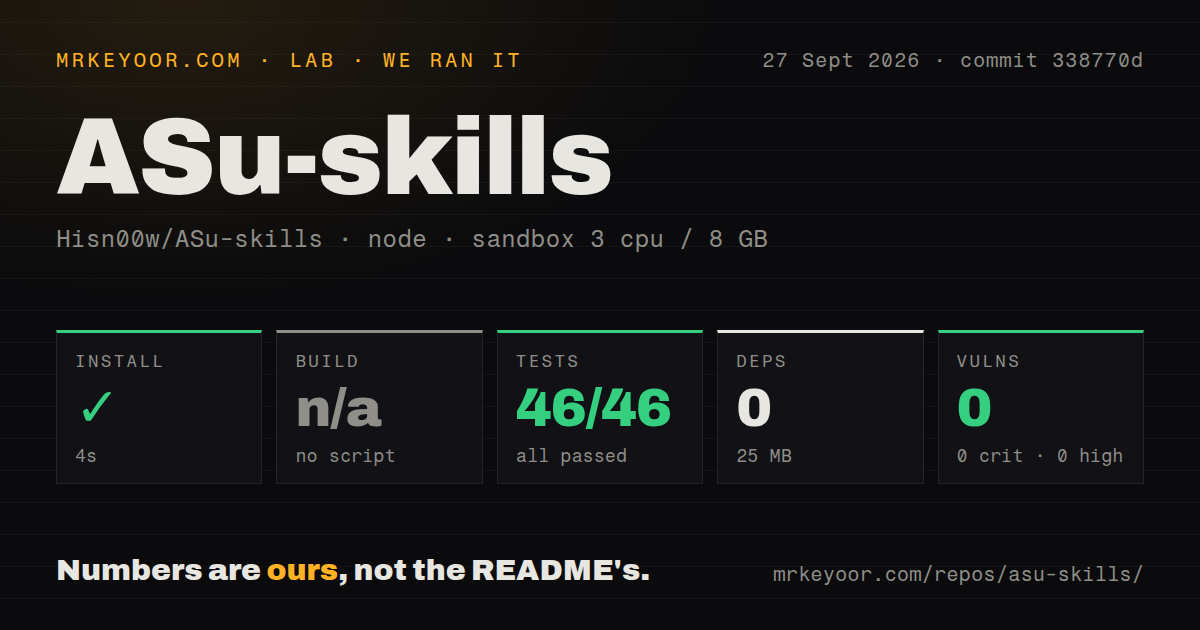
Our sandbox clone at commit 338770d contained 168 files, about 5,122 lines of source, and occupied 12.6 MB before installation. Npm completed in 4 seconds, installed 0 packages, and left 25 MB on disk. That small dependency surface fits the repository's actual shape: Markdown skill instructions, HTML and LaTeX templates, JavaScript and Python helpers, reference files, and plugin manifests.
Our 12.6 MB checkout still installs differently across hosts. Claude Code uses marketplace add and install commands. Codex accepts the GitHub repository as a plugin source. TraeWork and Qoder have their own paths, while Cursor, OpenCode, and WorkBuddy use bridge instructions. The catalog in skills.registry.json is the shared source for all 9 entries, which reduces drift between manifests. It does not make the host-specific setup disappear.
What happened when we ran it
In our fresh Debian sandbox, npm install succeeded in 4 seconds with 0 packages added. The environment used Node 22, 3 CPUs, 8 GB of RAM, no secrets, and no elevated privileges. Npm audit found 0 known vulnerabilities across critical, high, moderate, and low severities. The run measured repository mechanics only. It did not assess resume quality, browser compatibility, or whether an agent gave good career advice.
There was no build script or target, so we skipped the build instead of inventing a substitute. The available node:test suite finished in 5 seconds with 46 passed and 0 failed. The repository also had 1 CI workflow and a tests directory, but no Dockerfile. Those 46 green tests support the scripts and assets covered by the suite. They cannot validate a generated claim against a candidate's real history.
The resume files are editable, with browser-dependent output
Our 168-file checkout includes 18 Chinese HTML templates, and /make-resume can export optional LaTeX source in 3 layouts. The default ASu template stays read-only while the skill creates a user copy. You can also supply another template or a reference screenshot. Browser editing covers text, photos, fonts, colors, and emphasis, followed by print-to-PDF export. That is more useful than receiving a flattened image when a recruiter asks for one correction.
Our 5-second test pass does not inspect the final PDF, so the output still needs a human acceptance check. Local font reading requires browser permission, and XeLaTeX is the documented compiler for the optional .tex files. Open the PDF on another device, inspect page breaks, and confirm every contact field. The repository can structure the work, but it cannot see a missing glyph in the file you send unless you show it that artifact.
Active October pull requests offset the missing release tags
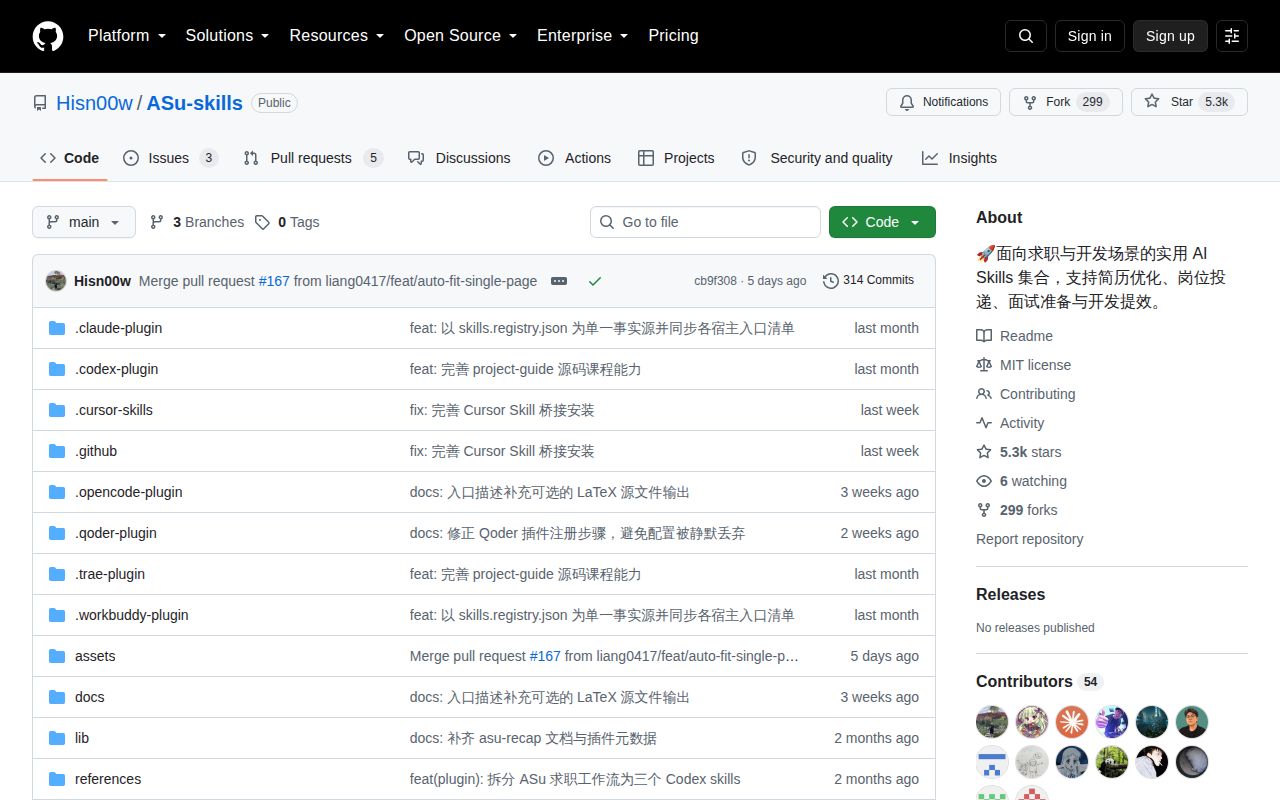
The default branch was last pushed on September 29, 2026, and GitHub showed 5,334 stars. On October 3 the open queue contained 3 issues and 5 pull requests, including work on Windows line endings and plugin metadata. That combination points to active maintenance. The latest-release endpoint returned no release, so teams should pin a reviewed commit instead of treating the package version as a published release contract.
One open issue asks for an npm installation CLI, and pull request 169 supplies it, but it had not merged when checked. Today the documented install paths are the host-specific ones in the README. ASu-skills earns a trial when its Chinese recruiting context fits and its confirmation stops feel like protection. If that context does not fit, 46 passing tests do not make the career material transferable.