The Python build passes before device automation is ready
Artemis built successfully in 4 seconds in our sandbox, then its tests stopped while importing OpenCV. That's a useful introduction to this Android automation project: getting the Python code packaged leaves native libraries and a connected device to deal with. The attractive part comes after that work. You describe a task in ordinary language, and Artemis observes a phone's interface, chooses actions and records what happened.
The README describes cross-app workflows, accessibility-based targeting and visual fallbacks for custom interfaces. Screenshots and Logcat output can help a coding assistant investigate an app after it makes a change. I'd consider it for exploratory checks where the useful result is a trace you can inspect. A release requirement with an exact expected outcome still needs an explicit assertion, regardless of how convincingly an agent describes its actions.
What happened when we ran it
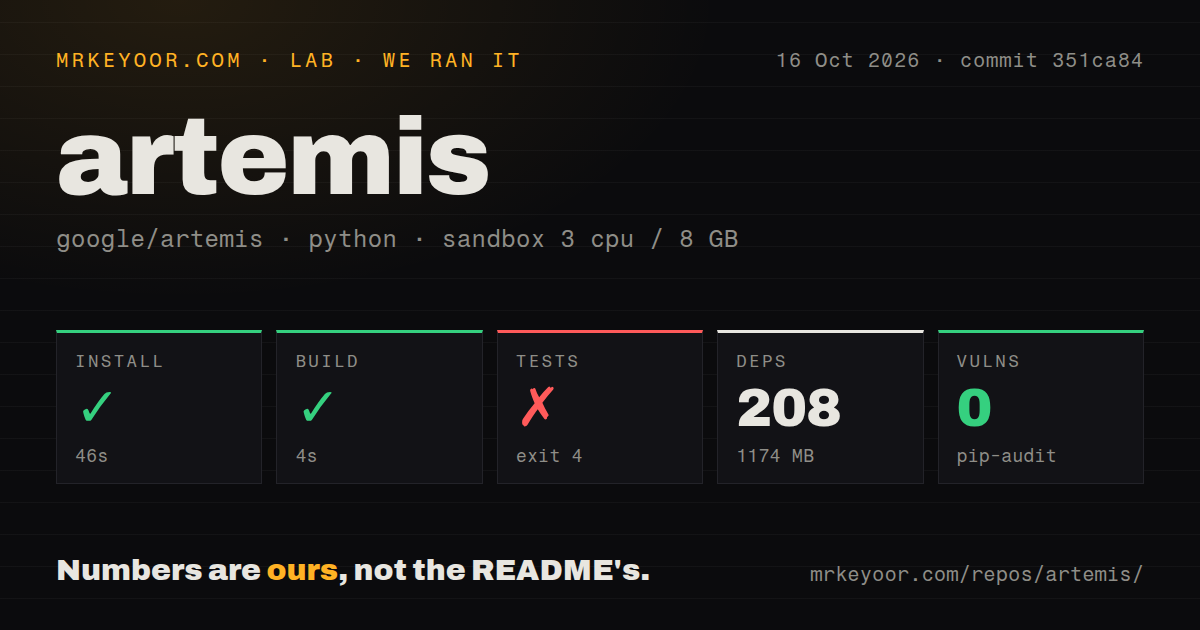
Our run installed Artemis commit 351ca84 in 46 seconds, adding 208 packages and occupying 1,174 MB on disk. The build succeeded in 4 seconds. We used the Python 3.12 Bookworm uv image in an unprivileged Debian sandbox with 3 CPUs, 8 GB of RAM and no secrets on October 16, 2026. These figures describe repository setup, without establishing whether Artemis can complete a phone workflow.
The test command failed with exit code 4 after 8 seconds. The supplied traceback reaches artemis.context, then the video utilities, then cv2. OpenCV's native import raises ImportError because libGL.so.1 cannot be found. That identifies the immediate blocker in this container. It does not establish a failing application assertion, and the log provides no passing-test count or evidence of what would happen after supplying the library.
Pip-audit reported 0 known vulnerabilities. The checkout contained 817 files, roughly 179,268 source lines and 36.6 MB before installation. Our scan found a Dockerfile, a tests directory and 1 CI workflow file. None of those signals overrules the import failure. The defensible finding is that Python installation and build completed, while the available environment could not get through the test command's native-library import.
The launcher also touches device and agent configuration
The quick start requires an Android device with USB debugging enabled or an emulator. Its launcher is documented to detect and install toolchains such as ADB, scrcpy and FFmpeg, then offer global MCP configuration and agent rules. Model-provider credentials live in environment configuration. Those are meaningful workstation changes, so I would read the prompts and select the clients I actually use before accepting global setup.
Our 208-package installation does not validate that launcher, an attached phone or authenticated model calls. A missing libGL.so.1 in the lab is evidence that the Python environment alone was insufficient. It isn't evidence that the documented startup script fails identically. For a deployment image, reproduce the package setup and resolve the native import before spending time diagnosing phone permissions or model behavior. Otherwise, unrelated setup failures become hard to separate.
Flash omits the checks that Pro adds
Artemis requires Python 3.12 or later and exposes Flash and Pro execution profiles. The README says Flash has no task plan, checkpoint verification or final report, and no ADB shell. Pro adds a maintained plan, checks before actions and a Checker for the requested goal. Pick the profile by the evidence your task requires. A quick navigation request and a release-signoff investigation should not inherit the same verification expectations.
The 8-second lab failure leaves both profiles unvalidated here. I would begin with a disposable test account and a narrow journey whose destination is easy to inspect, then examine the captured state myself. The README's default Flash loop is unbounded, although a turn setting exists. Set a task limit deliberately when connecting a model-backed agent to a device, particularly for unattended work that could keep retrying an unavailable target.
The accessibility helper changes the phone's environment
The first device task installs an accessibility helper according to the README. It reads layout information, appears in Accessibility settings and shows a running notification. Other automation using UiAutomation can suppress it unless configured to preserve accessibility services. Artemis documents helper inspection and removal, an opt-out of automatic installation, and a UIAutomator2 alternative. That matters if your lab already has another tool controlling the same phone.
The 1,174 MB host environment is therefore only part of the operating footprint. Device state and connection setup deserve their own checklist. Open issue 184 reports that the wireless panel connects but cannot perform initial pairing. Its documented workaround is a terminal adb pair before using the panel. A proposed fix exists as an open pull request, which should not be treated as a shipped capability.
October discussions continue without a published release
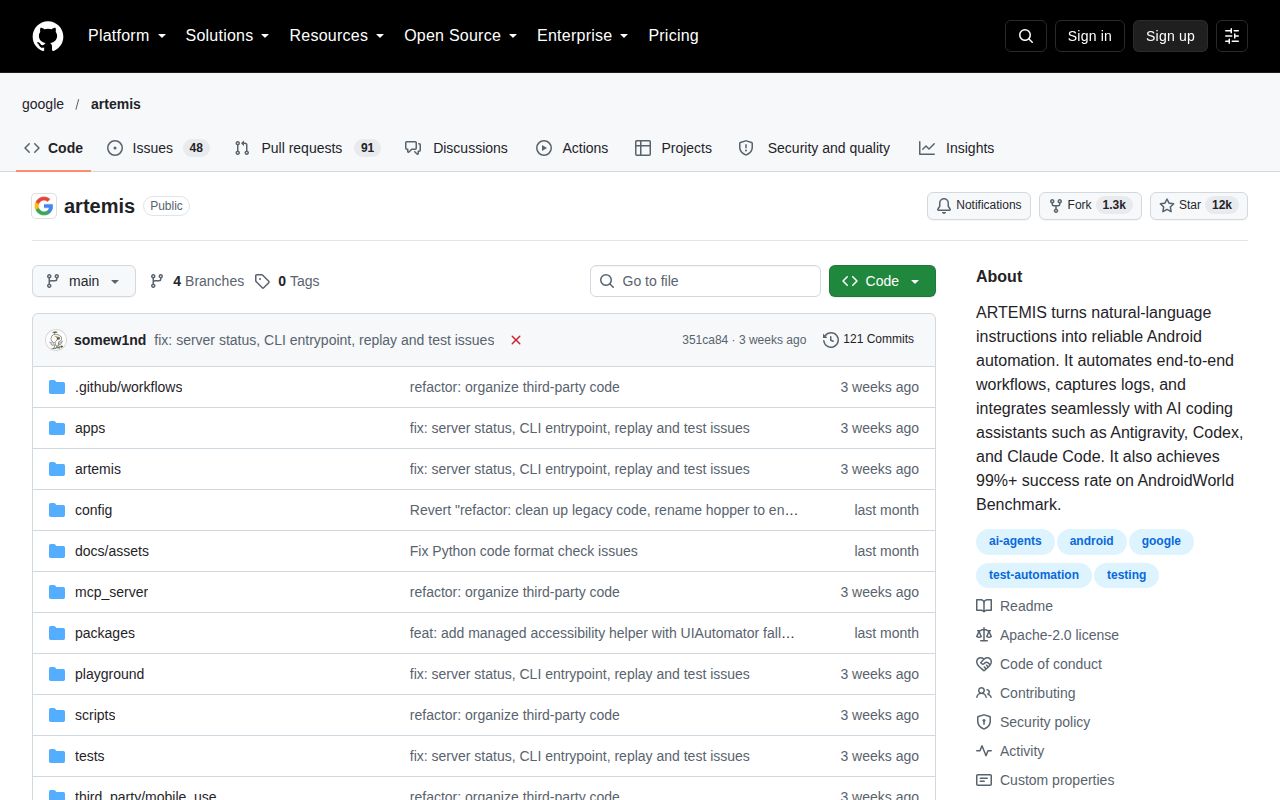
GitHub listed 12,033 stars and 139 open issues and PRs, with the last push dated October 1, 2026. The latest-release endpoint returned no published release. Discussion and proposed fixes continued in October, including wireless pairing and local model support. That combination describes an active development project without a published release to anchor adoption. It doesn't justify calling the repository abandoned, or treating an open contribution as merged functionality.
Appium is the stronger starting point when you want explicit WebDriver scripts and platform drivers. Maestro suits teams that want readable YAML flows and repeatable assertions, and it also has an MCP path. Artemis earns a trial when exploratory cross-app work and diagnostic traces justify a model-driven operator. Before giving it a permanent CI role, clear the native-library import and require a successful representative device journey with an inspectable result.