One WebDriver protocol reaches several app platforms
Appium 3.8.0 gives native, hybrid, mobile-web, and desktop automation the same basic conversation. A test client sends WebDriver commands to an Appium server. An installed driver translates those commands into the platform's own automation system, such as XCUITest on iOS.
The common interface has boundaries. Appium's architecture guide says some WebDriver commands do not make sense on every platform, with cookies in native mobile apps as its example. Official client libraries cover Java, Python, Ruby, and .NET C#, while other languages depend on third-party clients. You gain a shared vocabulary, not identical platform behavior.
The core install stops before the first device command
Our 61-second npm install produced an Appium server that could not automate a device by itself. You must add a driver, select it through capabilities, run the server, and point a client at it. That modularity keeps unused platforms out of the core, but it moves the working setup across several packages.
Appium 3.8.0 requires npm 10 or newer and Node ^20.19.0, ^22.12.0, or at least 24.0.0. The basic server runs on macOS, Linux, or Windows. The official requirements warn that platform drivers usually need the matching developer toolchain and SDKs.
What happened when we ran it
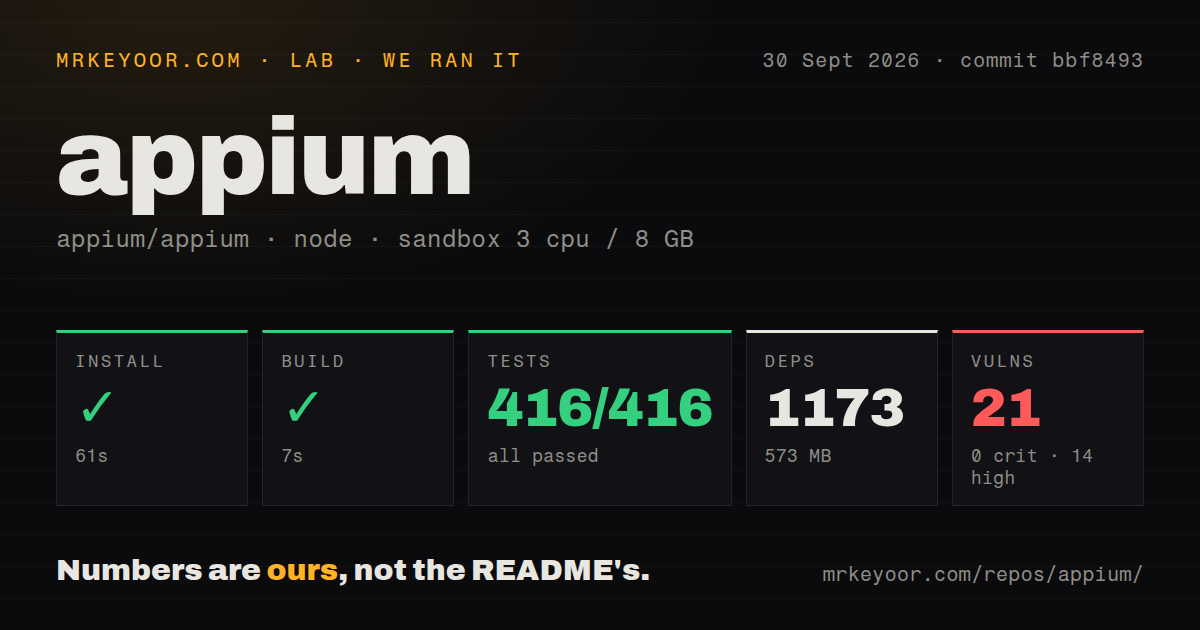
In our sandbox, we measured a 61-second install at commit bbf8493, which added 1,173 packages. The dependency tree occupied 573 MB. The build completed in 7 seconds, and the node:test run finished in 63 seconds with 416 passed and 0 failed. The container had 3 CPUs, 8 GB of RAM, Node 22, and no secrets.
The checkout contained 960 files, about 66,921 lines of source, and 12.1 MB before installation. We found 16 CI workflow files, a workspace monorepo, no Dockerfile, and no top-level tests directory. Npm audit reported 21 known vulnerabilities: 14 high, 1 moderate, and 6 low. We did not attach an Android device, boot an iOS simulator, or measure session speed, so the 416 passes say nothing about a real app flow.
Drivers widen coverage and split the upgrade surface
Appium 3.8.0's extension CLI installs, lists, updates, and removes drivers independently. Ordinary updates avoid a new major version unless you pass --unsafe. The server, driver, client, and platform SDK can therefore move on different schedules. Reproducing a failure requires recording every one of those versions.
The project supports only the most recent Appium release, according to its upgrade section. Appium 3.8.0 shipped on September 24, 2026, while 4.0.0-beta.2 followed on September 27. Teams on Appium 1 or 2 get migration guides, but long-lived device labs still need planned upgrade work. The stable core is mature; the surrounding extension graph needs ownership.
Android needs an SDK and JDK, while iOS needs macOS
Appium 3.8.0's Android quick start asks for an Android SDK platform, Platform-Tools, ANDROID_HOME, a Java JDK, JAVA_HOME, and either an emulator or a USB-debuggable device. It then installs the UiAutomator2 driver separately. appium driver doctor uiautomator2 checks those prerequisites and aims for 0 required fixes.
The same guide chooses Android because iOS automation requires macOS. Parallel execution is possible through multiple server processes or driver sessions, but the README sends you back to each driver's documentation for the right mode. Appium starts on 0.0.0.0:4723 by default, so a shared lab must also decide where the server binds and how remote clients reach it.
The HTTP server permits mixed client languages
In Appium 3.8.0, the server runs separately from the test process and accepts WebDriver requests over HTTP. That is why a Python suite can drive the same server architecture as a Java or C# suite. It also suits device-cloud providers: the client can live on one machine while the server, driver, and device live elsewhere.
The network boundary adds one current wrinkle. Open issue #22683 reports that Appium 3.7.0 failed to start with TLS certificate paths on Node 24.20.0, although the reporter's Node 22.23.2 setup worked. The issue remained open after an update on September 8, 2026. Teams that terminate TLS inside Appium should reproduce that exact path before choosing Node 24.
September activity is strong, while the audit needs attention
The repository was pushed on September 30, 2026, the day of this review. GitHub showed 22,036 stars and 46 combined open issues and pull requests, which split into 37 issues and 9 pull requests. Stable Appium 3.8.0 was six days old, and the latest beta was three days old. Those dates and the active queue show current maintenance rather than a project coasting on its name.
Maturity does not cancel dependency maintenance. Our fresh install's 14 high-severity findings need triage against actual runtime paths before a shared server goes live. The lab result establishes their presence, not exploitability. It also weighs against treating the core as a tiny coordinator: 1,173 packages and 573 MB are material costs before any driver, SDK, simulator, or app enters the system.
Pick Appium when platform breadth pays for the extra layers
With all 416 core tests passing, Appium makes sense when Android and iOS tests must share conventions, or when a device service needs a language-neutral protocol. Detox is more focused for React Native gray-box testing. Maestro offers flatter YAML flows across mobile and web. Playwright is cleaner when every target is a browser.
The deciding evidence is concrete: our core build passed, all 416 tests passed, and the repository moved on September 30. The cost is equally concrete: the core alone automates nothing, the install used 573 MB, and Android still asks for its SDK and JDK. Choose Appium when one protocol will replace several test stacks. For a single platform, those layers arrive before the first useful assertion.