AnyPS5 converts executables instead of emulating a console
AnyPS5 takes a clean PS5 ELF, processes its bundled modules, and writes a native Linux ELF or Windows PE file. Replacement PRX libraries provide the system functions that converted software expects. There is no separate emulator process. That is an interesting technical bet, but it also puts a hard boundary around compatibility: unsupported states throw an exception and terminate rather than being approximated.
The input layout is strict. Exactly 1 directory named sce_module or sce_modules must sit beside the executable, and having both is an error. Converted modules go under app0, while project-built PRX libraries belong in a separate libs directory. The output filename does not choose the platform. Windows conversion needs the --windows flag, and Intel hosts use --to-intel for supported AMD-only instructions.
The compatibility list contains one tested game
The project's compatibility page has 1 row: Dreaming Sarah. It marks the Windows result as in game and playable, while Linux is a question mark. That page is a much better buying signal than a progress badge. A library percentage counts functions known to the project, not every PS5 system function, and the total changes as maintainers discover more.
The technical-debt document explains why the list is short. It names silent UI stubs, unknown function signatures, missing headset behavior, unimplemented media cases, and conversion gaps. The contributor rules require unsupported work to throw rather than pretend success. That policy makes failures easier to locate, but it does not make more software run. For a researcher, an explicit exception is useful evidence. For a player, it is still a stopped game.
What happened when we ran it
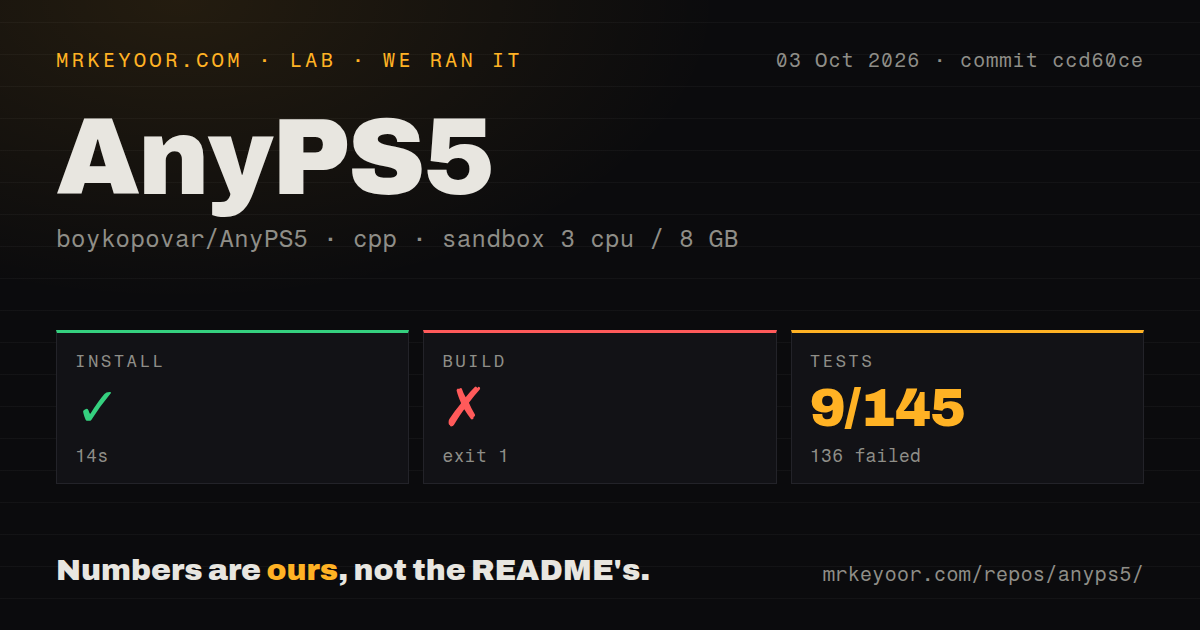
Our sandbox installed commit ccd60ce in 14 seconds inside an unprivileged Debian container with 3 CPUs and 8 GB of RAM. The checkout contained 10,465 files, about 2,300,908 lines of source, and occupied 222 MB. Installation completed successfully. The repository scan found 9 CI workflow files, no Dockerfile, and no top-level tests directory.
The build failed at exit 1 after 44 seconds. The supplied log tail points to source line 143 and an expression using std::chrono::clock_cast<std::chrono::system_clock>(written). Compilation continued through several other objects before Ninja reported that a subcommand failed and stopped. The tail does not identify a missing package or prove a compiler-version cause, so we will not invent one.
CTest then exited 8 after 1 second. It reported 9 passed and 136 failed out of 145, with one final case marked not run. The tail names failures including elf_offsets, tls_function_coverage, windows_gui, linux_load_alignment, elf_header, and guest_tls. Because the build was incomplete and the test tail omits individual causes, these results do not tell us which failures are code defects and which may follow from missing build outputs. They do tell us the documented sequence was not green in our container.
The toolchain and runtime layout leave little room for improvisation
Linux builds need x86-64, CMake 3.22.1 or newer, Ninja, a C++20 compiler, GCC, G++, binutils, and recursively initialized submodules. Configuration downloads FFmpeg binaries unless FFMPEG_PREBUILT_DIR points to an unpacked package. The repository vendors major components through submodules, including SDL, Vulkan headers, SPIR-V tools, glslang, FreeType, and FFmpeg-related code.
Windows is narrower. The build guide supports MinGW-w64 GCC 15.2.0 from one named WinLibs package, and the debt list says converted PRX libraries need 3 runtime DLLs nearby. The relinker has no --help flag; invoking it without arguments prints usage and returns an error. This is workable for a contributor following the docs line by line, but it is far from a download-and-play application.
Intel conversion rejects cases it cannot safely rewrite
PS5 code can contain AMD-specific x86 instructions. AnyPS5's --to-intel path rewrites supported cases, and refuses unsupported instructions or unreachable conversion stubs. The technical-debt page specifically says RDPRU and MCOMMIT are not lowered, while SHA instruction forms with a memory operand fail. Some conversion paths have only synthetic-test coverage and no verified game title on Linux or Windows.
That refusal is preferable to quietly producing a bad executable, yet it makes CPU choice part of compatibility. Even a successful C++ build only creates the relinker and libraries. You still need legal input binaries, the correct module directory, converted app resources, host-matched libraries, and a title that stays within the implemented surface. Every layer can end the run with a clear error.
October commits show speed, while 103 open PRs show review pressure
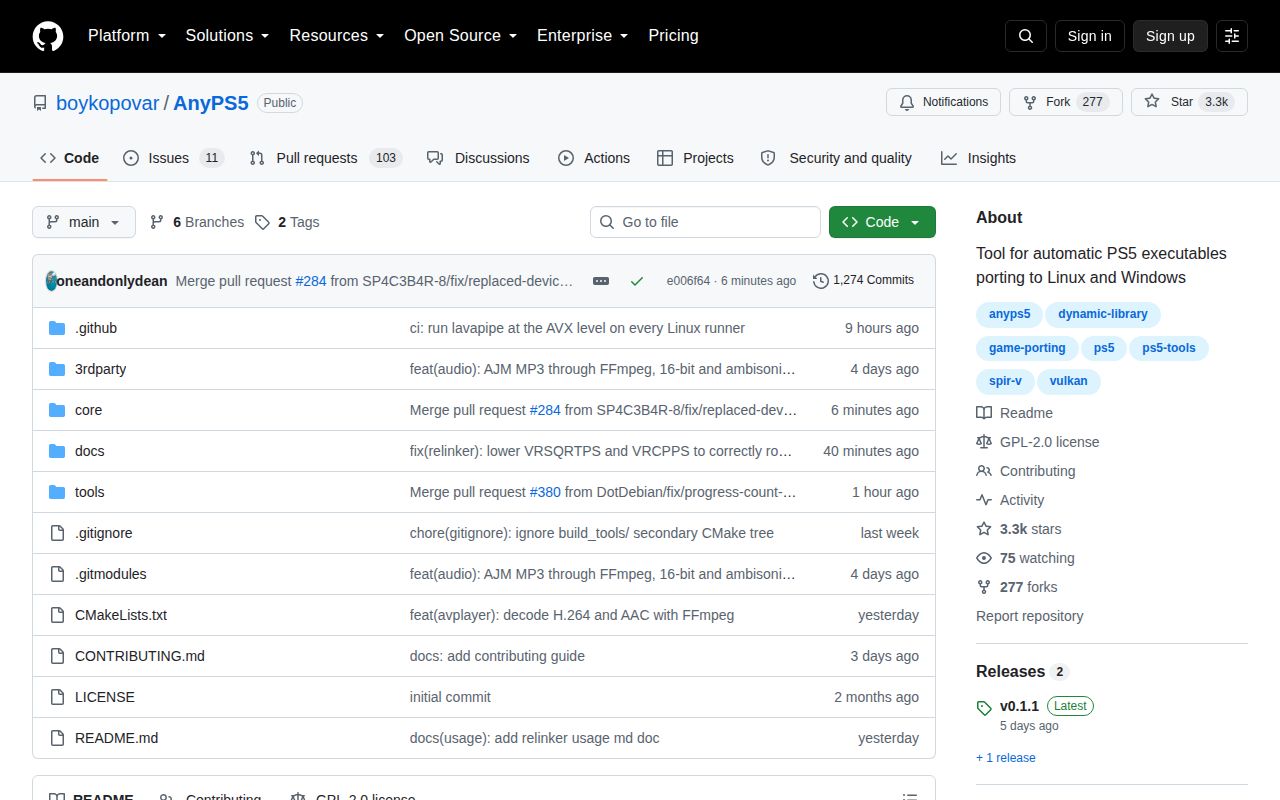
GitHub showed 3,271 stars and a push on October 4, 2026. Release v0.1.1 arrived on September 28 with work on fonts, save data, networking, video playback, shaders, and relinking. Search split the 114 open items into 11 issues and 103 pull requests. That is active development, not a dormant repository, but the pull-request queue is larger than the current release history.
The repository was created on August 3, 2026, less than 2 months before our run. Rapid changes make a commit pin important, especially when the measured commit did not build on our box. Contributors can find unusually direct notes about unknowns and unfinished behavior. Players should read the same notes as a warning label. AnyPS5 is worth following and useful for research, but its present evidence does not support treating it as a general PS5 compatibility layer.