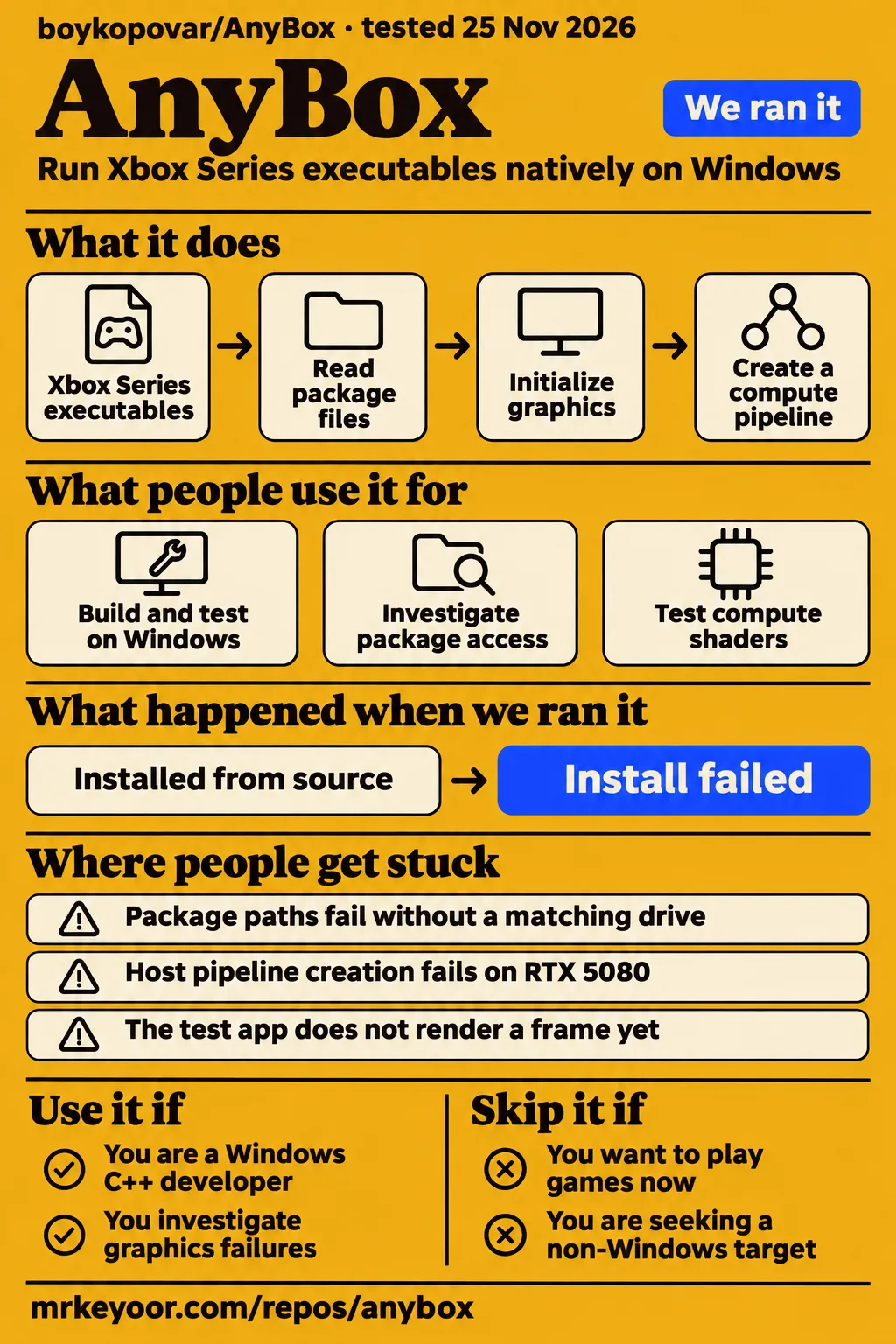
Our setup attempt stopped after 2 seconds with AnyBox requires Windows. Use boykopovar/AnyBox if you are a Windows C++ developer investigating Xbox Series executable compatibility. Skip it if you want to play games now: the README says even its test app does not render a frame yet.
The useful distinction is between compilation, package access, graphics initialization and rendering. AnyBox has evidence of progress at the earlier stages, alongside specific failures that contributors can investigate. This review follows those stages rather than treating a successful build or a created graphics device as a playable application. The repository owner also matters: boykopovar/AnyBox concerns console executables, while anybox.app concerns bookmarks.
What people use AnyBox for
Contributors use AnyBox to investigate Windows builds, console package access and graphics compatibility, as documented in issues #11, #15 and #16.
AnyBox describes itself as a compatibility layer for Xbox Series X|S executables on Windows. A compatibility layer supplies interfaces that software expects from its original system. For a contributor, the practical starting point is an identifiable operation: compiling a library, opening a package file or creating a graphics pipeline. Each operation gives a narrower investigation than asking whether the entire console software stack works.
| Who reported it | Use case | Reported outcome |
|---|---|---|
| Contributor adam25136 | Retest Windows builds with MSVC, clang-cl and MinGW at aba552f |
Reported clean builds and passing registered tests, with graphics validation exercised separately, in compiler issue #11. |
| Reporter of issue #15 | Start an unmodified executable from its package folder | A temporary G: mapping let the executable read its package, initialize and create its D3D12 device in package-path issue #15. |
| Reporter of issue #16 and adam25136 | Exercise extracted XboxBvhBuilder shader containers outside AnyBox | Reproduced a host pipeline failure on RTX 5080 hardware, including another card with a newer driver, in graphics issue #16. |
These reports offer different contribution starting points. Issue #11 connects a compiler failure to a fixed commit and a contributor retest. Issue #15 changes one part of the execution environment, the package drive mapping, and records how far startup proceeds afterward. Issue #16 moves the shader reproduction outside AnyBox, separating the host pipeline operation from the rest of the compatibility layer.
What happened when we ran it
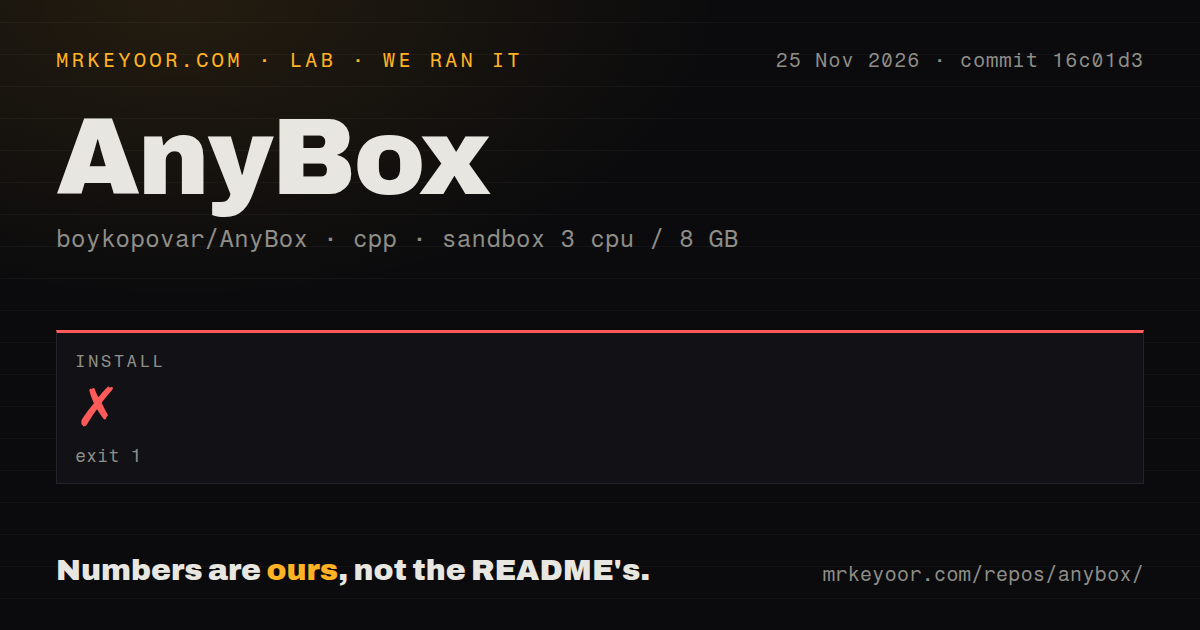
Our November 25, 2026 install attempt at commit 16c01d3 failed with exit 1 after 2 seconds.
In our recorded sandbox run, CMake reached cmake/AnyBoxOptions.cmake:2 and stopped with AnyBox requires Windows; the call stack points to CMakeLists.txt:7. CMake then reported incomplete configuration. The failing log repeats that message, so it describes one setup failure rather than separate application failures. The explicit platform check explains where execution stopped without assigning a package or graphics-driver cause.
| Recorded observation | Result | What the result describes |
|---|---|---|
| Install step | FAILED, exit 1, 2 seconds | CMake stopped at the Windows requirement. |
| Sandbox allocation | 3 CPUs, 8 GB RAM | Configured resources for the run. |
| Image label | lab-cpp:1 |
The recorded sandbox image label. |
| Checkout | 1,270 files, approximately 51,083 source lines, 2.7 MB | The source checkout inspected by the harness. |
| Repository scan | 0 CI workflow files, no Dockerfile, no tests directory | Files and directories found by that scan. |
The install result is our measurement; the compiler reports elsewhere on this page belong to GitHub contributors. Keeping that distinction makes the evidence useful: the harness records a platform refusal at 16c01d3, while issue #11 records Windows compiler work at aba552f. A reader investigating startup should retain the exact commit alongside the operation that succeeded or failed, because these records describe different code states.
The Compose route stopped before deployment
The separate Compose safety step failed because none of its accepted Compose filenames existed, and its teardown completed successfully.
The failed safety step looked for compose.yaml, compose.yml, docker-compose.yaml or docker-compose.yml. Its message used the phrase unsafe repo, followed by the concrete reason: that workflow required a Compose file. The teardown result was ok. Those are the recorded step outcomes and should remain visible alongside the CMake failure.
The run summary describes deployment with Docker Compose and every port bound to 127.0.0.1, whereas the detailed safety step records a stop at the missing file. The specific failed step determines the deployment outcome used here. AnyBox's documented build route is a Windows C++ toolchain with dependency submodules, which gives contributors a concrete setup path to follow instead of treating the Compose summary as a working installation recipe.
Where people get stuck: package paths and rejected shaders
Issue #15 documents a failing G: package access, while issue #16 documents rejected host graphics pipelines on RTX 5080 hardware.
In package-path issue #15, an unmodified executable starts with its package folder as the working directory and the AnyBox libraries on PATH. Its first G:\ access fails and it stops at int 3. The reporter checked that the package files existed at the expected relative paths. With a temporary drive mapping, the same executable reads its package, initializes and creates its D3D12 device, the object used to access Direct3D graphics.
| Symptom | Attributed finding | Recorded outcome |
|---|---|---|
| MSVC and clang-cl compilation failures | The maintainer identifies aba552f as fixed, followed by adam25136's retest in issue #11. |
Contributor reports clean builds and passing registered tests. |
First G:\ access stops at int 3 |
Mapping G: to the package folder changes startup behavior in issue #15. |
Package reads, initialization and D3D12 device creation proceed. |
LeafRehydration pipeline creation returns 0x8007000E |
Another RTX 5080 reproduces the first-attempt result with driver 621.14 in issue #16. | The first-attempt failure persists with the newer driver. |
Wave-size validation rejects Box32Rehydration and Box16Rehydration |
The shaders require 64-lane waves; the adapter reports 32 for its minimum and maximum in issue #16. | The issue explains that the validation check correctly rejects them. |
The shader report distinguishes two failures worth keeping separate. LeafRehydration returns an error during host compute pipeline creation, with no explanatory debug-layer message in the quoted reproduction. The other shaders fail a stated wave-size requirement. A contributor investigating the former needs the failing pipeline operation and driver details; a contributor investigating the latter has an explicit mismatch between the shader requirement and the adapter's reported capabilities.
Windows setup includes executable and graphics requirements
The README specifies C++20, 64-bit Windows and Microsoft Agility SDK 1.614.1, with additional requirements for unmodified executables and graphics validation.
The build instructions say to initialize dependencies with git submodule update --init --recursive before configuring CMake. Third-party libraries require a C compiler from the same toolchain as the C++ compiler. MSVC or clang-cl with the MSVC runtime is recommended for ABI compatibility and diagnostic C++ exception unwinding through test-app code. These instructions explain why selecting a compiler involves more than accepting standard C++20 syntax.
CMake downloads Agility SDK 1.614.1 into build/deps/agility, checks its checksums and copies the runtime beside the built libraries, according to the README. Unmodified executables require Windows Developer Mode for process-local SDK activation. The documented ANYBOX_REQUIRE_D3D12_VALIDATION=ON option enables graphics validation and requires Windows graphics debug tools, including DXGIDebug.dll; ANYBOX_DXGI_DEBUG_LIBRARY can supply an application-local copy. These are documented configuration details, rather than commands executed during our stopped setup.
The project disclaimer says users must supply their own application executables and data. Firmware, cryptographic keys and proprietary console SDK libraries are also excluded from the project. A contributor therefore needs both the repository and an appropriate application package to investigate executable startup. Merely cloning AnyBox does not reproduce the package-access operation in issue #15, whose result depends on the executable and its expected file paths.
Active development and rendering are different milestones
GitHub metadata records a November 25, 2026 push, while the README says the test app reaches graphics initialization and compute pipeline creation without rendering a frame.
The repository metadata records the dated push. More useful evidence of a resolved problem appears in issue #11: the maintainer identifies a fixed commit, asks the reporter to retest with their compiler versions, and the reporter returns results from fresh build directories. That sequence supports a concrete account of compiler progress rather than a general promise about reliability or support.
The README's status section describes seven system libraries, implementations for 37 exported functions and three exports that remain stubs. It also says some implemented functions have unsupported modes. These are upstream implementation counts, distinct from our install measurement. For a Windows contributor, they describe a project still filling out system behavior; the rendering statement supplies the clearest practical boundary for someone choosing between research work and playing games.
AnyBox vs alternatives
Xenia targets Xbox 360, while AnyPS5 supplies a relinker and system-library implementations; neither is an interchangeable target for Xbox Series executable work.
Xenia is an experimental emulator for the Xbox 360. AnyPS5 includes a relinker that converts executables to the target system's native format and implementations of system prx libraries suitable for dynamic linking. These descriptions give a useful first decision: identify the executable's console and the kind of compatibility work involved. Similar desktop destinations do not make software from different console generations interchangeable.
| Project | Documented role | Choose it for |
|---|---|---|
| boykopovar/AnyBox | Xbox Series X|S compatibility layer targeting Windows | Investigating the Series executable, package-access and graphics operations discussed here. |
| Xenia | Experimental Xbox 360 emulator | Investigating Xbox 360 software. |
| AnyPS5 | Executable relinker and replacement system libraries | PS5 executable-porting research and related implementation study. |
AnyPS5 also appears as a design reference in the package-path discussion. The issue #15 synthesis describes a proposal to redirect file imports to a library that translates console paths. AnyBox's own README says it uses the RDNA shader recompiler from AnyPS5 core through a pinned submodule with platform and storage adapters. That relationship gives contributors a specific shared component to inspect rather than a reason to assume identical compatibility results.
Outdated claims, corrected
Bookmark-app pricing and hierarchy claims concern anybox.app, while boykopovar/AnyBox is the Windows console compatibility project reviewed here.
Three namesake corrections are worth keeping together. SupaSidebar founder Kshetez Vinayak's June 2026 comparison lists a $39.99 lifetime option, whereas the bookmark app homepage lists $49.99 and says App Store prices may vary. An older hierarchy description is followed by release notes adding nested tags in 2.0 and folders with hierarchy import in 2.1. Finally, the homepage's promise never to lose important webpages sits alongside JF Martin's report that screenshot generation did not always work. None of those bookmark features or prices describes this repository.
FAQ
The README targets 64-bit Windows, and issue #11 contains a contributor's successful compiler retest at aba552f.
Does boykopovar/AnyBox build successfully with MSVC, clang-cl and MinGW?
Contributor adam25136 reports clean builds with those toolchains at aba552f in issue #11. The retest used fresh build directories after the maintainer identified the fixes. Graphics validation was exercised separately from the registered test run. Our setup used 16c01d3 and stopped at CMake's Windows requirement, so the two observations belong to different commits and execution environments.
How should AnyBox translate console G: paths to the Windows package folder?
Issue #15 demonstrates a temporary drive mapping that lets an executable read its package and create its D3D12 device. The package-path report records subst G: <package folder> as the change used in that reproduction. This is a report of the contributor's operation, not a complete installation command: the package-folder text stands for the reporter's application data location.
Should AnyBox fall back to the prepared compute path when the host driver rejects a pipeline?
Issue #16 asks whether host pipeline rejection should trigger the prepared compute path or stay a hard error. The graphics discussion connects that design question to the failing LeafRehydration pipeline. It separately describes shaders whose wave-size requirements differ from the adapter's reported capabilities, giving contributors distinct operations to investigate rather than a single generic graphics failure.
Does a newer NVIDIA driver fix the LeafRehydration pipeline failure?
The issue #16 reproduction reports the same first-attempt failure on another RTX 5080 with driver 621.14. In adam25136's retest, LeafRehydration again returns 0x8007000E, and the debug layer reports nothing. The comment also explicitly says later attempts do not return an error, before the excerpt ends during its description of the subsequent pipeline call.
What we have not tested yet
Our run stopped during configuration at 16c01d3; supported Windows installation, rendering and a completed game session remain outside that run.
The README was observed later than our checkout, and contributor reports refer to aba552f and other source states. We have not reconciled those states or repeated the Windows compiler and graphics checks. Actual sandbox runtime and operating-system versions require the raw toolchain logs. The configured 3 CPUs and 8 GB RAM are not application-usage measurements, and the missing tests directory does not show that tests are absent elsewhere. The release snapshot is null and does not establish release availability; it contains no dated HTTP 404 response.
The Compose summary conflicts with its failed safety step, so deployment and the reported port bindings have no completed-step confirmation. That safety message supplies no application vulnerability finding. The package mapping is a per-session workaround that can affect the user's other processes and collide with an existing drive; a permanent translation implementation is outside this evaluation. We have not tested executable isolation or compatibility across a library of titles. GPL version 2 only covers the repository's stated licence, not rights to application assets.
The NVIDIA evidence supplies no AMD or Intel comparison. Register pressure is a proposed explanation rather than a confirmed diagnosis, and the truncated later-attempt description leaves subsequent pipeline behavior unresolved beyond its explicit statement that those attempts return no error. Bookmark migrations, archives and current checkout prices were not evaluated hands-on. Direct Reddit or X accounts and video transcripts were not inspected. Search suggestions establish neither search volume nor shared identity. The next useful result is a Windows run tied to an exact commit, executable and GPU that records whether execution reaches rendering.