
Short answer
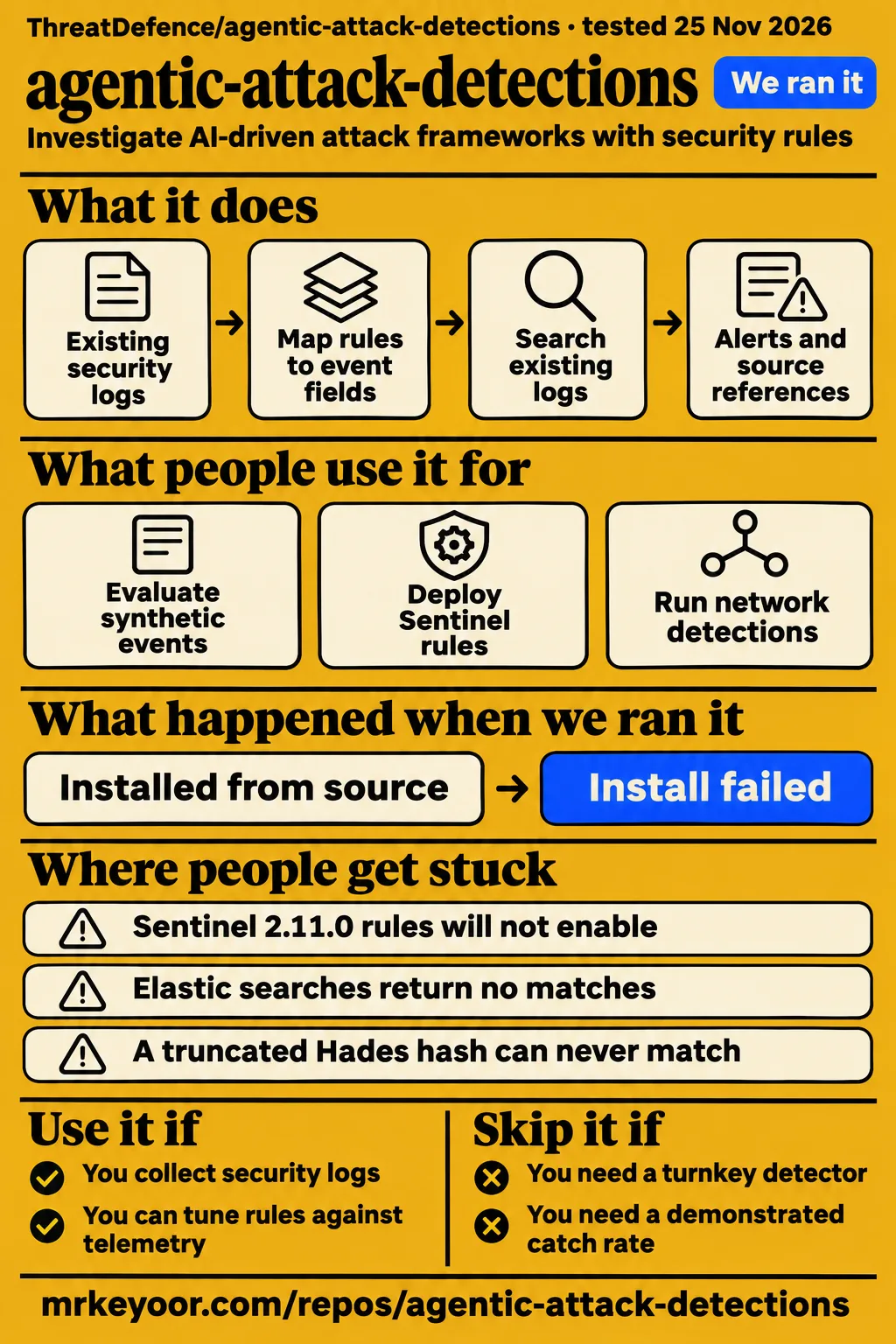
Our install of agentic-attack-detections stopped after 6 seconds with a disk-space error, so the useful recommendation comes from inspecting its rules and deployment history, rather than a working installation in our lab. Use it if you already collect security logs and can adapt detection content to those logs. Skip it if you need a turnkey detector with a demonstrated production catch rate. The README calls the rules experimental, and the setup log ended with “No space left on device”.
The strongest reason to consider it is the trail from a detection to its source, then from a reported defect to a concrete correction. That trail includes a Sentinel activation repair, a wrongly sized file hash removed from several feeds, and Agent Zero rules corrected after source inspection. Those are useful grounds for choosing content to investigate. They also make this a repository you should read selectively, starting with your own data sources, rather than enabling every rule because the framework names look relevant.
Framework folders do not all contain detection rules
The November 25 root table lists twelve console-only folders without rules. Agentic-attack-detections provides open-source detection rules, hunting queries and indicators for security teams, but that coverage does not extend to every folder. A hunting query searches existing logs for suspicious activity; an indicator is a known string, address or file fingerprint worth investigating. The project README describes formats for Microsoft Sentinel, Sigma, Suricata, Zeek, YARA and STIX. Sigma describes log-event detections in a portable format, while Suricata and Zeek inspect network activity. You bring the logs or sensor traffic those rules consume.
Choose the route that matches your existing equipment. Sentinel users get deployment templates and hunts. Splunk users get an app. Network defenders can load Suricata rules or Zeek packages, while threat-intelligence teams can import feeds. The README says HTTP rules need cleartext or decrypted traffic; DNS and TLS server-name rules can work with encrypted traffic. That is a concrete purchasing question for your security stack: can your sensors actually see the field a promising rule searches?
A folder describing how an internet-facing console looks serves a different purpose from a detection of malicious activity inside your network. Start with one behavior your logs capture, such as a web service launching a shell, and inspect its rule and source references before broadening the selection.
What people use agentic-attack-detections for
Spoor maintainer blitzcrieg1 adapted the Linux coding-agent rule and reported that synthetic completion events matched while authorization-only and benign-call events were excluded. The discussion in issue #13 shows why this is a more useful example than a claim that the rules simply “work.” The contributor identified which event means an action happened, then checked that permission to act was not mistaken for execution.
| Who used it | What they did | Reported outcome |
|---|---|---|
| Spoor maintainer blitzcrieg1 | Adapted the Linux process rule to Spoor fields, then evaluated exported Agentmetry events in Loki | Expected completion matched; authorization and benign-call events were excluded in synthetic validation |
| ThreatDefence maintainers | Exercised ARTEX network rules against a synthetic packet capture | Reported expected Suricata alerts and Zeek notices, with no hits on the fixture's benign traffic, in the ARTEX README |
| GitHub user christophwischow | Deployed Sentinel content and tried enabling rules for available log sources | Reported an activation error; maintainers later reproduced it and reported an in-place repair in issue #23 |
| ThreatDefence maintainer antonguzhevskiy-TD | Adapted contributed process-event cases and added a regression harness | Merged fixtures and added the runner to CI, according to issue #13 |
The Spoor example gives you a contribution model: preserve the meaning of the original detection when translating it into your event schema. The thread distinguishes a direct agent parent from an ordinary shell parent, and the maintainer explains which contributed cases carry over to the original process-creation rule. Copying only field names would miss that distinction. The follow-up says the adaptation was evaluated through an audit sink and Loki, making the event path explicit without turning a synthetic example into a production success story.
What happened when we ran it
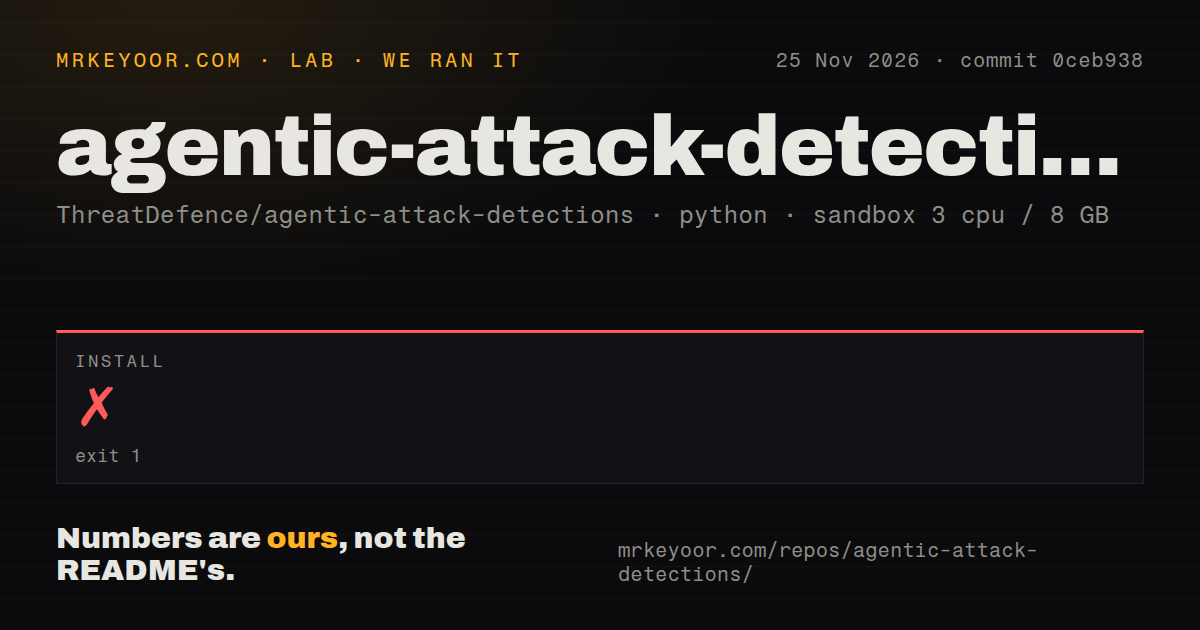
Our install failed with exit 1 after 6 seconds on November 25, 2026 at commit 0ceb938. The sandbox had 3 CPUs and 8 GB RAM, with configured image ghcr.io/astral-sh/uv:python3.12-bookworm. The install log reports failed archive extraction and file flushing, including the error No space left on device (os error 28).
| Recorded check | Result | What it tells you |
|---|---|---|
| Dependency installation | Failed, exit 1, 6 seconds | Setup stopped while extracting packages |
| Package extraction tail | sigma_cli-3.1.0.dist-info/entry_points.txt and pip/_internal/cli/index_command.py could not be flushed |
The reported failure was lack of device space |
| Checkout scan | 1,016 files, about 7,281 source lines, 9.8 MB | Size of the checkout, not installation storage needed |
| Repository signals | Two CI workflow files, a tests directory, no Dockerfile | Files found by the scan, not a passing CI result |
| Separate hands-on safety step | Failed because no recognized Compose file existed | The deployment attempt stopped at the safety prerequisite |
| Hands-on teardown | ok |
Cleanup was recorded |
The log first shows a failed flush inside the temporary Sigma CLI extraction directory. It then reports a failed download and extraction of pip==26.3, with another file-flush failure. The dependency explanation names pip-audit, pip-api and pip. That tells you what the installer was handling when it stopped. It gives no basis for blaming a corrupt package, choosing a minimum disk size, or concluding that the detection rules themselves are broken.
The separate hands-on safety step rejected the attempt because it found no Compose file. Its accepted names were compose.yaml, compose.yml, docker-compose.yaml and docker-compose.yml. The run-summary line says deployment used Docker Compose, but that conflicts with the failed prerequisite. We therefore count this as a blocked deployment attempt. The teardown result was “ok”. A harness requiring Compose is also a poor fit for assessing a collection whose normal use includes importing rules into existing systems.
Where people get stuck
Sentinel's 2.11.0 templates could create rules that the portal refused to enable. GitHub user christophwischow reported the exact error: 'templateVersion' can only be used if 'alertRuleTemplateName' is not empty. In issue #23, the maintainer says the 2.11.1 template updates existing rules in place. The important step is redeployment: the reported fix does not require deleting the rule collection and starting again.
| Symptom | What the issue says happened | Recorded resolution |
|---|---|---|
| Sentinel rules deploy but will not enable | Templates set templateVersion without alertRuleTemplateName |
Maintainers reproduced the error, redeployed 2.11.1 over the old rules and reported successful activation in #23 |
| Other frameworks require hand-built Splunk searches | Earlier packaging covered ARTEX alone | Maintainer says 2.11.0 shipped the all-framework app, upgrading the ARTEX app in place, in #24 |
| A Hades file hash can never match | A 63-character SHA-256 copied an upstream report's truncation | Removed in 2.6.1; feed builder gained hash-length validation, according to #1 |
| Elastic DNS, proxy and web searches return no matches | Generated queries retained Sigma field names instead of ECS fields | #4 is closed without a confirming implementation comment; see the testing limits below |
The Hades case is particularly instructive if you consume the feeds downstream. The issue says the malformed value reached plain hash lists, the Sentinel watchlist, the STIX bundle and Zeek intelligence content. Copying the published report faithfully preserved its mistake. The maintainer removed the unrecoverable value and added a builder check for correctly sized MD5 and SHA-256 strings. Source attribution and mechanical validation solve different problems, and this defect needed both.
Source review changed Agent Zero rules
ThreatDefence's Agent Zero source inspection corrected a detection blind spot and a false-positive risk in commit 4a10299. In issue #7, antonguzhevskiy-TD identifies an impossible parent-command-line condition and a YARA rule that could match default-profile prompts. YARA searches files or memory for patterns; matching prompts in a default profile would be a poor reason to label that profile hostile.
The maintainer says the source-signals document was checked against Agent Zero commit a6e41ca and gives file and line references for each signal. The correction is recorded under 2.9.1. This is the kind of maintenance worth examining before adopting a rule: a plausible-looking path condition was compared with the code that would have to produce it, and the discrepancy changed the detection. For your review, read the source-signals page alongside the rule rather than treating the framework name as its justification.
The same attention to semantics appears in the Spoor contribution. An authorization event and a completion event describe different stages of the same attempted action. A rule can be syntactically valid and convert cleanly while still choosing the wrong stage. The maintainer's account in #13 says the contribution prompted an event-level harness, turning that distinction into regression cases other contributors can extend.
Disabled rules give you time to tune
Sentinel analytics rules are disabled by default unless enableRules is true, according to the maintainer's deployment explanation. The ARTEX Splunk searches also ship disabled and instruct you to adjust macros and baseline first. Those defaults fit the project's warning that legitimate scanners, load tests and red-team exercises can match.
For Splunk, a macro is a reusable piece of search configuration. Pointing it at the correct indexes matters before you judge a saved search's results. The ARTEX hunting guide recommends excluding authorized testing sources and running searches over 30 days before enabling alerts. Treat that as tuning work inside your environment, not a promise that a month of history produces a universal safe threshold. Start with the log source you understand well enough to explain a match.
Indicator confidence changes how you should respond. The root README reserves low-confidence items, including legitimate model APIs, for context alongside another finding. It also applies review dates to addresses, because cloud and VPS addresses can change hands. Exposure listings are kept apart from the detection feeds. You should preserve those distinctions when importing content into a platform that might otherwise flatten every item into the same blocklist.
agentic-attack-detections vs SigmaHQ and Elastic Detection Rules
SigmaHQ supplies general log-detection content. Elastic Detection Rules targets Elastic Security’s detection engine. Those scopes give you two real alternatives to starting with an agentic-framework collection. The SigmaHQ README describes generic, threat-hunting and emerging-threat rules; Elastic describes its repository as the home for rules used by Elastic Security.
| Project | Documented focus | Choose it when |
|---|---|---|
| agentic-attack-detections | Framework-specific and shared-behavior content, with multiple output formats and feeds | You have a specific agentic-framework hunting question and can map it to your telemetry |
| SigmaHQ/sigma | Shareable log-event rules, including generic detections and threat hunts | Your priority is general log detection across threats rather than this framework collection |
| elastic/detection-rules | Rules and tooling for Elastic Security's detection engine | Your team develops and maintains rules within Elastic Security |
These choices can coexist. You might keep your general rule library and use ThreatDefence's source references to investigate a particular framework behavior. The specific concern for an Elastic user is the field mismatch reported in #4: adopting framework content still requires checking its conversion against the events you index. Elasticsearch Common Schema, or ECS, is the shared naming convention that gives fields names such as dns.question.name. A query for an absent Sigma field will not become useful merely because the import completed.
Outdated claims, corrected
The November 23 Internet Archive snapshot no longer describes the current Splunk packaging. Its text points non-ARTEX users to generated queries, while the maintainer's #24 reply says 2.11.0 shipped one app covering every framework. Treat the archived page as a dated snapshot, rather than a setup guide for the newer release.
The ARTEX README's inventory also conflicts with the root coverage table. The ARTEX page lists 30 KQL hunts and 27 Suricata rules, while the November 25 root table lists 31 ARTEX hunts and 46 hand-written Suricata rules. For a deployment inventory, inspect the chosen release's actual files instead of combining totals from those two pages.
The archived total of 3,968 active hosts belongs to November 23. The November 25 README reports 4,699 active hosts in its seven-day window. These are observed hosts, not confirmed attacks or independent operators. Issue #21 identifies concentrated CyberStrikeAI and PentAGI consoles in AS398823, excludes pages that were merely write-ups, and retains an ASN field for filtering the remaining hosts. An ASN identifies a network operator's routing domain; many hosts in one network can belong to a single deployment.
What the other reviews get wrong
LimaCharlie's “Fingerprinting AI Attacks” guide gives timing more diagnostic weight than you should use on its own. It calls fast, irregular timing a distinguishing signal. Brandefense's telemetry guide explicitly says scripts and legitimate automation can also act quickly. Use timing as a reason to correlate activity with identities, authorization and tool behavior, rather than declaring that an AI agent was responsible.
The CodeStuff repo-of-the-day overview does tell readers to treat rules as experimental. That caution is useful, but a short project overview does not replace the version-specific deployment history above. For a decision about importing Sentinel content, christophwischow's activation failure and the maintainer's reproduced repair are more useful than a format list. For deciding what a hit means, the Spoor completion-versus-authorization example is more useful than the number of frameworks named on a landing page.
Questions people ask
Use the repository's Sentinel ARM template to deploy the analytics rules, hunting queries and AGENTIC_IOCs watchlist together. The maintainer describes an all-content template and per-framework templates, with analytics disabled by default. ARM is Azure's template format for creating and configuring resources.
How do I deploy all Sentinel rules, hunts and the watchlist together?
The templates in deploy/sentinel/ create the rules, hunts and watchlist in one deployment. Supply the workspace name and choose the whole collection or a framework template. Issue #23 says the watchlist uses alias AGENTIC_IOCs and search key value.
Why can't I enable Sentinel analytics rules after deployment?
Rules deployed from 2.11.0 could carry templateVersion without alertRuleTemplateName. Maintainers report reproducing that error and fixing existing rules by redeploying 2.11.1. The thread says the Deploy to Azure button and release templates carry the repair.
Which fixture format or test harness should I use to contribute rule tests?
Use python3 tests/sigma/run_tests.py and the format documented in tests/sigma/README.md. The maintainer in #13 points contributors to the process-creation JSONL fixture. JSONL stores one JSON event per line. Keep expected matches and near misses tied to the fields the original rule consumes.
How do I import the threat intelligence feeds into MISP or OpenCTI?
Start with docs/threat-intelligence-platforms.md, added and linked from the README in commit 7ac7258. Issue #5 requested MISP freetext feeds for addresses and domains, plus STIX bundle imports for both platforms. The closing reply confirms the documentation addition; the platform-test boundary is recorded below.
Is there a Splunk app covering every framework and shared behavior?
Yes. The maintainer in #24 says 2.11.0 shipped one Splunk app covering every framework, with Sigma saved searches on CIM field names, ARTEX searches, indicators and a dashboard. CIM is Splunk's common field model. The release file is agentic-attack-detections-splunk.tgz.
Why do the generated Elastic DNS, proxy and web queries fail to match ECS data?
Issue #4 reports Sigma field names surviving conversion, including QueryName, c-uri and cs-uri-query. Those names fail against ECS indexes that use different fields. The issue proposes category mappings in tools/convert.py; its closed label alone is not a repair procedure.
Are exposed consoles independent operators or a mass deployment of decoys?
Host counts cannot tell you the number of independent operators. Issue #21 identifies an AS398823 concentration and preserves the hosts with ASN fields for filtering. The explanation is still open to information from someone who knows what that network runs.
Which Agent Zero fingerprints can be checked against its source code?
Use frameworks/agent-zero/source-code-signals.md, which the maintainer says names reviewed commit a6e41ca and file-and-line references. Its rule-dependency table explains the parent-command-line and default-profile prompt corrections recorded under 2.9.1.
Are framework User-Agents enough for detection?
No. Brandefense's telemetry guide says default strings can change. A User-Agent is a client-identification string in a request, so use it as context alongside behavior and the credential used. The ARTEX hunting guide also warns that user agents are easy to change.
Does a fast burst prove an AI agent was involved?
No. The telemetry guide explicitly says scripts and legitimate automation can also act quickly. Correlate the sequence with identity, authorization and related access. Timing alone does not attribute the decision to a model.
What telemetry can reveal an agentic attack framework?
Host processes, web requests, cloud API calls and sign-ins provide investigation starting points. Brandefense recommends joining those events by identity and action sequence. An external model's reasoning is not something your target-side web log records.
What should happen after blocking a source address?
Revoke affected sessions and tokens, rotate exposed credentials and check that later requests fail. Brandefense warns that changing routes can bypass an address block and that revocation can take time. An accepted revocation operation alone does not prove access ended.
What we have not tested yet
Our run produced an installation failure, not a working detection deployment or a measured catch rate. We have not tested these rules on captured intrusions, measured production false positives, or reproduced the Sentinel repair, Splunk installation, Elastic conversion behavior, MISP import or OpenCTI import. The ARTEX maintainers' synthetic network result and Spoor's synthetic event result belong to those authors. They do not establish production sensitivity or specificity.
The root README says version 2.7.0 was run over production telemetry for tuning. That is a maintainer account, without an independently measured detection-rate benchmark here. The closed Elastic issue contains no implementation or verification reply. The MISP/OpenCTI issue's closing reply does not identify which platform was exercised. Whether AS398823's consoles represent a mass deployment or decoys also remains unresolved.
The configured container image is a label, not proof of the actual Python or operating-system version. Raw toolchain logs are needed for those versions. The installation tail does not establish a storage minimum or the underlying reason space was unavailable, and it provides no successful build or test outcome. A useful next lab run would begin with adequate recorded storage, then feed a known matching event and an authorized near miss through one chosen rule into the target platform.